home I index I latest I glossary I introductions I e-mail I about this site
St Mary, Burnham Deepdale
Follow these journeys as they happen at Last Of England Twitter.
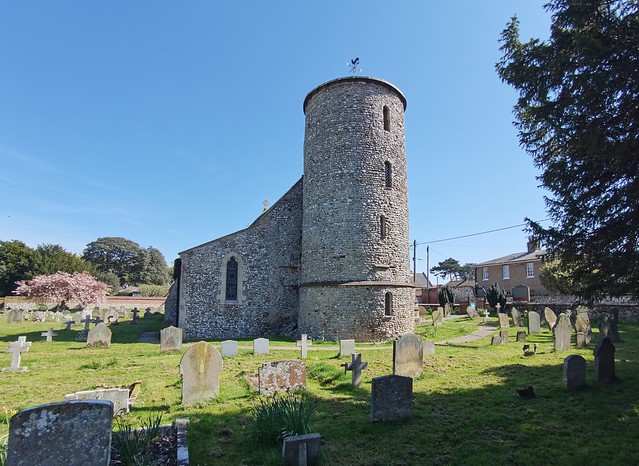
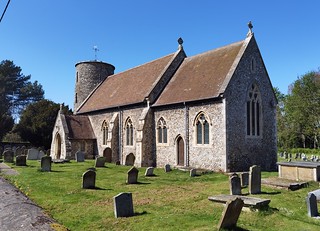
St Mary, Burnham Deepdale There are plenty of lovely and memorable little towns and villages along the East Anglian coast, but if there is a difference in the characters between those in Norfolk and those in Suffolk, it is that Norfolk has a coast road, which Suffolk doesn't. This means that some of Norfolk's coastal villages straggle and merge into each other, which can rob them of their individuality. Brancaster Staithe runs directly into Burnham Deepdale, and the parish church sits on the busy Wells to Hunstanton road. This is a bit of a disappointment when you first see it, because Burnham Deepdale is such a lovely name, and this little church is such an eye-catcher that you would have hoped for a kinder setting. In his introduction to
the Burnhams, Pevsner cites them as a remarkable
example of the medieval prosperity of Norfolk and the
closeness of village to village and parish church to
parish church... the great century for the Burnhams was
the 13th Century, based on trade. The River Burn was
navigable for seagoing vessels as far as Burnham Thorpe,
now nearly three miles inland. The river gradually
silted up in the late medieval period as the larger ports
of Blakeney, Wells and Kings Lynn took over. The marshes
start just to the north of this church, but today only at
Burnham Overy Staithe could you reasonably expect to see
a boat, and that would be a small one.
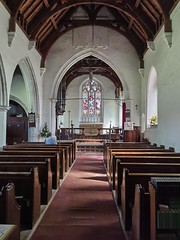
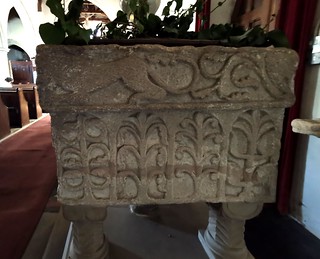
You step down into Preedy's refurnished nave. As often with his work, the feeling is somewhat anonymous, even urban, but it is saved from mundanity by the view to the east and by one of Norfolk's most remarkable fonts. It is a large, square stone block, the bowl quite deep, with a wide lip carved with foliage and lions. The body of the font is carved on three sides with the Labours of the Months, each side with four panels, making a total of twelve in all. The panels each represent a month of the year, and show an activity necessary or particular to that month. They run clockwise around the three sides from the north side, which means that you have to read them from right to left, which is intuitively wrong but suggests, as you'd expect, that it was created by and for people who had little experience of written texts. The sequence starts with the first four months of the year, and continues onto the east and then south sides. Each panel, except for the twelfth, features a single figure, who may well be intended as the same person in each panel. Starting at the right hand end of the north side the subjects are a man drinking from a horn (January), a man sitting in a chair (February), digging with a long-handled spade (March), pruning a vine (April). The east side continues with a man standing holding a rod beside a plant which is likely to be a Rogationtide procession (May), weeding out thistles (June), mowing hay (July) and binding a sheaf of corn (August). On the south side come threshing corn (September), filling a wine barrel (October), slaughtering a pig (November) and then finally men sitting at a table feasting (December).
It is interesting that
three of the panels, January, February, and December,
show leisure activities. That the font has survived in
such good condition is fortunate. During the late 18th
Century it was moved out of an aisle which was to be
demolished. In being moved, it was dropped, and broken
into several pieces. The bits were discarded, ending up
in a rockery at Fincham, thirty miles away. An elegantly
classical birdbath font took its place which you can see
it today in the sanctuary at nearby Titchwell. It was
only when the aisles were rebuilt by Preedy in the 1870s,
at the time of a renewed fascination with anything
medieval, that the pieces were returned here, stuck back
together, and the font given its current home at the west
end of the south aisle. The fourth side of the font which
faces the west wall is carved what appears to be a row of
vines or lilies.
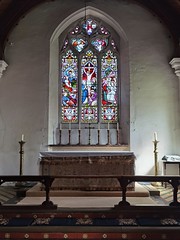
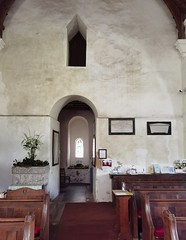
Under the tower, there are fragmentary remains of a 14th Century alabaster panel that appears to depict the Adoration of the angels at the Nativity. it probably came from an altarpiece. Stepping up into the chancel you find that the church's current altarpiece also has carved figures on it, the work of Sir Walter Tapper in 1932 when the chancel appears to have been considerably refurbished for incense-led Anglo-Catholic worship. The rood group came the same year, installed as a memorial to Edward Kerslake who had been rector here at the start of the century, and who was probably responsible for introducing this liturgical enthusiasm. Turning back to face west, the triangular-headed window above the round tower arch takes us back almost a thousand years to the very early days of this building. Simon Knott, May 2022 Follow these journeys as they happen at Last Of England Twitter.
Burnham Deepdale - Burnham Norton - Burnham Overy - Burnham Sutton - Burnham Thorpe - Burnham Ulph - Burnham Westgate |
|
|||||||||||||||||||||||||||||||||||||||||||||||||||||||
home I index I latest I introductions I e-mail I about
this site I glossary
Norwich I ruined churches I desktop backgrounds I round tower churches
links I small
print I www.simonknott.co.uk I www.suffolkchurches.co.uk