home I index I latest I glossary I introductions I e-mail I about this site
St Mary, Yelverton

Follow these journeys as they happen at Last Of England Twitter.
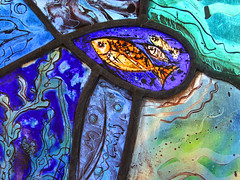
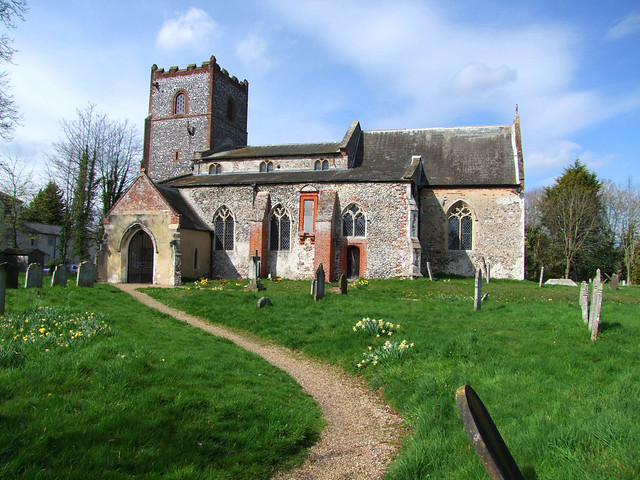
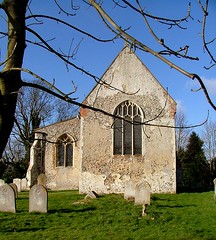
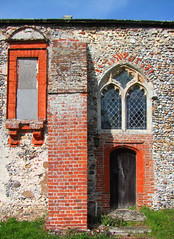
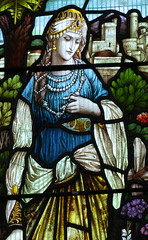
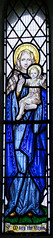
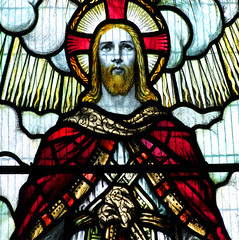
St Mary, Yelverton Yelverton is a fairly large and pleasant village to the east of Poringland, its houses settled on the wide village street where St Mary sits in its walled graveyard. We have reached the outer limits of Norwich commuterland, and beyond here south-east Norfolk dissolves into rugged fields with little villages huddled away from each other, the roads taking on the patterns of the past. Some churches are all of a piece, but you can see at a glance that St Mary is not. Some of Norfolk's most charming churches are those that seem to have been shaped organically by the buffetings of history, and this is one of them. Nothing is in proportion, a delightful clustering of work of different periods. The stubby little brick tower, rebuilt in the late 17th Century, and the massing of the tall chancel, squeeze a small nave that even with its clerestory barely seems to peep above the roofline of its south aisle. At one time the south porch windows contained early 19th Century glass by the Great Yarmouth-based painter Samuel Yarrington, but it was vulnerable and so at the start of the current century a pair of stained glass windows by that most vibrant of East Anglian stained glass artists Pippa Blackall were installed to replace them and they were moved to safety. The new glass uses the themes of pentecostal fire and baptismal water to complement the morning and evening light that shines through it from east and west.
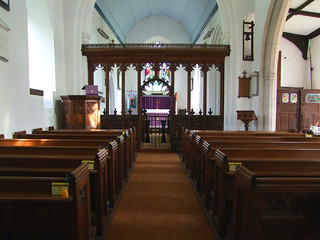
You step inside to a
wide, light, squarish nave. There is no north aisle, but
the south aisle is as wide as the nave itself. Everything
is well cared for and beautifully presented.
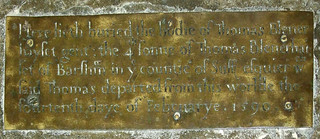
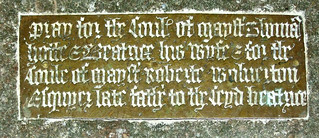
Near to the screen is a pretty little early 16th Century brass image of Margaret Aldriche, with an inscription asking us, in English, to pray for her soul. There's another of about the same date requesting us to pray for the souls of mayster Thomas Holte and Beatrice his wyfe nearby. On the other side of the theological divide, Thomas Blenerhayset has a typically secular brass inscription of 1590, while Humphrey Rant, who sounds as if he has stepped out of the pages of Dickens a century or so later, shares a grandiloquent wall memorial with his wife Anne in the south aisle. Fortunately, the aisle is wide and light enough to contain its exuberance. More humbly, not far off is a tiny thirteenth century coffin stone, perhaps for a child, in the south-east corner. Simon Knott, November 2020 Follow these journeys as they happen at Last Of England Twitter. |






|
|||||||||||||||||||||||||||||||||||||||||||||||||||||||
|
|||||||||||||||||||||||||||||||||||||||||||||||||||||||
home I index I latest I introductions I e-mail I about
this site I glossary
Norwich I ruined churches I desktop backgrounds I round tower churches
links I small
print I www.simonknott.co.uk I www.suffolkchurches.co.uk