| |
|
St Peter, Yaxham
Close to Dereham,
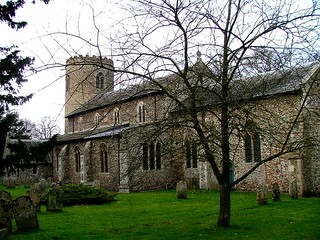
Yaxham holds its church in the centre of the village
while so many around here are scattered parishes, their
churches alone in the fields. You approach St Peter up
the alarmingly named Cut Throat Lane, a narrow way of
Victorian cottages, and it is a difficult church to
photograph in summer when the trees are in full leaf.
When I first came here in January 2006 they were barely
thinking of budding yet, and so we could see straight
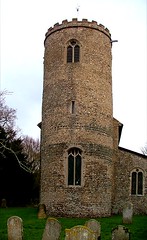
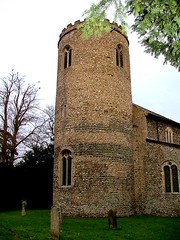
away Yaxham round tower's bandings of carstone threading
through the more familiar flint. Coming back some eight
years later in summer was to find a churchyard alive with
colour and birdsong.
Broadly speaking this
is a later Perpendicular church. The early 15th Century
brought a rebuilding of the church and the top of the
tower, although the Victorian restoration tries to
confuse us with Decorated windows in chancel that are in
the style of a century earlier. As often with churches
that only have an aisle on the south side, you enter into
a space which feels as if it is unfolding before you. The
organ gallery is set ahead of you against the north wall
and climbs into roof of the nave, hidden by the south
arcade. The lack of a clerestory on the north side
enhances the sense of height.
At some time this has been, in a diffferent way, a very
High Church indeed. The screen in the aisle was installed
to remember a local lad lost in the First World War, but
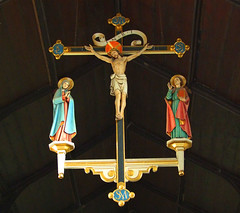
the rood screen is 15th Century at heart and you step
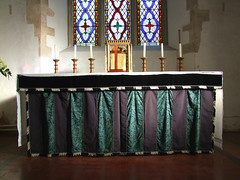
beneath Lawrence King's impressive rood group towards an
altar with a built in tabernacle and sporting six
candlesticks. And yet, we noticed that the hymn book
shelves at the back of the church were filled with copies
of Mission Praise, and so perhaps the liturgical
tradition here now is more mixed.
But Yaxham church is singular in other ways. Even on a
dull day the church is illuminated by Powell & Sons'
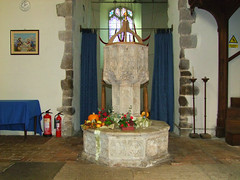
decorative glass, and the panels of the 14th Century
font, like the glass, are not figuarive, decorated only
with fleurons and patterns. But they are set in vaulted
niches, with high canopies rising on all eight sides. The
bench ends, though modern, appear to be based on the
medieval sequence at Stowlangtoft in Suffolk, including
an owl, a winged lion with a human face and an elephant
and castle. At some time, two bench ends and a cross-step
have been built into the west side of the font pedestal
to make it easier to get up and down, and not fall off
while you are up there. It would be nice to think that it
was made locally. Behind it, the tower arch with its
simple capitals rises high, looking so Saxon that it is
easy to think this may be the age of the tower outside.
Above it is another doorway, perhaps the original access
to the tower.
A memory of my first visit: while we were wandering
around the nave an old lady came to lock the church up.
She popped her head around the door and I said hello, but
she didn't reply, and so with my usual urban paranoia I
thought she was suspicious of us. But I needn't have
worried. She sat down in the porch, and so I went and
asked her if she needed us to leave. She give me a big,
beatific grin. "Sorry dear!" she shouted.
"I'm deaf, I can't hear a word you say!"
I raised my voice to a level with hers, and we just about
managed. She was very happy to wait, because the groom
was currently bathing her dog. We'd left the door open to
let some warmer air into the freezing church, and she'd
seen us, but normally she just shouts into the church to
say she's about to lock up. If no one answers (how does
she hear them?), they're locked in for the night. She
agreed with me that the church was beautiful, and
explained to me about the road beside the church being
called Cut Throat Lane. The house she lived in had once
been an inn, and one night two men had an argument there.
The landlord had pushed them out into the lane, and one
had cut the other's throat. She paused, thinking, as if
checking the story over for its veracity. "Well, I
can't think why it's called Cut Throat Lane if it isn't
true", she concluded.
Simon Knott, November 2020
Follow these journeys as they happen at Last Of England
Twitter.
|
|
|