home I index I latest I glossary I introductions I e-mail I about this site
All Saints, Wood Norton

Follow these journeys as they happen at Last Of England Twitter.
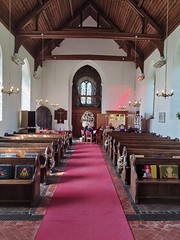
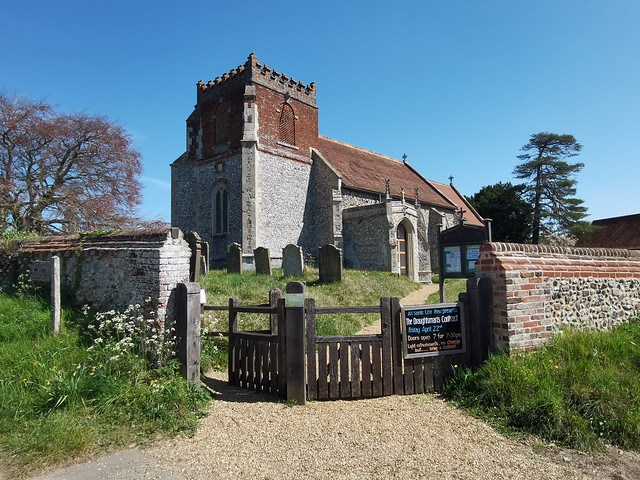
All Saints, Wood Norton Wood Norton is one of those quiet villages to the north of the Norwich to Fakenham road. There is a lovely old brick barn at the curve in the road beside the churchyard, and the church across from it is a pretty thing. Simon Cotton tells me that four wills of the 1530s left money towards the building of the tower, and it was begun but never completed before the Reformation intervened, cutting off bequests. The unfinished tower was completed in red brick in the late 17th Century, and there is a small but stately late 15th Century south porch. The nave is tall, but without clerestories or aisles, and the overall effect is that the building is hunching its shoulders. Despite its size and
remoteness, Wood Norton is a busy little place if its
church is anything to go by. A sign by the gate told me
that on Friday night it would become the village cinema
for a showing of Peter Greenaway's film The
Draughtsman's Contract, and when I stepped inside I
found a village meeting in progress, but they were very
happy for me to wander around. Large Perpendicular
windows, probably contemporary with the porch, mean that
the interior is full of light. It feels exactly like what
it is, a pleasantly renewed English village church,
well-kept and obviously loved. The 1880s restoration
stamped its mark, bringing the east window and its glass
by Charles Gibbs and also many of the furnishings. The
font is intriguing, for it bulges like a ripe cheese.
Pevsner thought that it was from the late 17th Century,
perhaps a replacement for one damaged or removed during
the Commonwealth, and probably contemporary with the
rebuilding of the tower. The cover may well be
contemporary, and designed for it. Simon Knott, May 2022 Follow these journeys as they happen at Last Of England Twitter.
|
|
|||||||||||||||||||||||||||||||||||||||||||||||||||||||
home I index I latest I introductions I e-mail I about
this site I glossary
Norwich I ruined churches I desktop backgrounds I round tower churches
links I small
print I www.simonknott.co.uk I www.suffolkchurches.co.uk