home I index I latest I glossary I introductions I e-mail I about this site
St Peter, Wolferton


Follow these journeys as they happen at Last Of England Twitter.
| St Peter,
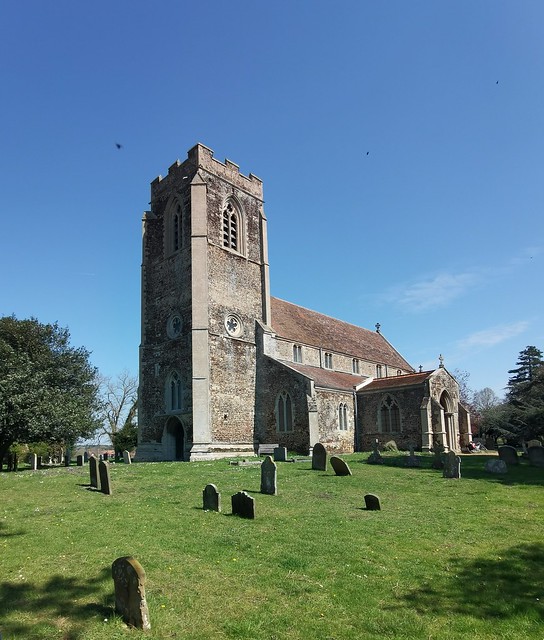
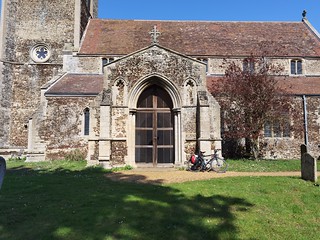
Wolferton Wolferton is an attractive little village a couple of miles to the west of Sandringham House, and yet its situation lends it an air of otherness, a sense of being very much out on the edge. It is cut off from the rest of Norfolk by the Dersingham Bog and the Wolferton Woods to the east, and from the rest of the world by the marshes and the Wash to the west. Two lanes reach it from the rest of the Sandringham estate, crossing the busy Hunstanton road and then narrowing through a mile or so of rhododendron hedgerows before coming together and then splitting into a loop around the village. The time to come here is early June, when the rhododendrons are in full flower, the purple globes startling in the Norfolk green. Pine trees tower over the sandy soil, giving off their unforgettable scent on balmy days. If you've heard of Wolferton it
might be because of the former railway station in the
northern part of the loop. I can just about remember
travelling along this line as a child on my way from
Cambridge to the sea. The station was famously made grand
and ornate by Edward VII to give a suitable welcome to
his royal guests reaching Sandringham by train, but the
trains have gone now, along with many of the crowned
heads of Europe of course. The part of the line north of
King's Lynn was closed as part of the Beeching cuts, and
the station itself is now a museum. The marshes to the
west swallow all sound, as does the Wash beyond, grey and
mysterious. Apart from birdsong, and the occasional
whinny from the Royal Studs to the west of the church,
the air is utterly quiet. It is remarkable to think that
we are fewer than ten miles from the centre of busy Kings
Lynn.
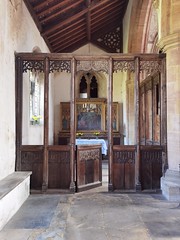
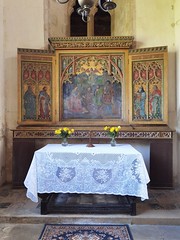
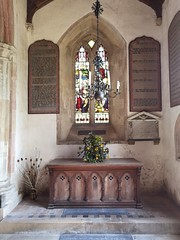
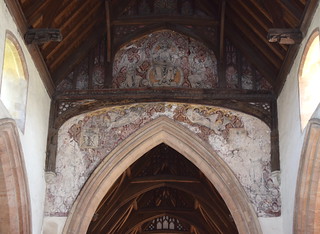
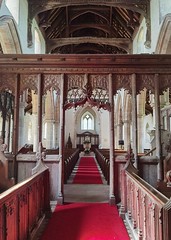
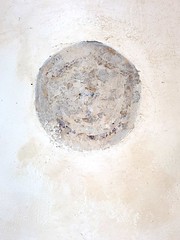
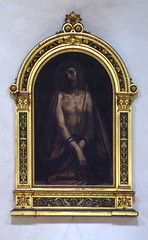
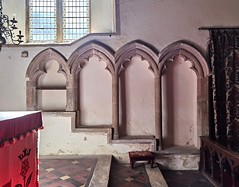
There is some restoration evident in these screens, and puzzlingly the south aisle parclose appears to be 14th Century. Did it survive the fire, or was it brought here from elsewhere? The north aisle chapel reredos depicts the Adoration of the Magi flanked by the four evangelists. Pevsner points out that it is a copy of a work by Titian and is signed by the artist Corsi who also gives his address in Florence as if hoping for more work. The south aisle chapel is plainer, and the church's decalogue boards, once in the chancel, have been reset in it, probably by Blomfield. Between them, the rood screen is mostly Blomfield's in his favoured dark wood style, but the 15th Century dado was retained and its panels have the figures of twelve saints, very faint now and largely fragmentary. They are hard to identify, so much so that Williamson did not include it in his great early 20th Century survey of rood screen figures. It may well be that they were twelve apostles, but one of them appears to be holding a rosary and so may be a donor. Above the screen, Blomfield's restoration uncovered a medieval doom painting, presumably contemporary with the screen. Unfortunately it was entirely repainted in the 1890s and the result is pretty terrible. The chancel beyond is perhaps a disappointment after the lovely aisle chapels, being rather plain in comparison. Back in the nave the arcade piers have what appear to be seats around them, and there is another long shelf-like seat along the north aisle wall. These are probably just too early to be evidence of the increasing popularity of congregational worship in the late medieval period, and are more likely a reminder that naves had other purposes than religious ones. A curiosity at the west end of this aisle is a large blank ogee arch. Was it perhaps a shrine of some kind? A large painting depicting Christ the Man of Sorrows hangs above the bench in the aisle, and alongside it are several late 13th Century consecration crosses. Opposite, in the south aisle, the royal arms of Queen Victoria are in embroidery, and are said to have been made by a vicar's wife in the 1840s. They've been recently restored. All in all, this is a church full of interest and beauty. But even more than that you'll remember the setting, the rhododendrons and the pine trees, and the sea in the distance, an unforgettable place to find a medieval church. Simon Knott, April 2023 Follow these journeys as they happen at Last Of England Twitter.
|
|
|||||||||||||||||||||||||||||||||||||||||||||||||||||||
home I index I latest I introductions I e-mail I about this site I glossary
links I small
print I www.simonknott.co.uk I www.suffolkchurches.co.uk
ruined churches I desktop backgrounds I round tower churches