| |
|
St
Margaret, Witton
 |
|
The
English summer had been a wash out. Apart from a
week of brilliant, balmy sunshine in late July,
it had been a season of overcast skies, cold
winds, and rain, rain, rain - a time of floods
and rumours of floods. As August became
September, and the children went back to school,
the sun came out again, and now it was time for
that annual celebration of the English country
church, and by extension all things rural and
English, the Historic Churches bike ride, which
takes place on the second Saturday of each
September. I cycled on this day for
years, but since starting the Norfolk site I have
used it as an opportunity to get round as many
churches as possible which are not normally
easily accessible. This means heading off in the
car with Tom and Peter, belting around the
country lanes, avoiding the cyclists. I'm not
proud of this, but it would not be possible for
the Norfolk Churches site to be so full without
it.
|
This year,
we decided to take on the northern side of the Yare
Valley. This is an area of marshes and tiny lanes, of
deceptively remote parishes, given our proximity to
Norwich and Yarmouth. It is also an area of small, pretty
churches, with interesting little details. These are the
kind of churches I like best.
A few days
before, Peter had succumbed to illness, and so I just met
up with Tom at Attleborough station at about nine
o'clock. We skirted the southern side of Norwich on the
busy A47. This becomes a shotgun-straight road from
Norwich to the coast, a fast and dangerous road which is
difficult to cross. And yet, turning off north of it into
the narrow lanes, we were immediately swept out of the
21st century into a landscape of hedged-in fields and
boiling copses. Although the sun was bright, it had
rained overnight, and the fields and hedgerows sparkled
and shimmered. The lane narrowed, twisting and turning,
and I was glad I had an OS map with me. Indeed, there is
no sign for Witton, and nothing for the church, which is
hidden up a track behind a farm. You would not possibly
come across it by accident.
Norfolk
has two parishes called Witton, and rather confusingly
they both have churches dedicated to St Margaret. This
one is sometimes referred to as 'Witton-by-Norwich', but
the name was surreal, for it was impossible to think that
we were barely ten miles from the centre of that great
city. Birds rejoiced in the sunshine - all their lives
they must have known bad weather, pretty much, and they
were making the most of it. The rays shone brightly
through the pretty wooden lychgate, erected on the eve of
the First World War. The trees swayed in a fresh, morning
breeze. It was a joy to be out in rural Norfolk again.
For anyone
who has not come across the Historic Churches bike ride
before, it is a sponsored event whereby people cycle from
one church to another, signing in when they arrive, and
getting their sponsor sheet signed by the welcomers. At
every church there is hospitality: hot and cold drinks,
scones and biscuits baked by someone's mum, and so on.
Best of all, the chance to step into the life of another
church community, if only for a moment; to stand and
reflect, and wander in the ancient sacred space. During
the day, a rhythm builds up that is almost a meditation,
and the day affirms that we are not alone in our isolated
communities and denominations. The event started in East
Anglia in the 1970s, and it has spread all over England,
but still nobody does it quite like the East Anglians.
Virtually every church takes part in Suffolk, and in
Norfolk there are nearly as many, a good ninety per cent.
I was looking forward to the day very much.
I was also
looking forward to Witton. It seemed a good place to
start. I knew that it contains an extremely rare medieval
brass to a vowess, one of only four in England. There is
also glass by Hardman & Co, of whom I am very fond.
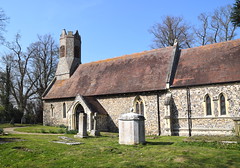
The building itself is rather unusual of aspect; the
tower was reduced, and topped off with a little octagonal
turret in the 17th century. It seems to grow out of the
west end of the nave. The effect is very similar to that
at Thurton, a few miles off on the other side of the
river.
I knew
something was wrong as soon as we approached the gate.
Where were the welcoming notices, the jolly pink signs
that Norfolk churches taking part place in a prominent
position to show you the way? We wandered around to the
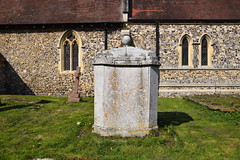
south side, being briefly startled by the extraordinary
early 19th century tomb to Mary Taylor, like an enormous
stone biscuit barrel.
Well, the
porch was open, but the door was locked. I felt
completely deflated. It is not unknown, although most
unusual, for churches with tiny congregations, and
particularly redundant churches, to be left open and
unsupervised on Bike Ride day, but still with provisions
and hospitality inside. However, a locked church is most
unusual, particularly one that claims to be taking part -
for on the bench in the porch were two perfunctory
bottles of water, and a note reading We're sorry the
church is not open. Please help yourself to some water -
there is a bin by the gate for empty bottles.
This was
annoying, especially as it was our first church of the
day. As it turned out, this would not be a sign of things
to come, but we were not to know that at the time, of
course.
| A
faded notice pinned to a timber post in the porch
indicated that a key was available at the
neighbouring farm. Leaving Tom to inspect the
gravestones, I wandered back up the track. I
walked between the outbuildings, which were
derelict and abandoned, although this is not
unusual in rural England, as patterns of farming
have been traumatically altered in the last two
decades. And then I began to notice that
everything was overgrown, a result of the last
few damp weeks, no doubt. Rooks erupted from the
big trees around the farmhouse. There was a smell
of decay in the air. I tugged open a rusting
gate, and began to walk up the path - but before
I even got there I could see that my journey was
pointless. The building was abandoned. The lower
windows were boarded up, and upstairs a ragged,
dirty curtain boiled from a broken window. The
place was utterly desolate. I headed
back to the graveyard before the mood of
melancholy could infect me. It was a bad start,
but the day would bring great pleasures and
treasures, and warm, welcoming friendly people.
We shook the chill of Witton out of our bones,
and headed on to Hemblington.
|
|
 |
|
|
|