home I index I latest I glossary I introductions I e-mail I about this site
St Andrew, Wickmere
Read the captions by hovering over the images, and click on them to see them enlarged.
St
Andrew, Wickmere
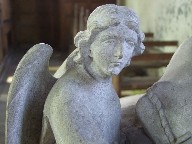
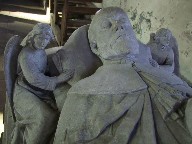
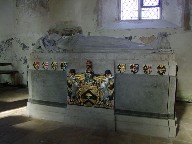
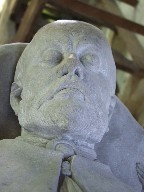
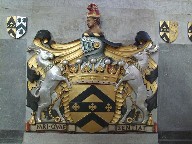
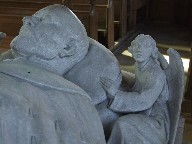
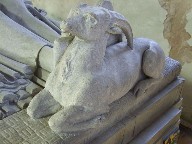
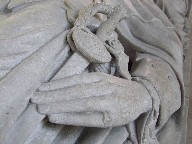
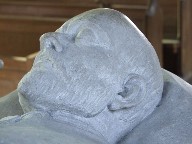
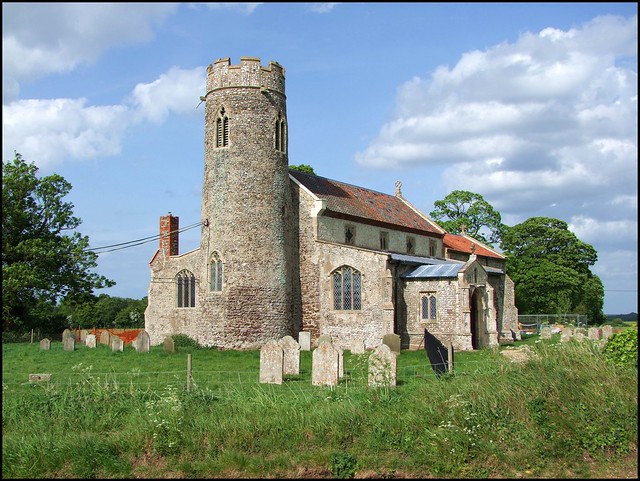
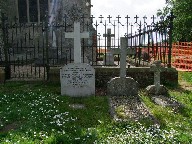
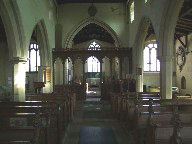
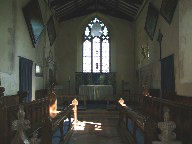
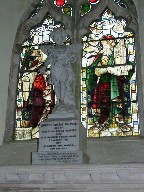
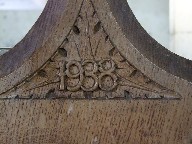
Instead, we wandered in the graveyard, remote at a crossroads with few other buildings in sight. Below its feminine late medieval crown, the narrow round tower begins in a rather austere manner, a little like a chimney of a Cornish tin mine, before tapering towards pretty 14th century bell windows. Now, in 2011, that same tower beckoned across the fields, many already ploughed and drilled as the Norfolk farmers stole a march before the land put itself to sleep for another winter. The hedgerow was full of high grasses, and St Andrew came into view across a field still wearing its barley stubble like an old cloak, still to be drawn back under the ground. I thought of Tom, dead now, his ashes scattered across a Norfolk field like this one. This was my last bike ride in Norfolk of 2011. I was cycling from Cromer to Norwich, to catch the train there back to Ipswich. Not a huge distance, but the pleasant meandering around lanes and the cutting off at tangents to visit churches, most of them old friends, would make it about forty miles all told. It is hard for me now, a couple of months on, to remember quite how warm it was that day, and how humid the air was in the sunken lanes around the Barninghams and the wide park of Wolterton Hall, home of the Walpoles. It was an utter joy to be flying through the landscape on my new bike, a few months old, a drop handle tourer which was still a novelty after years of hybrids. I had not owned a steel touring bike since I was in my twenties, and in truth a feeling of those days came back to me as the wheels spun on their bearings down the narrow Norfolk lanes. And there was an added excitement because I knew that Wickmere church would be open; I had finally got into Aylmerton church earler that day, and so St Andrew, Wickmere, was the very last north Norfolk church which I had not previously seen inside. St Andrew is a rare 20th century example of what was commonplace at the time the tower was topped; a major restoration paid for from a bequest, with the provider of that bequest memorialised in effigy inside. He was Baron Walpole, the fifth Earl of Orford, who died in 1935. The Orfords traced their title back to Sir Robert Walpole, Prime Minister, and the ruination of the church beside their Hall at Wolterton led them to adopt this one. Walter Caroe was paid to thoroughly rescue this building from collapse, which was accomplished before the Second World War broke out. Tie beams stopped the clerestory and roof pushing the arcades outwards, and the bulging of the tower was drawn back by tie beams about halfway up. The fifth Earl now lies, patiently asleep, inside; he rests in his robes, angels at his head and a goat at his feet in the medieval manner, and yet looking the very model of the early 20th Century aristocracy which was devastated by the First World War. I thought of Betjeman: Old men in country houses hear clocks ticking over thick carpets with a deadened force; Old men who never cheated, never doubted, Communicated monthly...
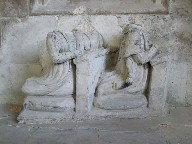
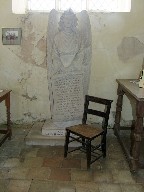
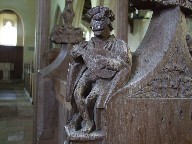
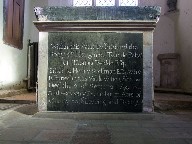
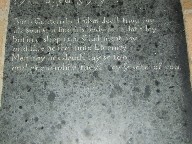
St Andrew is a church of uncommon interest, and is thanks to the sleeping Earl that it has been preserved for us. An extraordinary war memorial waits just inside the south door, an angel holding a roll. A medival minstrel strums a lute on a bench end, grinning wildly and looking for all the world like a 15th Century George Formby. Two ghosts from a late medieval memorial kneel headless in a window splay. Not only does the screen have Saints in the dado, but two of the panels from the Wolterton screen, depicting donors, are now fixed to the 1930s pulpit. A late 17th Century ledger stone indulges in a rather extraordinary theological debate: But is Gunton dead, what doest thou say? His soul is a live, his body here doth lay but in a sleep until ye Judgement Day, and live he shal until Eternity. Men say he's dead, I say so too, and ere a while they'll say ye same of you.
Simon Knott, January 2012 |


Amazon commission helps cover the running costs of this site.
home I index I latest I introductions I e-mail I about this site I glossary
links I small
print I www.simonknott.co.uk I www.suffolkchurches.co.uk
ruined churches I desktop backgrounds I round tower churches