home I index I latest I glossary I introductions I e-mail I about this site
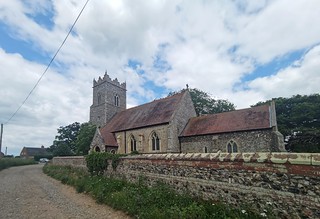
St Andrew, Wickhampton

Follow these journeys as they happen at Last Of England Twitter.
St Andrew, Wickhampton As they head
relentlessly towards the sea and begin to think about
joining up, the Rivers Yare and Bure suddenly sprawl out
to form the Halvergate Marshes, a land of flat green
pastures intersected by hundreds of ditches and dykes,
one of the largest areas of marshland in England. It was
formed by the silting up of the great estuary that the
two rivers once helped form. The little settlements that
line its western side were once small ports, their
medieval churches were coastal churches, their towers
landmarks for shipping. Now we are a good five miles from
the coast, and eastwards there is nothing but the marshes
until you reach busy Great Yarmouth and the sea. You step into an interior that is at first slightly disappointing, for the feel is largely of its 1880s restoration at the hands of Richard Phipson, the Norwich diocesan surveyor. Phipson on a grand scale, as at his restoration of St Peter Mancroft in Norwich or his complete rebuilding of St Mary le Tower in Ipswich, is impressive. But his attention to the letter rather than the spirit of the Gothic Revival results in a relatively anonymous feel in a rural church where the budget was smaller. However, there are delights in store, for Wickhampton possesses what are among the best late 14th Century wall paintings in East Anglia. Many wall paintings of this date were lost as liturgical patterns changed in the 15th Century, a full century before the Reformation, and were often destroyed by Perpendicular windows being punched through them. But the three main subjects at Wickhampton are pretty well complete. They are arrayed along the north wall, and that at the extreme west is the best surviving depiction in Norfolk of the Three Living and Three Dead.
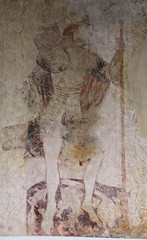
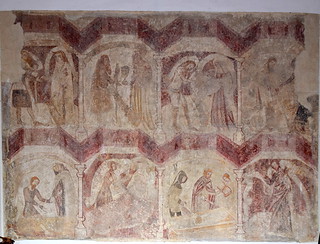
The allegorical tale of the Three Living and the Three Dead was particularly popular in the years after the Black Death as the need to avoid spending too long in purgatory concentrated the mind. It depicts three nobles out hunting in all their finery, who meet three corpses in successive states of decay. As you are, so once were we, says one. As we are now, so you will be, observes the second. Therefore, prepare to follow me, concludes the third. This barbed observation on the transitory state of wealth must have been more of a comfort to the poor parishioners saying their private devotions than to the lords and ladies in their chapels hearing private masses. The Wickhampton example has some delightful little details. One of the nobles extends an arm with a falcon perched on it. Below the six figures, a man with two hunting dogs flushes a hare from cover. To the east of the Three Living and Three Dead is St Christopher, a common survival in this part of East Anglia and he must once have been always everywhere. There seems a little confusion as to the purpose of the St Christopher image. In guidebooks, it is often suggested that it was enough for medieval people to look at the image to prevent sudden death during the day's journey. This isn't quite right. Medieval Christians didn't believe in magic, they believed in the economy of grace. They understood the dangers of dying without making a confession, and that they would be exposed to this danger more on a journey away from home than if they were in their own parish within reach of the priest. St Christopher was the patron saint of travellers because they believed that his prayers would protect them on their way, but also because he would pray for your soul if you were taken suddenly from this life. Every travelling stranger could focus their request for his prayers by looking in at the churches that they passed, because the image of St Christopher would be painted opposite the entrance. It made the church a kind of spiritual service station. Further east still is a splendid survival, a complete set of the Seven Works of Mercy. On two levels,Christ's teachings in Matthew 25 are illustrated by examples. The faithful are called upon to welcome the stranger, give food to the hungry, give water to the thirsty, to clothe the naked, to comfort the sick, to visit the prisoner and to bury the dead. There is another set not far off at Moulton St Mary, and they are so similar that they are likely to be by the same workshop. Does that mean they were created by itinerant artists rather than by locals? Perhaps so, because they also bear a similarity to the wall paintings at Little Witchingham away on the other side of Norwich.
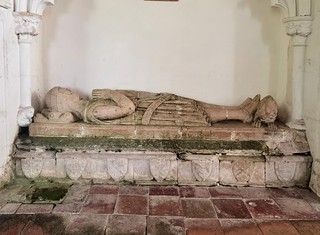
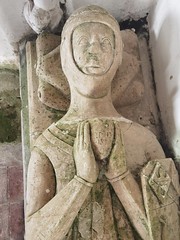
The way in which meditative images could be used as a devotional guide like this gives us an insight into the way in which medieval Christianity was practised in the days before congregational worship became the norm. Devotional use, perhaps with a rosary, reinforced the orthodox doctrine of the Catholic Church, a form of catechesis. The illustrations at Wickhampton are simple and direct and in remarkably good condition, one of the best survivals of their kind. It was only as preaching rose to prominence in the following century that they must have fallen into disuse. Pevsner felt that the long chancel at Wickhampton was essentially that of the 12th Century, its windows altered in the 13th Century to suit the changing fashion of the day as Romanesque morphed into Early English. This may well have been at the behest of the Gerbygge family, because on the north side of the chancel are two impressive tomb recesses, and in them lie Sir William and Lady Isabella Gerbygge. Pevsner was impressed with the quality of the cusped arches above them, pointing out that although they date from before the Decorated period, they are already prefiguring its ornateness. Of course, this assumes that they weren't carved at a later date than the figures they contain. The effigies can be dated to about 1280. Sir William was a bailiff of the ports, and he lies holding a heart in his hands. Lady Isabella wears a wimple, her hands raised in prayer.
The moribund state of the Church of England in the first half of the 19th Century is demonstrated by many examples, but few indicate it so blatantly as at Wickhampton. At the time of the 1851 Census of Religious Worship the population of the parish was one hundred and thirty one, but only fifteen people tipped up that day for the morning service, with twenty coming to hear the afternoon sermon, a number which likely included many of those who had attended in the morning. Further, Bernard Smith, who filled in the return and signed himself oddly as Officiating Minister rather than as rector, vicar or curate, noted that these numbers included the Sunday Scholars who had no choice but to attend. Given the size of the parish population it is likely that Smith's congregation consisted of little more than these children! Meanwhile, up at the Wesleyan chapel, forty five people attended the morning service and a remarkable one hundred and seventy five the afternoon service, which must have included people coming in from Halvergate, Tunstall and elsewhere. The Anglican revival was already underway, coming in waves out of Oxford and Cambridge universities, and it would of course change all this dramatically. But given how remote Wickhampton is even today, The Reverend Smith's furrow must have been a peculiarly lonely one to plough. Simon Knott, July 2022 Follow these journeys as they happen at Last Of England Twitter.
|
|
|||||||||||||||||||||||||||||||||||||||||||||||||||||||
home I index I latest I introductions I e-mail I about
this site I glossary
Norwich I ruined churches I desktop backgrounds I round tower churches
links I small
print I www.simonknott.co.uk I www.suffolkchurches.co.uk