home I index I latest I glossary I introductions I e-mail I about this site
St Mary, Whissonsett
Follow these journeys as they happen at Last Of England Twitter.
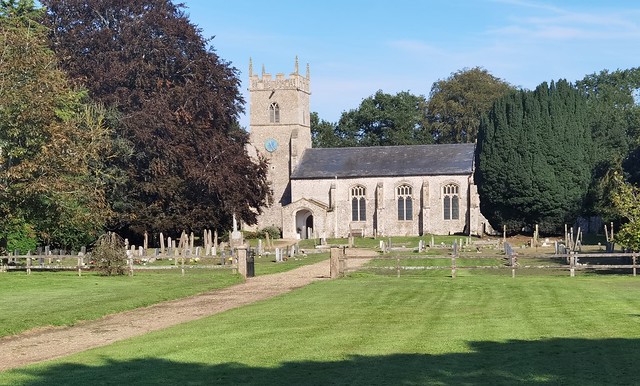
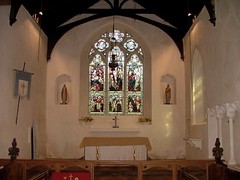
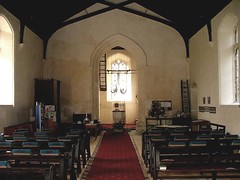
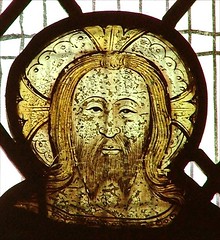
St Mary, Whissonsett Whissonsett is a large, handsome village in the lanes to the south of Fakenham, and its church is set back from the village street beyond a wide field, the track taking you into the southern side of the churchyard. It is an attractive approach, and the church is elegant, with spirelets on the tower and a beautiful Decorated east window. This is not unusual in this area, but in fact much of what we see today is later, the nave largely of the 15th Century. In any case there was an overwhelming restoration in the 1890s, and I can only assume that the church was in a bad state by then because very little of its medieval fabric was left unaltered or replaced, unusual at such a late date. By the end of the 19th Century restorers were generally more careful about such things. You step into a wide, aisleless interior, and as if to compensate for the lack of medieval riches the restoration has left the church with a character all of its own, although perhaps the fanciful sugar-icing of the pulpit and screen cry out for something more elaborate than the plain benches which are not quite long enough for the nave. Did they come from elsewhere? There are a few survivals. There are three large image niches, one in the nave and two in the chancel either side of the east window. The one in the nave contains a real surprise, the large head of a Saxon cross, unearthed in the churchyard. It is perhaps a thousand years old, and although such things are common enough in some parts of the British Isles, there are only a handful in East Anglia. The other medieval survivals are glass fragments set in the west window under the tower. Did they also come from here originally, I wonder? The most striking is an oriental-looking Christ in Majesty, battered by half a millennium of East Anglian winters, which only serves to give it more character. Simon Knott, October 2021 Follow these journeys as they happen at Last Of England Twitter. |



|
|||||||||||||||||||||||||||||||||||||||||||||||||||||||
home I index I latest I introductions I e-mail I about
this site I glossary
Norwich I ruined churches I desktop backgrounds I round tower churches
links I small
print I www.simonknott.co.uk I www.suffolkchurches.co.uk