home I index I latest I glossary I introductions I e-mail I about this site
All Saints, Wheatacre


Follow these journeys as they happen at Last Of England Twitter.
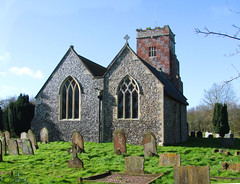
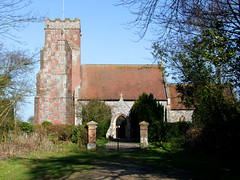
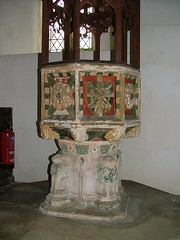
All Saints, Wheatacre This quiet little spot in the middle of the marshland peninsula has a church which is more interesting than at first it might appear. The tower is a chequerboard of flint and brick relatively unusual in Norfolk, although the same thing seems to have been begun at neighbouring Burgh St Peter. The tower there was never finished and was later replaced in the 1790s by Samuel Boycott's extraordinary ziggurat mausoleum, but this one was, probably on the very eve of the Reformation. However, not everything planned here reached completion, as we shall see inside. The step into a plain, simple interior, typical of this part of Norfolk. Looking east, the screen appears modern, but if you look closely you can see that the lace-like tracery is late 15th Century. And then, look up. There is a vast chancel arch, but it is partly filled, and beneath it is a small arch into the current chancel, and an even smaller one into the north chancel aisle. what happened here? It appears that the nave was widened by moving the north wall outwards, and the great arch built in preparation for refashioning the chancel and aisle into a new, wider chancel. The south chancel aisle had already been demolished - witness the filled in arcade on the south wall of the chancel. But the new chancel was never built before the Reformation intervened. The font has been recoloured, so it is hard to tell if the reliefs are recut, though there may be reason to think they survived the Reformation. Between the chancel and the aisle is a simple little tombchest, probably designed to act as an Easter Sepulchre. It is anonymous, but the Holy Trinity symbol held by an angel matches the one on the font which is likely contemporary with the tower, so what we have here may well be the tomb of the donor of the late medieval church. Intriguingly, an angel on the other side holds a blank shield. Was a set of Instruments of the Passion intended for it? The survival of the font imagery, if that is what it is, might be explained by the brass inscription to John London and Anna his wife, who died in 1627 and 1620, which gives an insight into their theological position with its sacramentalist imagery and hopes for the souls of the righteous. Unusually in this area, the Londons supported the Crown in the Civil War and may well have taken steps to protect their sacramental furnishings from passing iconoclasts. Simon Knott, November 2020 Follow these journeys as they happen at Last Of England Twitter. |



|
|||||||||||||||||||||||||||||||||||||||||||||||||||||||
|
|||||||||||||||||||||||||||||||||||||||||||||||||||||||
home I index I latest I introductions I e-mail I about
this site I glossary
Norwich I ruined churches I desktop backgrounds I round tower churches
links I small
print I www.simonknott.co.uk I www.suffolkchurches.co.uk