home I index I latest I glossary I introductions I e-mail I about this site
All Saints, Weybourne

Follow these journeys as they happen at Last Of England Twitter.
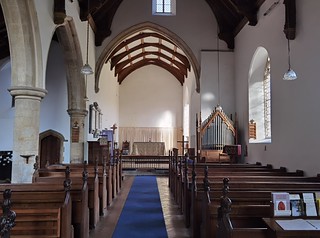
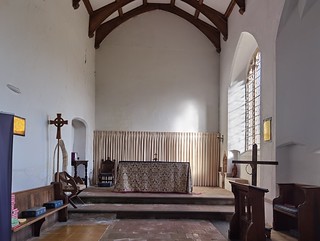
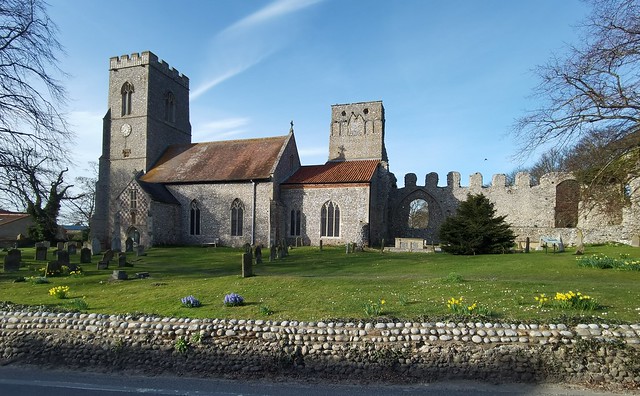
All Saints, Weybourne The marshes peter out as they head eastwards, and then before the cliffs of Sheringham and Cromer take over there is Weybourne Hope or Haven, where the deep water lies just off of the coast. Because of this, and by tradition, Weybourne sits at the least easily defended point on the coast, and as the old rhyme says He who would all England win must at Weybourne Hope begin. The Reverend FW Russell, in his 1859 book Kett's Rebellion in Norfolk, remembered that the Vikings were said by locals to have landed in their thousands at Weybourne. He thought back to the wars at start of his own century, and asserted that at the time it was generally thought in Norfolk that if Napoleon invaded England, he would do so at this point. Of itself, All Saints
is by no means the most exciting church on the Norfolk
coast, but it intrigues because Weybourne was home to an
Augustinian priory, and remains of the priory buildings
survive to north and east. Even more interesting, the
early 13th Century priory swallowed up an earlier late
Saxon cruciform church, and the remains of the tower of
that church can still be recognised to the north of the
modern chancel. The north aisle of the present church is
on the site of the nave of the Saxon church, the arcade
between the current nave and this aisle being set in what
was the south wall of that church. It appears that the
priory built the current church for the parish to replace
the older one they'd taken over, but the priory was never
wealthy, and by the early 15th Century there were just
two canons left in residence. The fact that the tower of
the current church was rebuilt later in that century
suggests that by then the parish was wealthier than the
priory. Simon Knott, March 2022 Follow these journeys as they happen at Last Of England Twitter.
|
|
|||||||||||||||||||||||||||||||||||||||||||||||||||||||
home I index I latest I introductions I e-mail I about
this site I glossary
Norwich I ruined churches I desktop backgrounds I round tower churches
links I small
print I www.simonknott.co.uk I www.suffolkchurches.co.uk