| |
|
St Mary, West Walton
When you come this way for the
first time you might think you are heading for a quite
magnificent East Anglian wool church. This is because of
the mighty tower which can be seen from miles away, a
bulky sentinel standing high above the fens. If the tower
is so vast, you may think, then just how big is this
church going to be? If you have come from neighbouring
Walpole St Peter, you may even think that this is going
to be a similarly massive late-medieval rebuild, full of
Perpendicular space and light.
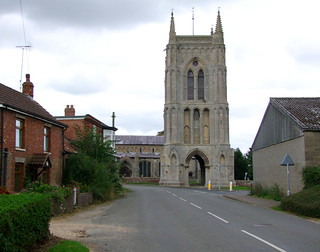
But this is far from the truth, for on arriving in the
centre of the village you will find that St Mary is a
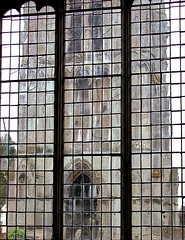
towerless church, and the great structure you had been
heading towards is a detached bell tower to the south of
the church, at the junction of the main roads.The long,
low church beside it is an Early English extravaganza
full of arches and curves, and quite different to the
great majority of other Norfolk churches.
West Walton is the most westerly parish in Norfolk. We
are just a stone's throw from Cambridgeshire from here.
But perhaps it is our proximity to Lincolnshire that will
be most brought to mind, for St Mary was built between
1225 and 1240 in a style which resonates directly from
Lincoln Cathedral. This is not immediately apparent from
the outside, which can appear a little dumpy and scruffy,
especially on a dull day. These are odd proportions, for
the porch was made shallow when the aisles were widened
at about the time the tower was built, and the chancel
was truncated in the early 19th century. Perhaps most
striking of all is the clerestory, a continuous run of
blank arcading punctuated by the occasional window. The
pattern is quite different inside, as we shall see. How
magnificent the west end must have been when it was the
main entrance. As so often, the interplay between
exterior and interior here is going to raise and answer
questions.
There are a number of separate bell towers in this part
of the world, the builders learning the lesson of Elm,
just across the Nene, where the sinking tower dragged the
west end of the nave down to the south, a twist in its
structure that survives to this day. The tower here has
been declared redundant, and is now in the care of the
Churches Conservation Trust. As part of their restoration
they have replaced the floors, recreating the rooms that
had once been inside, because for a century or more the
tower had been a hollow shell. It is so like the tower of
a great confident town church, the bell windows lifting
to pinnacled battlements, that it seems a little out of
place beside its church.
No more than a few decades separate
the building of the tower from the church, but the two
speak complex architectural languages, as if one is at
the start of a movement and the other at its flowering.
It is rare to find two such strong Early English
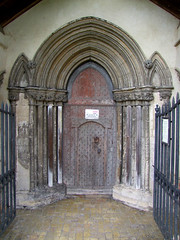
buildings in such close proximity. The path to the church
passes pleasingly under the tower and through that
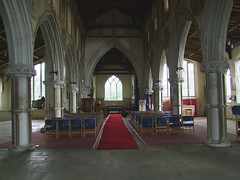
extraordinary south porch. You step into a church which
is simply one of the loveliest buildings in England, full
of that paleness and ancient light you find in churches
of this age, a simplicity, a chiarascuro, a balm for the
soul. There are no big noises here, no seven sacrament
font or rood screen, no medieval glass or bench ends.
This is an architectural masterpiece and an artistic
delight, a perfectly harmonious whole. It isn't a church
to break down into elements. Nothing here is bad.
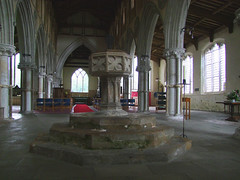
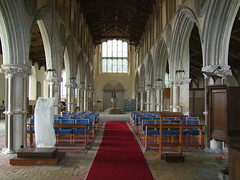
The nave is full of simple, modern chairs, which always
enhances a medieval building, especially an old one.
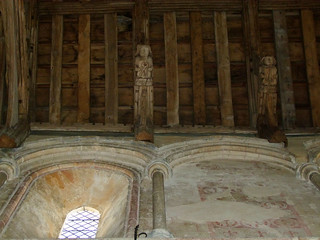
Under the 15th Century roof, with one of the angels
holding a shield depicting Judas kissing Christ, the
beautiful clerestory is punctuated by wall friezes that
date from the time the church was built. You can make out
repeated patterns, monograms and the like. The large
roundels on the arcades are 18th century, and are
supposed to depict the twelve tribes of Israel. In the
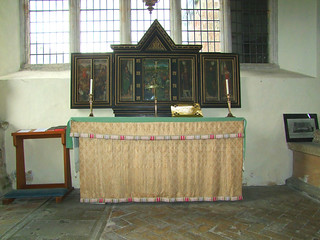
aisles, modern benches are angled towards a simple,
devotional altar. The long hall of the nave is so
beautiful that the truncated chancel appears as almost an
afterthought. The arcades march through all this like an
elegant forest, slender columns clustered together and
crowned by beautiful capitals.
West Walton is not a church to be awed by. It will not
stun you into silence. Rather, your silence will grow
from within you, a quiet peace that is rooted in beauty
and simplicity. It is just lovely. Early English
architecture like this is architecture on a human scale,
perhaps the most simple and pure form of Gothic before it
became the language of power and glory. And West Walton
is Early English at its best, a coherent essay in all
that is so lovely in mere snippets at so many other
English churches.
Simon Knott, November 2020
Follow these journeys as they happen at Last Of England
Twitter.
|
|
|