home I index I latest I glossary I introductions I e-mail I about this site
All Saints, Weston Longville

Follow these journeys as they happen at Last Of England Twitter.
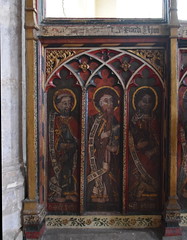
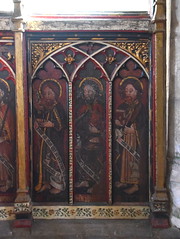
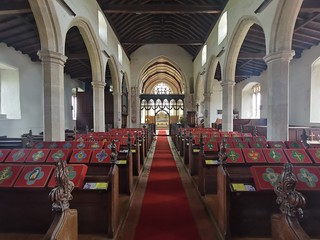
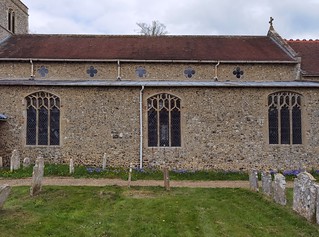
All Saints, Weston Longville We've escaped the orbit of Norwich here, and we are heading out into the gently rolling agricultural landscape of the centre of the county with its busy little villages, among them Weston Longville. After the Conquest, the manor here was in the possession of the Lords of Longueville in Normandy, hence the name. They also possessed Orton Longueville over the border in Cambridgeshire, and the Giffards of Longueville gave their name to Stoke Gifford in Gloucestershire, another possession. The church sits in the village in a relatively tight sleeve of a churchyard. This is a large church, and the lowness of the tower accentuates the length of the building. The church was gradually rebuilt from the 13th to the 15th Century, the tower coming first, the quatrefoil windows of the clerestory before the Perpendicular windows of the aisles. Much of the window tracery was replaced in the 1880 restoration, although Pevsner felt this was accurately done. All Saints is perhaps best known today for being the church of James Woodforde, its incumbent from 1776 to 1803, whose diary is still read and enjoyed more than two centuries on. Parson Woodforde's vignettes of late 18th Century rural Norfolk life are at times moving, at others intriguing, and occasionally bordering on the surreal: I walked up to the White Hart with Mr. Lewis and Bill to see a famous Woman in Men's Cloaths, by name Hannah Snell, who was 21 years as a common soldier in the Army, and not discovered by any as a woman. Cousin Lewis has mounted guard with her abroad. She went in the Army by the name of John Gray. She has a pension from the Crown now of 18. 5. 0 per annum and the liberty of wearing Men's Cloaths and also a Cockade in her Hat, which she still wears. She has laid in a room with 70 soldiers and not discovered by any of them. The forefinger of her right hand was cut of by a Sword at the taking of Pondicherry. She is now about 60 yrs of age and talks very sensible and well, and travels the country with a Basket at her back, selling Buttons, Garters, laces etc. I took 4 Pr of 4d Buttons and gave her 0. 2. 6. Much survives of the church that Woodforde knew before its 19th Century restoration, although mostly gone is the prayerbook atmosphere he would have been familiar with. The brick floors are now furnished with heavy Victorian benches, although there are still some box pews in the south aisle to show us what they replaced. The view east is to the late medieval screen, which retains not only its dado but also the upper tracery. It is beautifully painted with a textbook example of an Apostles' Creed sequence, the twelve Apostles each holding one clause of the Creed.
Unusually, the figures are set in threes under interlocking tracery. From north to south they are St Peter, St Andrew, St Simon, St Matthias, St Jude, St Matthew, St John, St James, St Thomas, St James the Less, St Philip and St Bartholomew. There is a dedicatory inscription above the dado figures to Richard Lyon, matching a bequest of 1492. The fragmentary carving in the spandrels is intriguing, apparently depicting two separate dragon legends, of St George and St Margaret, the second of which appears in the porch spandrels nearby at Swannington. On the chancel arch on either side of the screen are wall paintings of two figures. St John the Baptist stands to the north in his camel-hair coat holding the Lamb of God, while to the south a more fragmentary St John the Evangelist holds his poisoned chalice, the tiny dragon fleeing. These predate the screen by at least a century, and it is generally thought that they are by the same workshop as the wall paintings at nearby Little Witchingham. Part of the same scheme is in the north aisle, a Jesse Tree, the figures representing Christ's ancestry contained within vine-like borders from which hang bunches of grapes.
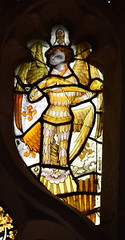
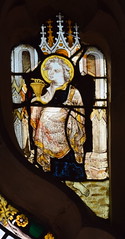
The font is a curiosity, a bulky and somewhat asymmetrical octagonal bowl set at a slight angle on a colonnade. Is it possible that it is cemented over? This was the customary 16th Century fate of fonts with religious imagery. There is little evidence of puritan damage of fonts, simply because what had been considered superstitious at the Reformation had already been hidden by the time the 17th Century came along. In Suffolk, the iconoclast William Dowsing visited several churches with beautifully carved Seven Sacrament fonts, but doesn't mention them in his journal. Most bowls had their cement removed in the 19th Century, and a few revealed themselves as great treasures. In the upper lights of the south aisle windows is glass which Birkin Haward thought was probably by the Norwich glassmaker John Dixon, and set here in the 1840s. It consists mostly of figures of saints and angels and symbols such as the Lamb of God and the Dove of the Holy Spirit. It incorporates fragments of 15th Century glass, but also includes several almost complete figures, including a delightful angel harpist, as well as St Philip and St John.
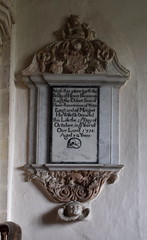
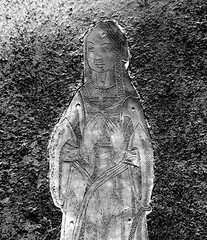
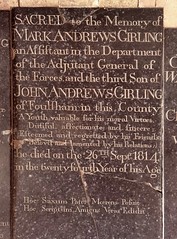
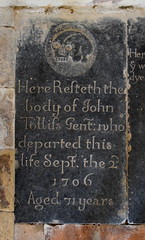
Around the font are some good 18th and early 19th Century ledger stones, several to members of the Girling family, and memorable for their flowery inscriptions. Mary Girling, who ceased to be mortal in 1789 and thus would have been buried by Parson Woodforde, was eulogised by her brother John, telling us that she was endeared to him by the tenderness of her affection to her friends, by the gentleness of her manners, the sweetness of her disposition and the purity of her heart, rendered more pleasing by the beauty of her person. John's son Mark died at the age of 24 in 1814. He was an assistant in the department of the Adjutant General of the Forces, and his father remembered him as a youth valuable for his moral virtues, dutiful, affectionate and sincere, esteemed and regretted by his friends, belov'd and lamented by his relations. Elizabeth Rokewoode's elegant brass figure of 1533 has an inscription asking us to Of your charite pray for the soul of Elyzabeth late the wyfe of Ffyrmyn Rokewoode esquyre, and daughter & eyr of Sir John Tymperley, knight, ye whyche Elizabeth deceased ye 22nd day of Maye in the yere of our Lorde God MDXXXIII on whose soul Jhesu have mercy. Two smaller figures kneel at her feet, her sons Edmund and William. Henry Rookwood nearby is remembered by a wall monument of 1718, its severe inscription and skull on the tablet a contrast to the Baroque explosion of foliage above and below. Among the later memorials is, of course, that to Parson Woodforde himself. He died here in 1803, a bachelor, and his inscription records that his parishioners held him in the highest esteem and veneration and as a tribute to his memory followed him to the Grave, going on to tell us that the poor feel a severe loss as they were the constant objects of his bounty. Simon Knott, June 2022 Follow these journeys as they happen at Last Of England Twitter.
|
|
|||||||||||||||||||||||||||||||||||||||||||||||||||||||
home I index I latest I introductions I e-mail I about
this site I glossary
Norwich I ruined churches I desktop backgrounds I round tower churches
links I small
print I www.simonknott.co.uk I www.suffolkchurches.co.uk