home I index I latest I glossary I introductions I e-mail I about this site
St Andrew, West Dereham



Follow these journeys as they happen at Last Of England Twitter.
| St
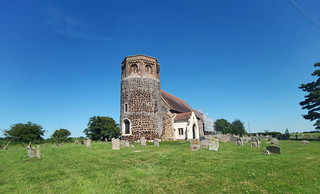
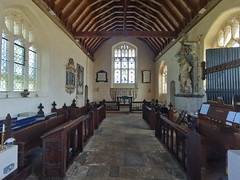
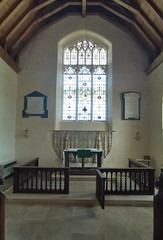
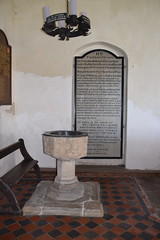
Andrew, West Dereham As the Breckland gives way to the edge of the Fens, the busy Kings Lynn to Thetford Road slices through the landscape, leaving parishes like West Dereham not far off, but feeling strangely lost and remote. The lanes meander and dogleg, cutting down through cushions of fields, and the carstone buildings add a hint of the exotic. There isn't really a village centre, and the church sits near a crossroads with the former rectory for company. Sometimes everything falls into place aesthetically, and there can be few more beautiful sights in Norfolk than the fat gingerbread Norman round tower of St Andrew crowning its wide churchyard. It is Norfolk's widest round tower, and it is topped pleasingly with a red brick bell stage, which was added probably as late as the early 16th Century. The south porch came a century later, its gable typical of the date, and through it you step into an interior which is bright, light and surprisingly large, a wide nave built to scale with the tower. Judging by the tower arch, this must have been a substantial Norman church, but the window tracery now is almost all of half a millennium later. The nave has entirely the character of the 19th and 20th Centuries. There was a major restoration in the 1850s, and then the roof collapsed into the nave in 1901. More recent years brought an elegant reordering to the west end of the nave. However, it is when you step through into the chancel that things get interesting. Despite the backwater character of the parish, the Dereham and Soame families seem to have had plenty of money and enough sophistication to remember themselves with substantial monuments, the grandest of which is to Edmund Soame of 1706. He stands life-size in marble, in a curious combination of armour and wig, and is entirely secular. The eulogy inscribed below makes fascinating reading, for Soame was one of King Billy's henchmen in Ireland in the late 17th Century, and went on to travel widely and, as an MP, achieve some influence. Pevsner agreed with Rupert Gunnis that is an exciting and remarkable work, though to non-expert eyes like mine perhaps striking and imposing would be more accurate.
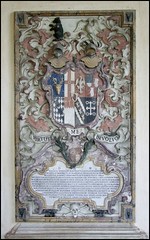
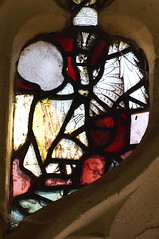
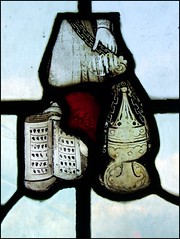
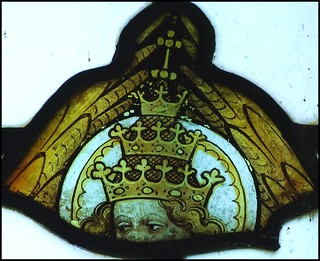
The Dereham monuments at least have a reminder of last things. Grinning skulls, one winged and the other standing proud of its crossed bones, stare out at us. But the best of them, and really rather a remarkable piece, is the 1722 memorial to Sir Thomas Dereham. It consists of his coat of arms set in a leafy background, but what makes it unusual is that is set with coloured stones. Pevsner thought it very decorative, though somewhat conservative, and probably Italian. Indeed, for Julian Litten tells us that it was made in Florence, a collaboration of Ferdinando Fuga & Filippo Della Valle. The most significant medieval survival at West Dereham is the range of 15th Century glass, some of it more fragmentary than others. There is what remains of a sequence of the Orders of Angels. One has peacock feathers and holds a scroll with musical notation, another swings a thurible. A fragment of another wears a papal triple crown.
A little later, but not much, came the pulpit, one of a fair number of pulpits in Norfolk that date from the years before the Reformation, a reminder of the significance placed on preaching towards the ends of the medieval period. Modern iron candelabras with memorial inscriptions hang the length of the nave, a pleasing feature, as is the inscription above the poorbox from the Book of Tobit, reminding us to be merciful after thy power, if thou hast much give plenteously, if thou hast little do thy diligence gladly to give of that little. Simon Knott, July 2021 Follow these journeys as they happen at Last Of England Twitter. |



|
|||||||||||||||||||||||||||||||||||||||||||||||||||||||
|
|||||||||||||||||||||||||||||||||||||||||||||||||||||||
home I index I latest I introductions I e-mail I about
this site I glossary
Norwich I ruined churches I desktop backgrounds I round tower churches
links I small
print I www.simonknott.co.uk I www.suffolkchurches.co.uk