| |
|
St
Andrew, Walpole St
Andrew
 |
|
It had been
twelve full years since I'd last visited Walpole
St Andrew, and as I cycled down the dog-legging
lanes from Terrington St Clement on a bright day
shortly before Easter 2017 I wondered what to
expect. The entwined villages of Walpole St
Andrew and Walpole St Peter lie together on the
edge of the marshland, looking across the Nene
towards the Cambridgeshire fens more than to the
rest of Norfolk really. The two church towers
rise out of a sea of scrubby suburban estates,
although you don't see them until you are almost
upon them.
It is St Peter that attracts tourists, especially
with its annual flower fesatival in May, but in
almost any other village in northern Europe St
Andrew would also be well known, and would also
be a draw for visitors. However, as it sits
barely a mile from one of the grandest and most
important churches in England, we can be forgiven
for not thinking to beat a path to it. As it is,
we would think this a big church if it were not
for its neighbour, and St Andrew can beat St
Peter in being wholly Perpendicular, a purer,
later Perpendicular that is a result of the
mid-15th century and a couple of crisp late
19th/early 20th century restorations. |
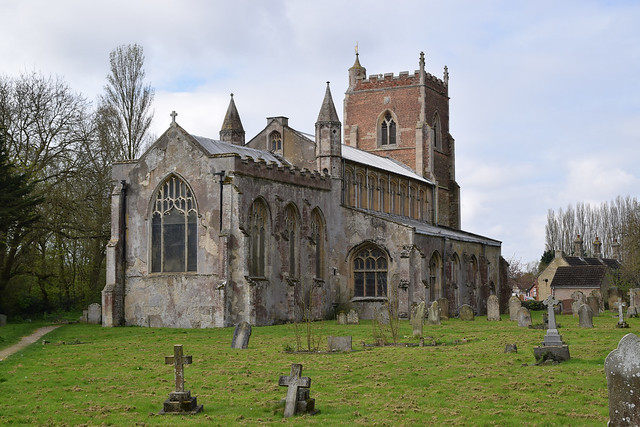
There are aisles, there is
a clerestory. The rood turret spires and sanctus bell
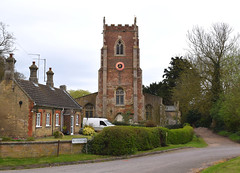
turret echo its neighbour. The gorgeous red-brick and
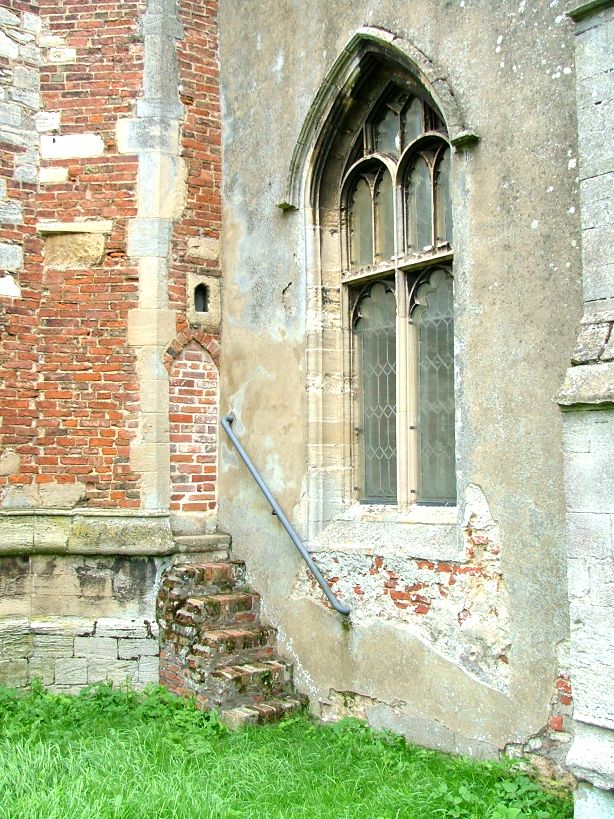
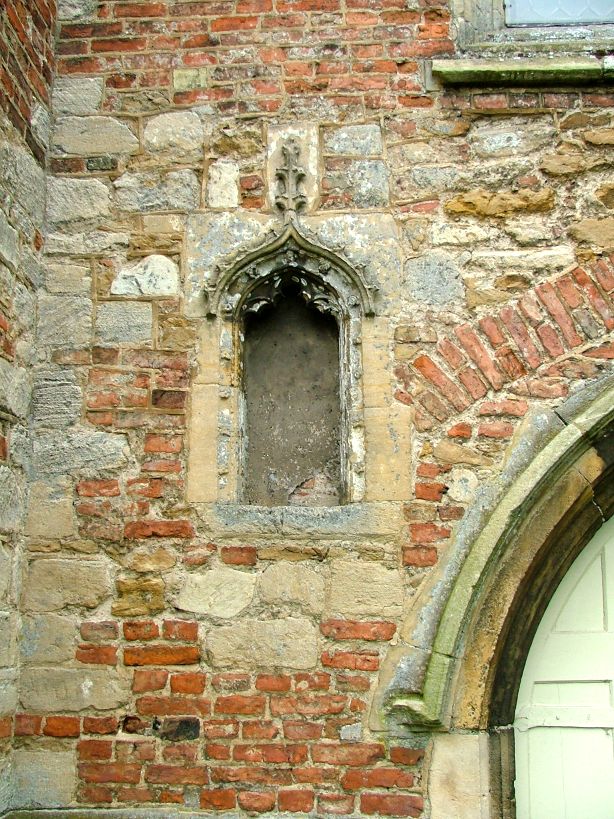
stone tower has a little room built into the
south-western buttress, which may have been a roadside
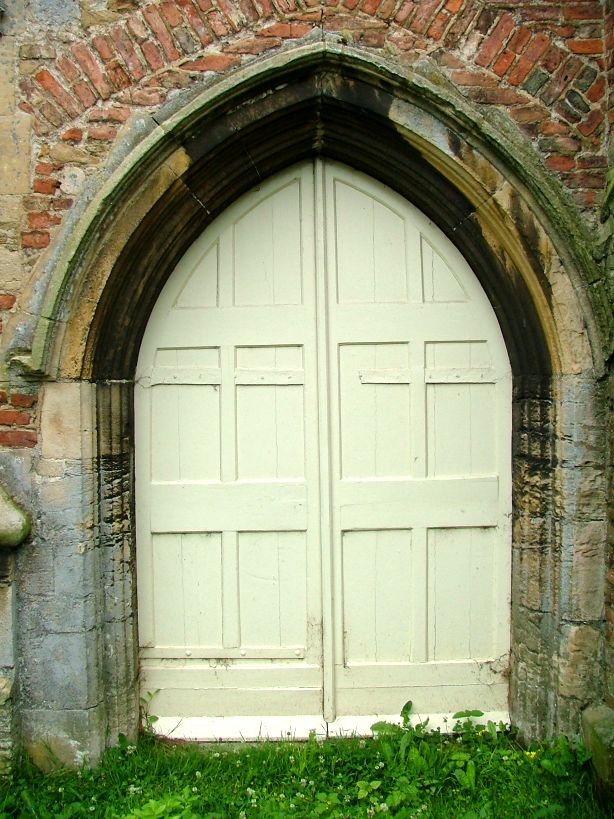
shrine. There is another little door set in the south of
the tower.
It all sounds lovely, but when I'd visited in 2005 I
found that St Andrew had fallen on hard times. It had
been declared redundant and placed in the care of the
Churches Conservation Trust. The congregation had
decamped to St Peter, and St Andrew now had the authentic
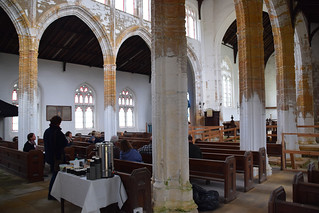
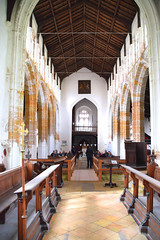
CCT feel, cleared of clutter, the interior seemly, if a
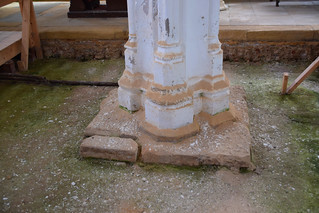
bit grubby. The most striking feature of the interior was
that the stone of the arcades, chancel step and pulpit
base was heavily eroded. This is not unique; you will
find it in several other churches, including a few in
Norfolk, but St Andrew is probably the most famous
example. An architect's report pointed to rising damp as
the cause, but of course all medieval churches have
rising damp. Probably, it is the result of a combination
of the nature of the stone, the damp, and exposure to
salt in the air - probably, the church spent years
roofless.
My other main memory was of how difficult the keyholder
had been, insisting I return the key within ten minutes,
and that there had been no less than five locks on the
door. I thought this was overdoing it a bit. After all,
there is very little inside that would be stealable, so I
couldn’t see the point in having even one lock, let
alone five. When I wrote about this, however, I received
a rather snooty e-mail from someone in the Churches
Conservation Trust putting me in my place. Among other
things, it told me that this is the most heavily
vandalised of all their properties, which perhaps tells
you a lot of what you need to know about this part of
Norfolk.
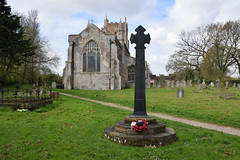
Approaching from the north-west, the church looked lovely
in its open graveyard, although the dilapidation of the
exterior rendering seemed to warn of what might be
inside. However, the church was open, and there were CCT
banners outside, hooray! But when I stepped inside it was
to discover that a public meeting had just begun. The
lead from the south aisle roof had recently been stolen
(so much for the locks), and some representatives from
the CCT were explaining to a group of villagers quite how
much work needed to be done.
Beyond them, I could see that the church was in a
dreadful state, far worse than in 2005. The floor has
gone completely at the east end of both arcades, and the
bases of the pillars are cordoned off and exposed. As I
wandered around I could hear the village being presented
with an ultimatum, more or less - either you help raise
money to save this church, or you're going to lose it to
being a ruin. This has always been a difficult one for
the CCT, and it looks like remaining so.
If you ignore the
distraction of the erosion, decay and impending
dereliction, you find inside St Andrew the
elements of a typical East Anglian village church
- indeed, it could be used as a teaching example.
The 15th century font has quatrefoils and
shields, the pulpit is 17th century with a
preacher's hourglass, the west gallery survives,
there are even some rustic benches. There are
some curious alcoves which may be associated with
a shrine in the nave.
The stained glass is
good of its kind. In the south aisle, a late
Heaton, Butler & Bayne window depicts the
three Marys meeting the angel at the empty tomb
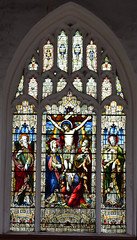
in a pleasing Arts & Crafts style. The east
window is more interesting, the work of Arthur
Moore who was parish priest of neighbouring
Walpole St Peter. A highly skilled amateur glass
designer and maker, there are a number of his
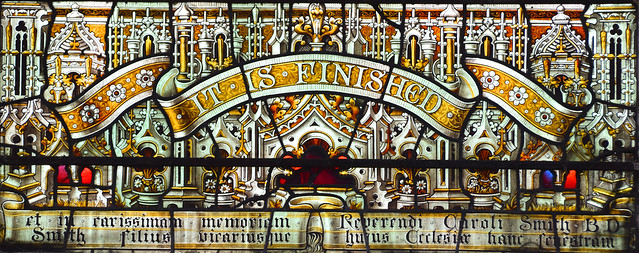
windows in Ely cathedral. This window depicts the
crucifixion, and one cannot help notice the
banner along the bottom which reads IT IS
FINISHED, which may serve as a warning to
the parish. Heavens knows what will happen to
this church. I won't leave it twelve years this
time before I go back and find out. |
|

|
Simon Knott, April 2017
|
|
|