home I index I latest I glossary I introductions I e-mail I about this site
All Saints, Upper Sheringham


Follow these journeys as they happen at Last Of England Twitter.
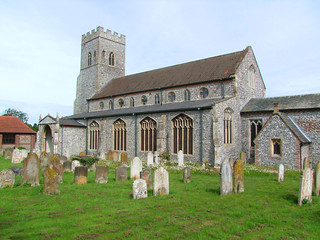
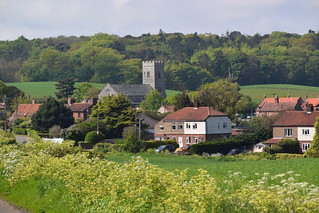
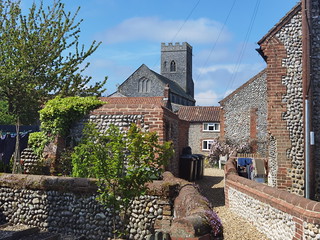
All Saints, Upper Sheringham This grand old
building sits in its huddled hamlet, somewhat aloof from
the high drama of its overgrown child at the bottom of
the hill. A couple of hundred years ago this was one of
England's more remote outposts, but the coming of the
railways transformed the fishing harbour on the coast
below into the brash seaside resort of Sheringham. Now,
Sheringham and its even larger neighbour Cromer have
fallen out of fashion, but that is exactly why I like
them, and so do thousands of other people who flock to
this coast every summer to populate a resort which still
feels as if it has stepped out of The Ladybird Book
of the Seaside. It is certainly preferable to the
metropolitan takeover of Burnham Market and Wells a few
miles to the west.
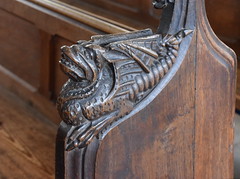
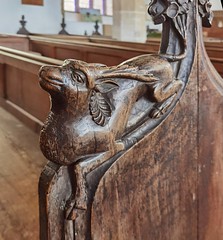
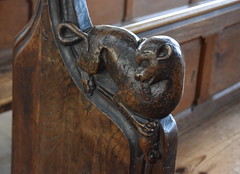
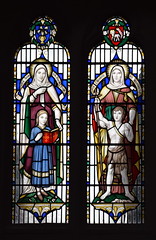
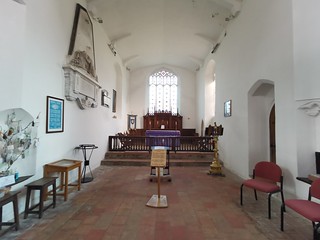
The chancel has a number of memorials to the Upcher family, whose mausoleum we have met outside. That to Abbot Upcher is the grandest, depicting a near-life size figure of grief prostrate before a broken column. the inscription proclaims him the purchaser of the estate and the founder of the mansion belonging to his family. He died at the young age of 34 in 1819 (hence the symbolism of the broken column) and his death was the reason for the building of the mausoleum. A window in the chancel contains glass by Christopher Webb depicting St Anne with the young Blessed Virgin and St Elizabeth with the young St John the Baptist. Coming from different generations, the two children can never have known each other as children, but charmingly it does look as if they are being introduced to each other. To enter the nave you pass through the rood screen, which is an unusual one for several reasons. Firstly, it retains the floor and part of the front parapet of the rood loft, albeit restored but the only one in Norfolk. It is an exciting sight for anyone interested in late medieval Catholic liturgy. It was built up with an upper rail by the Victorians, which is not unsympathetic, but surviving is the pair of mythical creatures in the spandrels between the rood loft floor and the uprights. One is a strange monkey/crane hybrid, the other a wyvern. Incidentally, it is worth pondering these uprights for a moment. There's an assumption that the rood lofts in medieval churches were supported by two stone corbels, but perhaps the arrangement at All Saints was once more common.
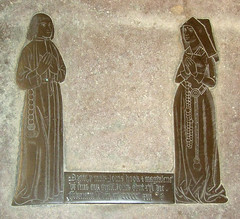
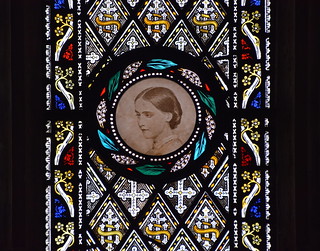
At the opposite end of the nave is a large beam above the font, still decorated in a 15th Century style. This obviously supported a font cover as at Salle, and it must have been a mighty affair to have needed such a beam to hang it from. You wonder what happened to it. Not far off, early 16th Century brasses remember John and Magdalene Hook. More recently, Augusta Louisa Upcher died in 1863 at the age of 15, and her memorial glass at the west end of the south aisle includes her photographic image, an early use of this technique. Birkin Haward thought it was the early work of Powell & Sons and came as part of the same scheme that filled the other windows of the south aisle with their pressed pattern glass. A memorial to a more famous Upcher, the architect Cecil, is in the north aisle. He is probably best known today for restoring Pulls Ferry on the bank of the river to the east of Norwich Cathedral after the Second World War. He lived in it until his death in 1972. Simon Knott, March 2022 Follow these journeys as they happen at Last Of England Twitter.
|
|
|||||||||||||||||||||||||||||||||||||||||||||||||||||||
home I index I latest I introductions I e-mail I about
this site I glossary
Norwich I ruined churches I desktop backgrounds I round tower churches
links I small
print I www.simonknott.co.uk I www.suffolkchurches.co.uk