home I index I latest I glossary I introductions I e-mail I about this site
St Peter and St Paul, Tunstall


Follow these journeys as they happen at Last Of England Twitter.
St Peter and St Paul, Tunstall If you head south from
the A47 east of Norwich, you enter a land of narrow,
high-hedged lanes, a rolling landscape that dips to meet
the rivers. Once you get past the bridge at Acle on the
Bure and the little ferry at Reedham on the Yare there is
no way of crossing the rivers, and so this area remains
isolated. Nobody passes through this backwater except by
boat. On land, you come either by intention or by
accident. As you head eastwards, the landscape flattens,
and the aspect becomes bleaker. We really are beyond the
back of beyond here. A mile from Halvergate, along a
straight, narrow lane, you reach this church and a couple
of neighbouring houses, and that is it, pretty much.
Eastwards of here for almost five miles there is nothing
but the marshes, no roads, no houses, no people, until
you can at last cross the rivers and meet brash, noisy
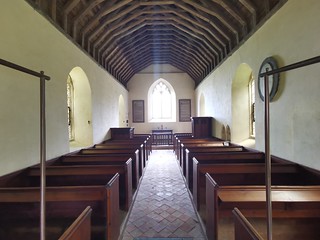
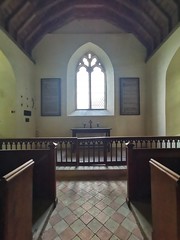
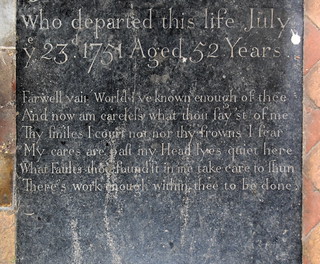
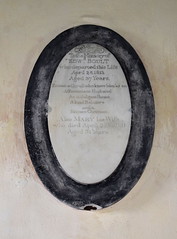
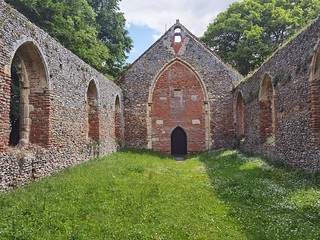
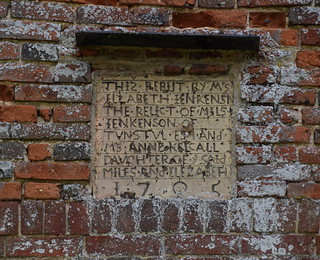
Great Yarmouth huddled on the coast. The chancel arch was blocked in and the two bay chancel was restored to use for worship, the arcade that had once led into a south chancel chapel also being blocked. Above the new entrance is set a plaque with remarkably crude lettering reading THIS REBILT By MrS ELZABETH JENKENSN THE RELICT OF MILS JENKENSON OF TUNSTUL ESq ANd MrS ANNE KELCAL DAUGHTER OF ye SAId MILES ANd ELIZABETH 1705. This is evidence, I think, of what a backwater Tunstall was if this inscription was thought appropriate, for this was nearly half a century after puritan suspicion of literary elegance had come to an end. In the 1850s the chapel was extended eastwards in brick, doubling its length, and an elegant east window added. The church was entirely refurnished in a Low Church manner, and is pretty much untouched since then. The interior is inevitably dark and gloomy when you have stepped in from the sunshine of the former nave, but it has a pleasing atmosphere, giving you an authentic sense of what it would have been like to worship here in the late 19th Century, a real period piece. On the floor is a memorable inscription on a 1751 ledger stone to John Browne in which he leaves his last thoughts to his neighbours, saying Farwell vain world, I've known enough of thee, And now am careless what thou say'st of me. Thy smiles I court not, nor thy frowns I fear, My cares are past, my head lyes quiet here. What faults thou found'st in me take care to shun, There's work enough within thee to be done. There is an 1813 plaque to the memory of thirty-seven year old Edward Boult on the south wall telling us that he was Esteemed by all who knew him as an Affectionate Husband, An indulgent Parent, A kind Relative and a Sincere Christian. His wife, who was presumably responsible for this simple and pleasing eulogy, followed him to the grave five years later at the age of thirty-one. Simon Knott, June 2022 Follow these journeys as they happen at Last Of England Twitter.
|
|
|||||||||||||||||||||||||||||||||||||||||||||||||||||||
home I index I latest I introductions I e-mail I about
this site I glossary
Norwich I ruined churches I desktop backgrounds I round tower churches
links I small
print I www.simonknott.co.uk I www.suffolkchurches.co.uk