home I index I latest I glossary I introductions I e-mail I about this site
Beheading
of St John the Baptist, Trimingham
('St John the
Baptist's Head')


Follow these journeys as they happen at Last Of England Twitter.
| Beheading
of St John the Baptist, Trimingham Trimingham is out in the north-east of Norfolk, where Poppyland becomes the caravan coast. There is something very old fashioned about the small resorts along this stretch of coastline, and that is exactly why people choose to go on holiday here, and all the churches are open every day, including Trimingham. However, the aspect of Trimingham church is rather out of the ordinary. The short, probably unfinished tower is heavily buttressed from the west, while the nave to the east cuts around it to embrace it. This peculiarity may be partly the result of a restoration by Thomas Jekyll in the 1850s. Pevsner feels that he almost completely rebuilt the nave. You step inside to a nave that is not exactly gloomy, but is in sharp contrast to the light outside. Trimingham church may not be the biggest or most magnificent of the churches in this area. But it does have something that is shared with just two other churches in all England, its dedication. The other two are at Doddington in Kent and at Coln St Aldwyns in Gloucestershire. Now, there is no reason to think that the dedications of the majority of English parish churches are necessarily based on anything medieval. The very idea of a dedication was different in medieval times. Churches were dedicated on, and to, feast days, not to Saints as such. The most common dedication in East Anglia nowadays is to St Mary, but this would not have been thought a proper dedication in medieval times. Rather, Marian dedications were to one of her feast days, and perhaps two hundred churches in East Anglia alone were dedicated to the feast of the Assumption by the end of the 15th century. St John the Baptist has two feast days, one on June 24th to his Nativity, and then on 29th August comes the feast of the Beheading of St John the Baptist. At some point, probablyin the early 20th Century, this rather dramatic appellation has been neutered to 'St John the Baptist's Head' here at Trimingham, although I did notice when I visited Doddington that they still prefer the more gruesome version there. Church dedications fell into disuse
after the Reformation, except as a way of differentiating
two close-together churches from each other, in towns for
example. Many of the modern dedications of medieval
churches are the result of well-meaning antiquarians
delving through the records in the 18th century. They
found wills and bequests to individual altars, and some
churches had several of these. Since Marian doctrine was
suspect to protestants, and the Church of England didn't
recognise the doctrine of the Assumption in particular,
those churches became St Mary, and so on. Some modern
dedications are simply the result of exotic fancy by
enthusiastic Anglo-catholic Rectors.
All these
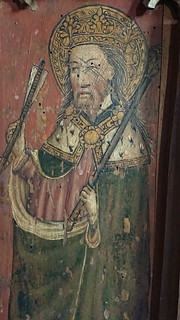
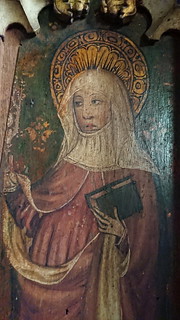
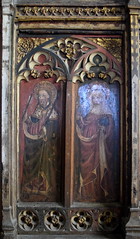
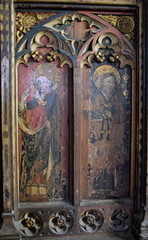
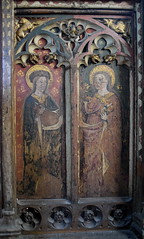
Saints are widely found on other Norfolk screens, but
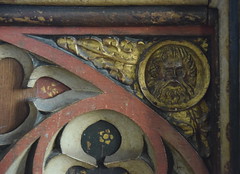
what makes the screen here remarkable is in the spandrels
above the figure of St James. On one side is the Agnus
Dei, the lamb and flag which John the Baptist is
traditionally shown holding, and there, in the other
spandrel, is the Baptist's head on a platter, as shown
above left. This, of course, suggests that the screen did
come from this church, although the way that it has been
crudely extended to north and south to fit the chancel
arch |
Simon Knott, July 2019
Follow these journeys as they happen at Last Of England Twitter.


|
|||||||||||||||||||||||||||||||||||||||||||||||||||||||
|
|||||||||||||||||||||||||||||||||||||||||||||||||||||||
home I index I latest I introductions I e-mail I about
this site I glossary
Norwich I ruined churches I desktop backgrounds I round tower churches
links I small
print I www.simonknott.co.uk I www.suffolkchurches.co.uk