home I index I latest I glossary I introductions I e-mail I about this site
St Ethelbert, Thurton
Follow these journeys as they happen at Last Of England Twitter.
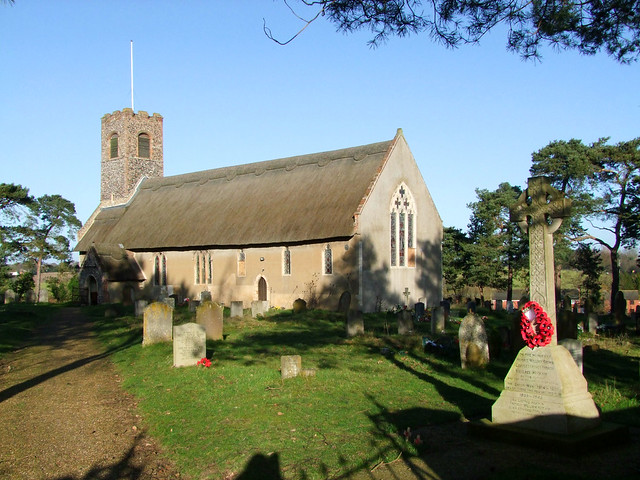
St Ethelbert, Thurton You come through narrow lanes that dogleg and doubleback through the fields. These must be ancient routes, because they cut down up to six feet below the open fields, and in several places zigzag along the ends and up the sides of old strip systems. Thurton is a delight in Spring, the churchyard a riot of wild flowers. I had been here bfore some ten years earlier on one of the coldest, wettest, most windswept days of the winter, the sleet sweeping in from the east. To be here is spring was to see a world transfigured. Thurton is quite a large place, and
just above the busy Norwich to Beccles road, but you
wouldn't know it from the setting of the church, which
stands below the village top road, the houses hidden in
the valley, an incinerator chimney the only incongruous
intervention in the landscape. The long church is
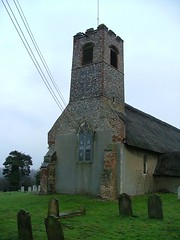
thatched under one roof, the little tower appearing to
grow out of the west end of the nave as at nearby
Bramerton. At nave level the tower is probably 13th
century, but the top part is more recent. I've seen it
described as early 16th Century, and this would fit in
with a bequest, but it looks more recent. It is one of
those upper stages that looks as if it was specifically
designed for bell-ringing, although all the bells are
early, so a bit of a puzzle. The church is otherwise a
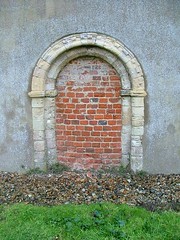
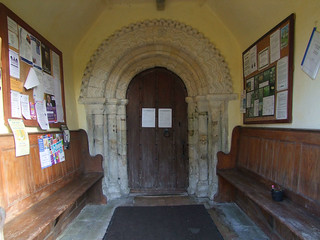
simple Norman structure that was given a good going over
in the 14th Century and then that was it until the
Victorians came along.
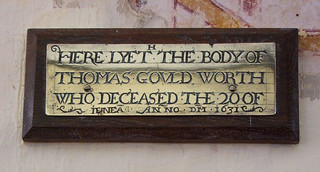
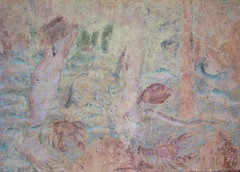
The wall painting of St Christopher on the north wall was uncovered in the late 1980s, and at first sight appears disappointingly indistinct. On closer inspection though, there are a lot of the details which have now faded from St Christophers which have been exposed for a century or more. In particular, the azure blue of the water, and the multitude of creatures in it, among which you can make out a lobster, a crab, several eels, a flounder, what looks like a pike, and several others. You often see ghosts of such things in other churches, and Cautley records a similar menagerie at Mutford just over the Suffolk border in the 1930s, but they have all faded there now. Up at the top, the Christchild sits behind the Saint, holding his orb in a gesture of reigning in majesty. The style of the child puts this painting very late, perhaps as late as the early 16th century. Another curiosity is the font. It is elegant and plain, and unusual in that its style dates from the later years of the 17th Century. Probably, it was installed to replace one removed during the Commonwealth. From earlier that century is a sweet little brass plate to Thomas Gouldworth, who died in 1631. It sits on the south wall, vestiges of wall painting behind it. Simon Knott, November 2020 Follow these journeys as they happen at Last Of England Twitter. |

|
|||||||||||||||||||||||||||||||||||||||||||||||||||||||
|
|||||||||||||||||||||||||||||||||||||||||||||||||||||||
home I index I latest I introductions I e-mail I about
this site I glossary
Norwich I ruined churches I desktop backgrounds I round tower churches
links I small
print I www.simonknott.co.uk I www.suffolkchurches.co.uk