home I index I latest I glossary I introductions I e-mail I about this site
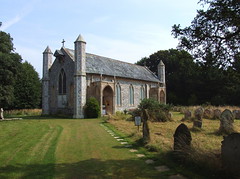
St Margaret, Thorpe Market



Follow these journeys as they happen at Last Of England Twitter.
St Margaret, Thorpe Market The lanes to the north of North Walsham are
narrow, winding and occasionally wild, especially as you
pass the secretive hulk of Bradfield church. Continuing
on beyond Antingham, however, and just before the lane
cruelly spits you out on to the busy Cromer road, you
come to a most sedate and perhaps surprising sight,
Thorpe Market's elegant parish church. It was built at an unusual date, 1796, when
almost no other churches were being built in East Anglia.
More than this, the use of 'Gothick' is mature, with a
number of ecclesiological features which anticipate the
Oxford Movement and the Camden Society by almost half a
century. These include tall, blank image niches, which
flank the two south porches and are also set in the west
and east walls. The porches are more typically of their
century, with spiked pinnacles which echo the towers at
each end. The church is broadly symmetrical about the
centre, with the east and west ends being just about
identical.
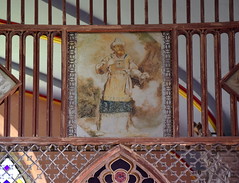
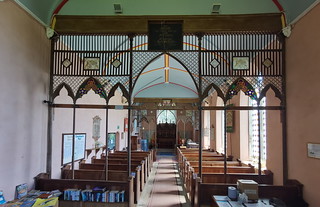
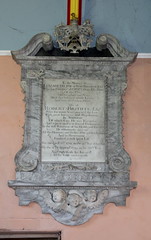
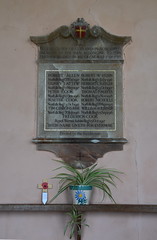
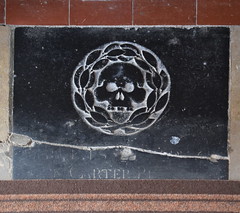
Other glass includes the figures of Moses and Aaron, who were often used in the 18th Century to flank a decalogue board of the ten commandments. It is an intriguing thought to wonder if they were once part of a glass decalogue, which would be unique in my experience. The font survives from the earlier church as do several memorials, including those to members of the Rant family who we have already met at Marlingford and Yelverton. Only the imposing Victorian sanctuary furnishings are a later development. In front of the, a ledger stone with a wholly secular inscription from the middle years of the Commonwealth reads in part: This stone covers the dust of William Rant, Doctor of Phisicke, and fellow of the Colledge of Phisitians in London, who after that he had exercised there his art with much honour and successe for full 20 yeares... he finished the race of his life at Norwich, where he first tooke breath to runne it. Simon Knott, July 2021 Follow these journeys as they happen at Last Of England Twitter. |






|
|||||||||||||||||||||||||||||||||||||||||||||||||||||||
|
|||||||||||||||||||||||||||||||||||||||||||||||||||||||
home I index I latest I introductions I e-mail I about
this site I glossary
Norwich I ruined churches I desktop backgrounds I round tower churches
links I small
print I www.simonknott.co.uk I www.suffolkchurches.co.uk