home I index I latest I glossary I introductions I e-mail I about this site
All Saints, Thornage

Follow these journeys as they happen at Last Of England Twitter.
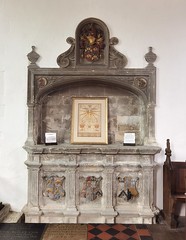
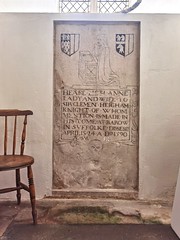
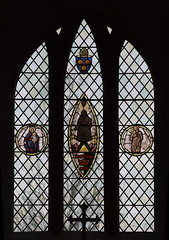
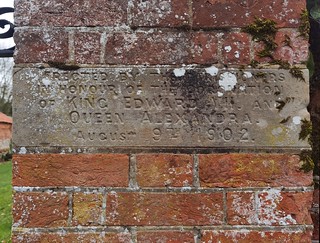
All Saints, Thornage Thornage is a lovely little village not far from Holt, and its church is set back from the village street behind cottages. You reach it by a gateway to the north-west which tells us that it was erected by the parishioners in honour of the Coronation of King Edward VII and Queen Alexandra August 9th 1902. There seems to have been a general going over of the church at this time at the hands of diocesan surveyor AJ Lacey. Pevsner's view was that it had been drastically restored, while Mortlock thought the restoration brutal. These seem harsh words, for although it must be said that the building appears rather stark when you approach it from this angle, once inside this is a pleasant and restrained interior, full of light. There was a south aisle at one time, the arcade now filled in. Pews have been replaced by simple modern chairs, and the view east is towards a collection of early 20th Century glass that must have come as part of Lacey's restoration. Medallions in the east window depict the Blessed Virgin with the Christchild and St Joseph either side of Christ seated in Majesty. It must be said that they aren't terribly good. More interestingly, in the south side of the chancel, the borders and quarries make use of barleycorns and wyverns. There are two memorials of some significance. The 1583 memorial to Sir William Butts is fully in what would have been the English Renaissance style. His father, also William Butts, was chief physician to Henry VIII, and Sir William inherited the manor of Thornage on his father's death in 1545. White's 1845 Directory for Norfolk mentions, almost in passing, that Henry Butts, Sir William's son, was vice-chancellor of the University of Oxford in 1629 but soon after was found hanging in his garters, in his own chamber. Under the tower there is an incised slab which feels of an earlier age, but is actually of seven years later. It remembers Lady Anne Heigham, wife of Sir Clement Heigham Knight of whom mention is made in his tome at Barow in Suffolk. The Heighams were a prominent west Suffolk family, as their memorials at Barrow and elsewhere attest, and Lady Anne was Sir William Butts's mother-in-law. Both of them would have seen the Elizabethan scriptural wall texts here when they were new. Part of one survives, looking as if it must have been very like the one at nearby Briningham. Simon Knott, May 2022 Follow these journeys as they happen at Last Of England Twitter.
|
|
|||||||||||||||||||||||||||||||||||||||||||||||||||||||
home I index I latest I introductions I e-mail I about
this site I glossary
Norwich I ruined churches I desktop backgrounds I round tower churches
links I small
print I www.simonknott.co.uk I www.suffolkchurches.co.uk