home I index I latest I glossary I introductions I e-mail I about this site
St Andrew, Themelthorpe
Follow these journeys as they happen at Last Of England Twitter.
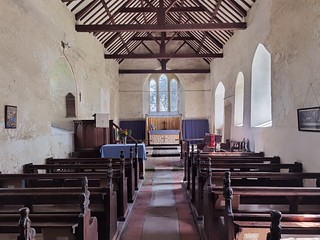
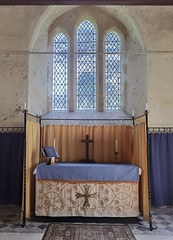
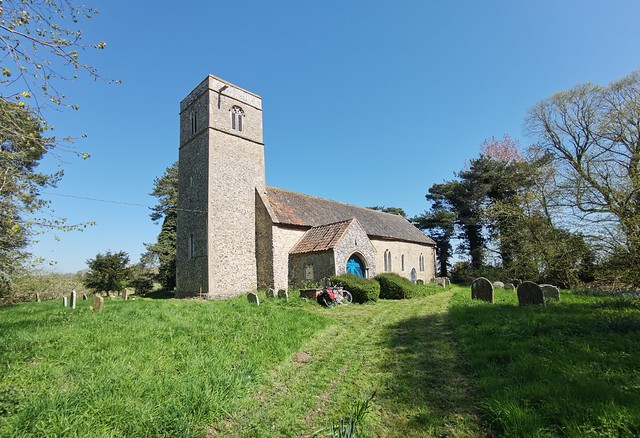
St Andrew, Themelthorpe I wonder how many people outside of Norfolk have ever heard of Themelthorpe, and there must be plenty even in the county who don't know it. A small village minding its own business to the west of Reepham, the name probably means the outying settlement of a man called Thymel, or, more interestingly, as thymel was the Old English word for a thimble, it might mean a thimble-sized outlying settlement, which would not be inappropriate even today. Even when you know the village, the church takes some finding as its secluded churchyard is hidden away behind houses and reached by a long path from the village street. The building is simple, and although there have been restorations it must have been pretty complete by the 13th Century. With the exception of the later porch, this is the church which our ancestors before the Black Death knew, and here it still is, a touchstone down the long generations. It was a rebuilding of a Norman church, or more accurately an extension of it, for when the tower was built the nave was continued eastwards to form a chancel, although even today both run under a single roof with no break in the exterior walls. You step into a church which is entirely rustic in character, and even the 19th Century restoration has left it feeling local and homely. The English altar with its screen still in situ is a lovely touch. The 15th Century font is a plain and simple octagon, rather green with the damp of ages. And there is one other significant and lovely late medieval survival here. This is the figure brass of William Pescod, who died in 1505. He stands simply in a tunic, his hands at prayer, his hair in the pageboy style of the early 16th Century. There are pieces of three other pre-Reformation brass inscriptions, two of them to members of the Pescod family and the other to a Tork, now mounted on the nave wall. They appear to be removed prayer clauses. Fragmentary and evocative, they are appropriate things to find in this place. Simon Knott, May 2022 Follow these journeys as they happen at Last Of England Twitter.
|
|
|||||||||||||||||||||||||||||||||||||||||||||||||||||||
home I index I latest I introductions I e-mail I about
this site I glossary
Norwich I ruined churches I desktop backgrounds I round tower churches
links I small
print I www.simonknott.co.uk I www.suffolkchurches.co.uk