home I index I latest I glossary I introductions I e-mail I about this site
All Saints, Swanton Morley


Follow these journeys as they happen at Last Of England Twitter.
| All
Saints, Swanton Morley
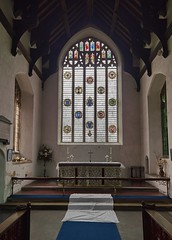
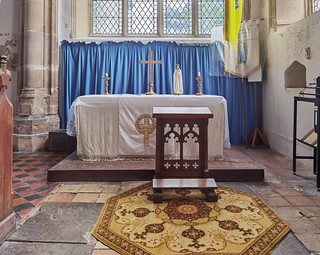
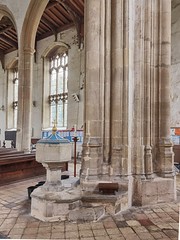
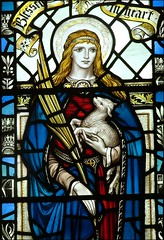
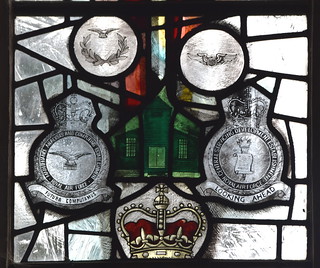
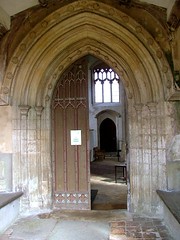
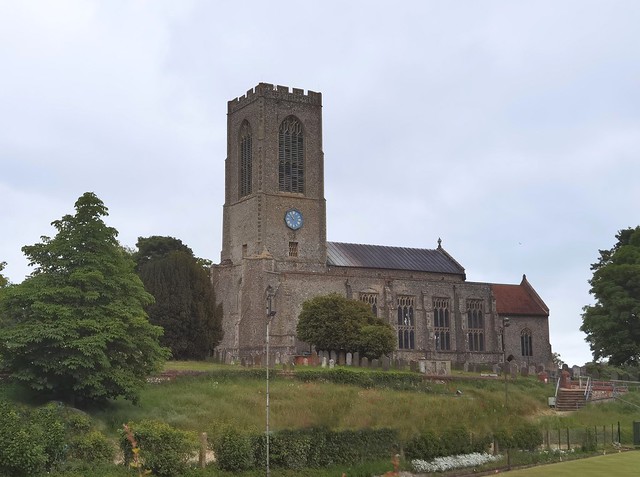
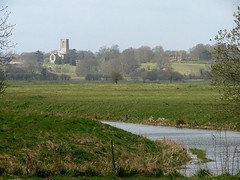
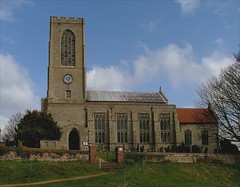
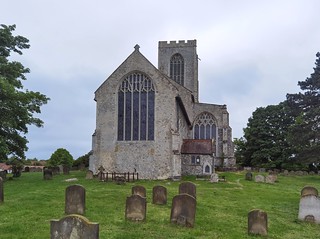
Swanton Morley is about as close to the centre of Norfolk as it is possible to get, a busy working village but beautifully situated in the Upper Wensum Valley. And what a church it has! It sits on a bluff looking out over the river, its churchyard tumbling eastwards with a view of Bylaugh church a mile or two off across the water meadows. Here is early East Anglian Perpendicular on a grand scale, but the architecture is deceptive. The wide aisles almost hide the clerestory, rising like walls of glass, but in fact the nave is only four bays long, and the enormous bell windows make the tower appear taller than it actually is. Perhaps it would be more accurate to describe this church as imposing rather than enormous, and an imposing church is exactly what is required for this delightful setting. In 1379 Sir William de Morley gave 10 marks, roughly £7,000 in today's money, to the work of the church now begun, handily indicating a starting date for the rebuilding. The pestilences of the mid-14th Century were, if not over, then in abeyance. Over the previous thirty years Norfolk had lost roughly half its population to disease and famine, and there was a severe shortage of labour, but wage inflation was suppressed by government action. The biggest shake-up of land ownership for three hundred years was getting underway. Heirs to estates had been lost to the pestilence, and land became a commodity to be bought and sold. For the new owners there was a need to impress themselves on the imaginations of their parishes, and almost two centuries before the Reformation there was a revitalisation in the English Church expressed most dramatically in the rebuilding of churches. Another bequest to the rebuilding of Swanton Morley church survives, and this is John Fox's bequest to the lead roof in 1440. This probably means to the top of the tower and it may well be that the nave, aisles and clerestories were not yet complete, but even so it is likely that this was one long, continuous building campaign that extended beyond the lifetimes of most Swanton Morley parishioners. The chancel is, in Pevsner's word, humbler, as so often in Norfolk, as if those responsible for it were not yet quite up to speed with the new mood of the nation. For all these caveats, if Swanton Morley church was picked up by a giant hand and put down in a number of other English counties it would be quite the largest and most architecturally significant. However, unaccountably in this great county of open churches, Swanton Morley church is kept locked, and I think there can be no real good reason for this.The notice on the porch tells us that is is because of vandalism, but is it really true that crime in the Upper Wensum Valley is so much higher than in the centre of, say, Ipswich, where the main churches are open every day? And if there has been vandalism it can't have been very recent, for I found this exact same situation when I first visited in 2006. There used to be a key available at the garage across the road in working hours, but that is no longer the case. And it is worth saying that while having to go for a key may put off the casual visitor, or the stranger, or the pilgrim, or the grief-stricken local in need of a sacred place to say a prayer, it will not put off the determined vandal or thief, and 90% of East Anglian churches know this and act accordingly by leaving their churches open every day. Reflecting on this perhaps,if you are allowed to enter through the curiously small south porch into the west end of the nave you will find that, at once, the vastness seems to quash all sound. The busy day outside with its car engines and bird song becomes a swallowed, dusty hush. Brick floors spread in all directions, quietly organic with the patina of age. A curiosity is that the aisles extend westwards, enfolding the tower. Because of this, the most westerly pier in each arcade is actually supporting the tower, and both of them are as thick as an oak tree. On one of them the font is set and is dwarfed by it. Beside it there are the deep-set grooves familiar from a dozen other East Anglian churches. they were most likely made by parishioners scraping dust to be used in medical potions, since fragments of the structure of a church were perceived to have healing qualities. Part of the awe that this building generates is a result of its small amount of coloured glass, but there are a few pieces. Powell & Sons in the 1920s produced the glass of St Agnes, St Andrew and St Margaret, and it is typical of the studio at that date. They came back in the late 1940s for the east window, which is principally of clear glass, for which we may be thankful given its size, but featuring an arrangement of shields. There's a 1991 window by Glenn Carter commemorating the role of RAF Swanton Morley in the Second World War. But my overall impression of the church was of its plainness and simplicity, and the sadness that comes from a building that can now never be what it was intended to be, and which is not even allowed to be of daily use to locals or to be welcoming to strangers and pilgrims. It is as if its current worshipping community here is camped out in the ruins of something which they are wholly unable to imagine. Simon Knott, June 2023 Follow these journeys as they happen at Last Of England Twitter.
|
|
|||||||||||||||||||||||||||||||||||||||||||||||||||||||
home I index I latest I introductions I e-mail I about this site I glossary
links I small
print I www.simonknott.co.uk I www.suffolkchurches.co.uk
ruined churches I desktop backgrounds I round tower churches