| |
|
St
Michael, Swanton Abbot
 |
|
The
heat of July 2006 will stick in our memories for
a long time in East Anglia. The spring had been
wet enough for the world to turn green, and
although the temperature rose into the nineties,
the Norfolk landscape still hadn't really dried
out completely. Now, in the dying days of
the month, there was a high haze that was turning
into clouds, and a sense that more than just the
month was ending. Even so, they were cutting back
firebreaks around the houses in the woodlands of
Swanton Abbot, knowing that there are far more
serious consequences of a hot British summer than
mere drought.
|
Swanton
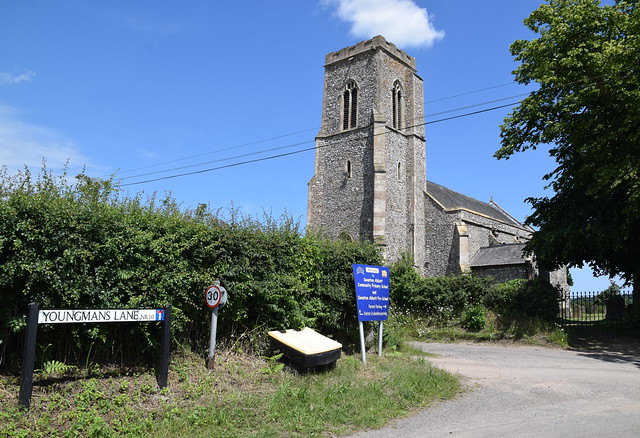
Abbot is a curious place. The church is more or less at
the centre of the parish, but there is hardly a house in
sight, only the village school for company. The streets
where the people live are half a mile away, in two
groups, to the north and the south. We came down from the
north, where the woodlands are, gunning our bikes crazily
down the steep narrow path to the church.
In some
ways, St Michael is a typical East Anglian church, a 14th
century tower with a 15th century rebuilding of the nave
and chancel, the most common arrangement. There are no
aisles, no clerestory, just a wide nave spanned by a
single roof. If it was in Suffolk, it would be even more
typical. There are some serious gargoyles draining the
roof, which Mortlock tells us was replaced in the 1970s,
the old one being unable to cope with the span.
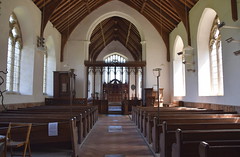
On this
humid day we stepped in to a cool, slightly damp
interior, with a feel of the late 19th and early 20th
century about it. There's nothing too tidy and precise
about it, though, and there is a slight bat problem. All
in all, it feels a rural, rustic place.
 |
|
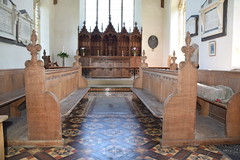
Up
in the chancel is an excellent clerical brass to
Stephen Multon, who died in 1477. He is wearing
eucharistic vestments with a high collar, the
stole hanging down beneath. Multon is an
interesting person, because he has left his mark
elsewhere in the church in the form of the
roodscreen, of which he was the donor. Pevsner
feels that the SM letterings in the
carving mean Stephen Multon, not St Mary or St
Michael. Perhaps they mean all three. However, another
Rector has also left his mark on this screen, and
not in a good way. It was rebuilt in the early
years of the 20th century by the eccentric
octogenarian Rector of the day. It was, as
Pevsner puts it, not well done. For
reasons that have not been handed down to us, but
possibly because he disapproved of them, the
Rector replaced the dado panels so that the
figures face east rather than west.
|
It is,
because of this, easily missed, and we cannot know now
what the original order was. Has each panel been
reversed, or were they reversed in their pairs? Was each
side, north and south, reversed as a whole? Or was the
whole screen reset but the other way around?
The
figures show, from left to right, on the south side: St
Andrew with his saltire cross and St Peter with keys and
a church; St John with his poisoned chalice and St James
with his pilgrim staff and bag; St Jude with his boat and
St Simon with his fish. On the north side, left to right,
are St Batholomew with his flencing knife and St Matthew
with his halberd; St James the Less with his fuller's
club and St Philip with his basket of loaves; curiously,
St Antony with his T cross, and St Thomas with his spear.
The pairings look absolutely right, more or less; if they
were all reversed in pairs it would make St Anthony the
first Saint on the north side, which may mean that
Stephen Multon had a special devotion to him.
The reredos is an alarming piece of
pseudo-gothick which may have come from the hands and
tools of the same eccentric Rector as the screen
restoration. However, Swanton Abbot has an unusual set of
royal arms to William IV, who wasn't King for long enough
for many churches to get around to replacing the
ubiquitous arms of George III.
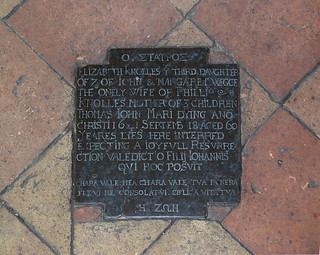
Perhaps the most moving memorial here is set
in the old bricks at the west end of the nave. It is a
crudely cut brass plaque, the corners removed to make it
cross-like.
| It
reads: O STAUROS
(the cross), and then Elizabeth Knolles the
third daughter of 7 of John and Margaret Wegge,
the onely wife of Phillip Knolles, mother of 3
children, Thomas, John, Mari. Dying Ano Christi
1641 Septemb 18 aged 60 yeares, lyes here
interred expecting a joyfull Resurrection.
Valedictio Fili Johannis Qui Hoc Posuit.'(A
farewell from her son John, who placed this). it concludes: Chara vale mea,
chara vale, tua funera flevi me consulatur celica
vita tua. Farewell my dear one, farewell
dear... The green staining is caused by drips of
bat urine.
|
|
 |
|
|
|