| |
|
St
Margaret, Stratton Strawless
 |
|
In
an interview on BBC Radio Suffolk recently I was
asked, rather sneakily I thought, which were the
best - Norfolk churches or Suffolk churches?
Without too much hesitation I hope, I observed
that Norfolk had the best big churches, but
Suffolk the prettiest small churches, which is
true in a general kind of way, although it
doesn't account for the likes of vast, wonderful
Blythburgh in Suffolk, or the lovely little
church at Horsey on the Broads, not to mention
lots of others. I suppose that it is generally
accepted that Suffolk is the prettier county, and
its little churches are an adornment to its
rolling landscape of fields and copses, but much
of Norfolk is pretty too. But Norfolk is big, and
places can become hidden. If Suffolk has the big
skies, then Norfolk has the breadth of the land,
breathtaking in its sweep across the vastness of
England's fourth largest county. Norfolk is
big enough to have regions - the Marshland, the
Breckland, the Broads, and so on - and separating
the Broads from the western part of north Norfolk
is a belt of secretive woodland. I had become
used to travelling through it on the way from
Norwich to Aylsham, and had often seen the little
handmade sign pointing down a way through the
woods to a church. Welcome! it said. Open
every day!
But
I was always on my way to somewhere else, and
what I knew of Stratton Strawless church I knew
from others - people who told me it was one of
the most welcoming churches they'd visited, and
the kind patient churchwarden who had contacted
me by e-mail nearly two years before and asked me
to visit.
|
I had
still not got around to doing so, but this was not for
lack of interest. Indeed, what else I knew of Stratton
Strawless came from books. Here was a church with some
excellent medieval stained glass, and two of the finest
monuments in East Anglia. What was I waiting for? As it
turned out, I was waiting for a beautiful day in
mid-October 2008, when Mother Nature seemed to have
forgotten that she was supposed to be getting on with
autumn and putting Norfolk to bed, and instead had let
the bright sun run riot in a cloudless sky. We had been
to Ringland, undoubtedly the most important church yet to
find a place on this website, and a succession of less
well-known parishes to the north-east of Norwich with
confusingly similar names to each other. Now we were
heading through the woods, and not for the first time
that day I felt a mounting anticipation.
Stratton
Strawless - Stratton meaning an enclosure by a Roman
road, Strawless probably meaning exactly that, without
straw - is about halfway between Norwich and Aylsham, but
feels much more remote. We headed up on the back road
from Hainford. The long lane narrowed, and then at a bend
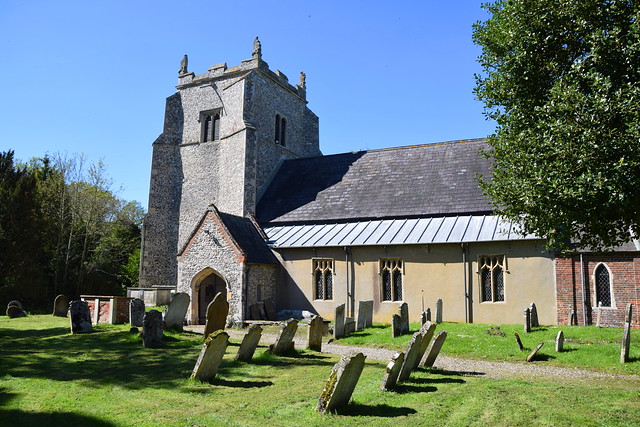
the hedges opened up, and there St Margaret was, a long,
low church huddled beneath a squat tower in a narrow
graveyard. The tower is clearly late Medieval, and was
probably never finished. The east window tracery, of a
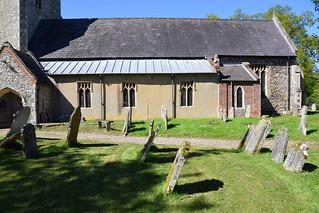
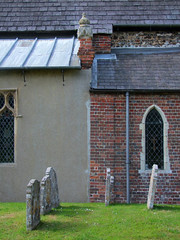
century or so earlier, is beautiful. The little south
aisle has elegant 17th Century details. We opened the
gate, and wandered along the south side of the church.
The sun gleamed on on the windows of what really is the
tiniest of aisles. We felt the warmth of it on our backs,
and it really did seem incredible that the year was
almost over.
The south
door was wedged open, but we resisted going in. Instead,
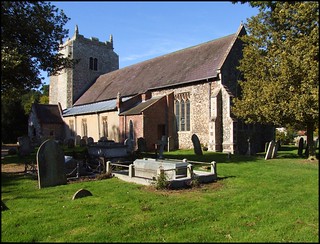
we wandered around to the tower, and there, to the west
of the aisle, were the tombs and memorials of the family
most strongly associated with this church, the Marshams.
Strictly speaking, these ones are to their less
significant members, because the famous ones are inside
in the aisle, but it is a very picturesque little spot.
Walking around to the north side, we found that the north
door was also wedged open. Beyond the gloom inside we
could see the fierce sunlight bursting through the open
south doorway.
And so we
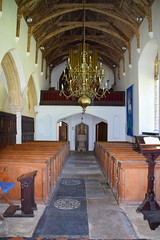
stepped inside. At first, the interior is quite
unfamiliar. This is because of an angled partition across
the church which divides off a vestibule at the back of
the nave and aisle. It runs level with the westernmost
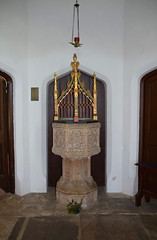
bay of the south arcade, but cuts back around the font,
with three doorways into the nave, two at angles and one
from behind the font into the base of the tower. It is
probably a 17th Century idiosyncracy, put in place at the
same time the aisle was rebuilt as the Marsham mausoleum.
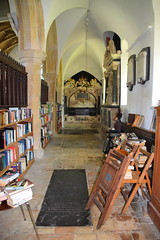
Walking across it to the south, we turned, and were
inside the south aisle, home of the Marshams. Their two
considerable monuments are set against the south and east
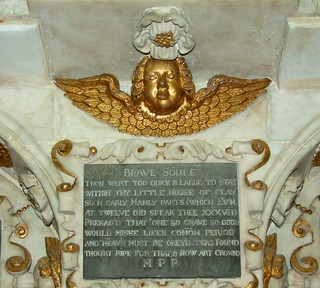
walls. That to the south is to Henry and Anne Marsham and
their family. Henry died in 1678, and is dressed in the
full splendour of the Restoration. His teenage son son
Henry kneels between them, and his splendid inscription
reads:
Brave Soule
Thou wert too quick and large to staye
Within thy little house of clay.
Such early manly parts (which ev'n
At twelve did speak thee XXXVII)
Presag'd that one so grave, so good,
Would misse life's common period
And heav'n must be obey'd. Was found
Thourt ripe for that and now art crown'd
MPP
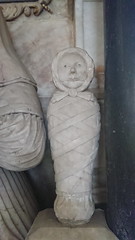
Down in
one corner, a detail so shocking that at first it is at
first difficult to take in, is another child, a baby:
rigid and upright, but bound tightly in swaddling
clothes. He shares an inscription with his mother, who
died in childbirth:
Here lie a vertuous son and mother
who dy'd in kindness to each other:
Death seaz'd him first, when she him freed
By yeilding up her self in's stead,
Which was no sooner done, but hee
Dyes too to keep her companie.
This thou'lt think unhappie fate
To two such heires of fayre estate,
But twas not: for they did forgoe
A state for life; 'n reversion too
to gaine possession of a fee
In rich and Blessed Aeternitie.
The aisle is not very wide, and so there is
a sleight of hand about the way the sculptor has rendered
them facing outwards at prayer - or, more accurately, a
sleight of foot, because, as Sam Mortlock observes, the
effect is of a family of amputees. Topping even this
curiosity is the monument to Thomas Marsham, at the east
end of the aisle. Thomas died in 1638, on the other side
of the great Commonwealth divide, and while his memorial
shows more evidence of Puritan influence, with its
emphasis on death and judgement and the transitory nature
of existence, it is also spectacular in its own way.
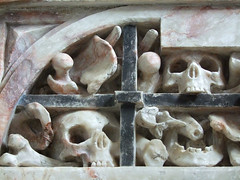
Marsham lounges in his graveshroud on a comfy cushion,
raising his head in response to the last trump being
sounded above his head. Beneath him is the extraordinary
prospect of a charnel cage, filled with his skull and
bones, and those of his ancestors. It takes you a moment
to realise that they are not in fact real, but finely
carved from alabaster. You can see similar works at South
Acre and Norwich St Andrew.
Thomas Marsham's is the only reclining
effigy that I have seen which has designer stubble. We
know he had the memorial made before he died; did he
perhaps think that his likeness looked too effeminate,
and asked them to alter it?
The most famous of the Stratton Strawless
Marshams was Robert Marsham, whose life spanned all but a
handful of the years of the 18th Century. He effectively
invented the Science of Phenology, the practice of
meticulously recording and predicting the passage and
effects of the seasons. He was also responsible for
planting the woodlands on the Marsham estate, which
survive today.
If the Marsham memorials were all there was
to Stratton Strawless, it would still be worth going out
of your way to visit, but there is much more. So far, we
have not touched on the medieval life of this place, but
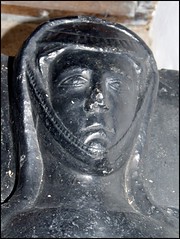
here also in the south aisle is the 13th Century effigy
of a woman wearing a wimple. She lies on her back, and
the stone of the memorial is black. Not surprisingly, she
is known as the Black Abbess, although this is certainly
inaccurate, because she is holding a heart in her hand,
which suggests that her husband died abroad, probably on
a crusade.
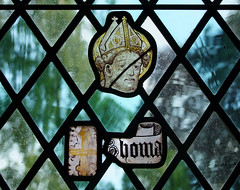
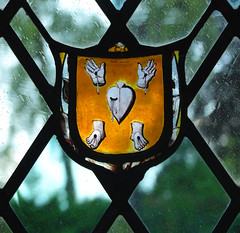
There is also a hint in the south aisle of
Stratton Strawless's greatest treasure. This is one of
the best sequences of medieval glass in Noroflk. There
are just fragments here; part of a Bishop, and an
intriguing shield depicting a round-towered church, which
is probably later and continental. But the best of the
glass here is in the nave. A long wooden screen spearates
the aisle from the nave, so you must go back into the
west of the church and enter behind the font to see it.
It has all been reset in windows on the north side of the
church - fortunately, the lack of a clerestory above the
arcade on the south side meant that the strong aurumn sun
did not stop us photographing it.
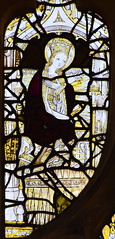
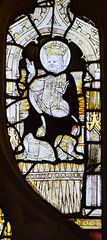
There are survivals of four main subjects.
Firstly, the four evangelists,Matthew, Mark, Luke and
John. It is unusual to find all four surviving from the
same 15th Century set, and delightful to note that St
Luke is depicted as a painter - traditionally, he painted
the first icon, a portrait of the Blessed Virgin. Mark,
Luke and John all have their mythical beast symbols
seated at their feet. Secondly and thirdly, the
Annunciation and the Coronation of the Blessed virgin.
These two pairings, of Mary with the angel Gabriel, and
then with her son crowning her the Queen of Heaven, must
surely always have been intended to be seen together.
Lastly, just two female martyr Saints, St Margaret and St
Catherine, looking similar to their counterparts at
Salle. Presumably, there were once many more.
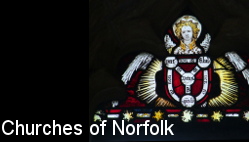
A bit
further east is Stratton Strawless's single most famous
feature, the angel head. This is so perfect that it has
appeared in many books as a fine example of 15th Century
Norwich School glass. About ten years ago, it formed the
centrepiece of an exhibition at the University of East
Anglia, but it was felt too important to be returned to
the church without a proper restoration of its setting.
This took several years, but you see it today in all its
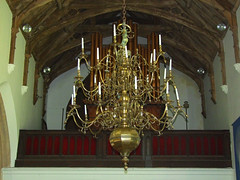
glory. In front of it, and almost filling the little
nave, is one of the county's largest chandeliers, said to
be Russian in origin. Mortlock thought it was probably
17th or 18th century. Perhaps it arrived here from a
Russian cathedral after the Revolution. Beyond, in the
chancel, a lovely modern Blessed Virgin and child set in
the clear glass beneath the Decorated tracery is the
icing on the cake of this, one of the loveliest of all
Norfolk church interiors.
If
Stratton Strawless were merely lovely, then that, of
course, would be enough. That it is also of outstanding
artistic and historical importance is a bonus. But there
is even more to it than that, for this is certainly one
of the most welcoming of all churches. I have already
told you that we found both the north and south doors
wedged open. In this, the tercentenary year of the birth
of Robert Marsham, you might think this was simply
because of the exhibition detailing his life, which had
been set up in the nave. But this is always a church
which is keen to welcome visitors.
| On
a table in the south aisle is an electric kettle,
teabags, coffee, squash and a bottle of fresh
water, a tin of biscuits and cakes, second-hand
books and locally made jam for sale, and notices
making it clear quite how glad the parish is that
you made the effort to pay them a visit. It is
outstanding hospitality, and made me so glad that
I had come here. I bought a jar of marmalade, and
a quaint paperback copy of Evelyn Waugh's Put
Out More Flags. Coming here by car, I didn't
feel that I had earned the right to a cup of tea,
but we put the money in the tin anyway, before
setting off to Coltishall on the other side of
the woods. Outside, on one of the
Marsham tombs, a robin cocked his head and
watched us as we left the south doorway. Off in
the hedge, a blackbird piped ardently, if a
little sadlly. He knew that the days were getting
shorter, and that all too soon the trees would
shed their leaves. Then the storms would come,
and within a few short weeks East Anglia would be
in the grip of an icy, sub-zero winter, the
hardest for years. But until then the unexpected
sun gladdened his heart, as it did mine.
|
|
 |
|
|
|