home I index I latest I glossary I introductions I e-mail I about this site
St Michael, Stratton St Michael

Follow these journeys as they happen at Last Of England Twitter.
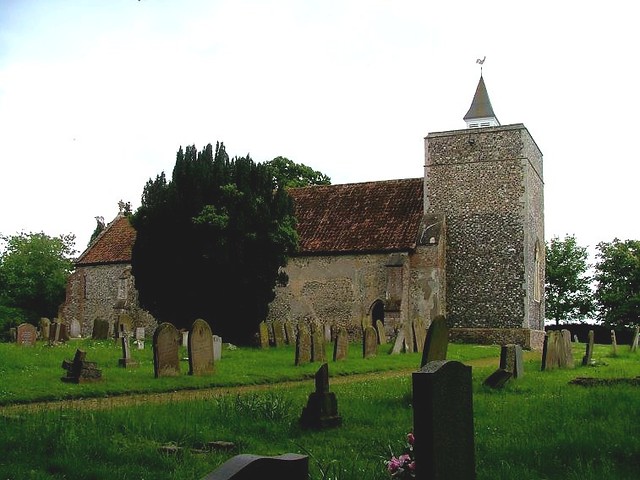
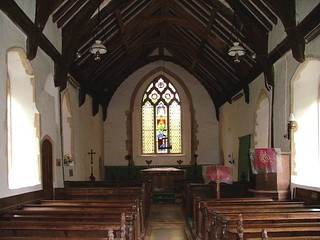
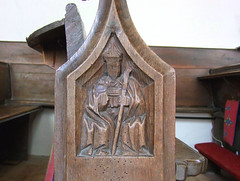
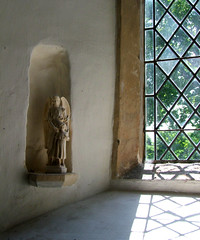
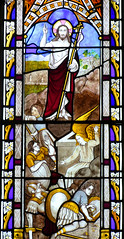
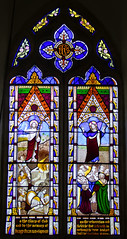
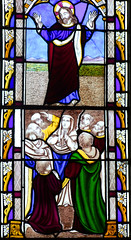
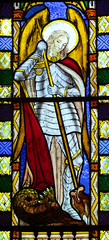
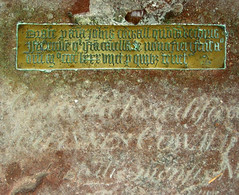
St Michael, Stratton St Michael From the map you can see that this church is set on the outskirts of the town of Long Stratton, and so you might fear some dreary suburbia, housing estates and light industry, but nothing could be further from the truth. St Michael sits sleepily at the end of a long country lane, with only a converted barn for company. The slightly truncated tower with its jaunty little bell turret is just about a landmark from the A140, although the road is far enough away for its noise not to intrude. Close up, this is an idyllic spot, the churchyard surrounded by high-hedge fields, and if you are here in spring it will be filled with a shimmer of bird song. You step into a typical small country church with evidence of its life down the long centuries. The 15th Century font is a typical East Anglian one of the period, with angels on the bowl and lions on the stem. It is strikingly green, no doubt a result of soaking up moisture from the earth on which the church is built for the last half a millennium. Some of the bench ends are also old and are mostly simple, though a couple have figures carved in relief on the sides, one of them apparently a bishop. Others have castellated platforms which likely once supported figures, perhaps angels, now removed. A scattering of old glass includes a fragmentary head of the risen Christ with a forked beard. Two surviving brasses are each a few decades before and after the Reformation, and are consequently from quite different theological traditions. John Cowall's brass of 1487 asks us in Latin to pray for his soul and incidentally tells us that he was responsible for making the cancella de novo. Oddly, Pevsner didn't notice this brass but refers to a record made of it by the 18th Century antiquarian Frances Blomefield as if the brass were now lost. Blomefield interpreted it as 'made the chancel new' which confused Pevsner, as the chancel is largely 14th Century. Pevsner hedged his bets and decided 'it must refer to embellishments only'. Although cancellus might refer to a roodscreen, Simon Cotton tells me that in this case the use of de novo suggests an upgrade to the existing chancel rather than a rebuilding, as wills of the period suggest that work was going on then, with a bequest to the 'reparation' of the choir in 1479. The other brass is a wholly secular inscription to Richard Vynne whoe died the six & twenty day of January Anno Domini 1626 being of the age of 67 yeares. If he was born in 1559 then he must have been one of the first to be baptised into the new Church of England of the Elizabethan Settlement. A last survival here, and one that has probably only come to be appreciated in recent years, is the 1850s scheme of glass by Joseph Grant of Costessey. It would be wrong to call it pre-ecclesiological, and yet appears to be of an earlier age. The east window depicts the Resurrection and the Ascension, and on the south side of the chancel St Peter, St John and St Michael. The 1850s is not an early decade for such traditionally Catholic imagery, and yet the idiosyncratic rendering makes of them something rather thrilling. Birkin Haward pointed out that Grant, who married into a Catholic family in that most Catholic of Norfolk villages Costessey, would have been familiar with the old continental glass installed in the chapel of Costessey Hall earlier in the century, far more so than with anything that the English workshops were doing at this time, and perhaps this is reflected in his own work. Grant's work appears in a number of churches in the Norwich area, but mostly decorative and nowhere else on such a scale as this. Simon Knott, November 2020 Follow these journeys as they happen at Last Of England Twitter. |








|
|||||||||||||||||||||||||||||||||||||||||||||||||||||||
|
|||||||||||||||||||||||||||||||||||||||||||||||||||||||
home I index I latest I introductions I e-mail I about
this site I glossary
Norwich I ruined churches I desktop backgrounds I round tower churches
links I small
print I www.simonknott.co.uk I www.suffolkchurches.co.uk