home I index I latest I glossary I introductions I e-mail I about this site
St Mary, Stradsett


Follow these journeys as they happen at Last Of England Twitter.
| St Mary,
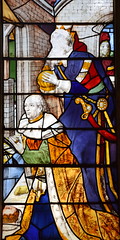
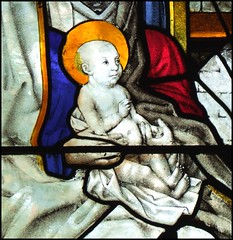
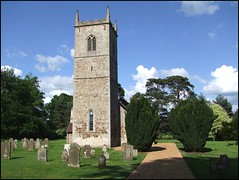
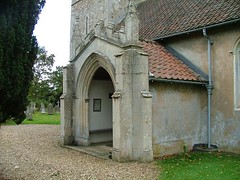
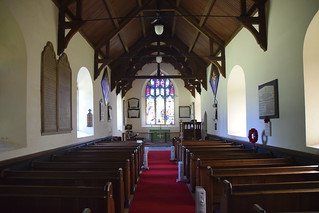
Stradsett Stradsett Hall is a large Elizabethan house in a landscaped park to the east of Downham Market. It has been the home of the Bagge family since the mid-18th Century, and was given its Georgian facade by them in the early years of the following century. The parish church of Stradsett sits immediately beside the Hall, and as you might expect has been cared for by the Bagge family who have beautified it and remembered their dead in it for 250 years or more. The church sits to the north of a grassed area, the headstones being around to the north and west. It is a small church with an elegant tower which, although restored, reveals that this is essentially a church of the late 13th Century. The nave and chancel run into each other, the window tracery to north and south coming from the 1891 restoration paid for by the Bagges which, as we will see inside, also brought the glass for them. It also brought the south porch through which you enter the church. As you might expect in a small church where the nave windows contain solid late-19th Century glass it can be a little dark inside, especially if you step into it out of a sunny day. You eyes adjust to a plain, simple interior with memorials and the old decalogue boards on the walls, the furnishings from the late 19th Century, an unusual small royal Arms for Queen Victoria of the same date. This is a suitably quiet setting for the glass in the east window, one of the most memorable pieces of continental glass in Norfolk. It depicts the Adoration of the Magi, and was made in Augsburg, Germany in 1540. It was given to the church by the Thomas Bagge who refurbished the house in the first decades of the 19th Century.
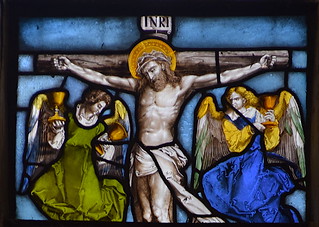
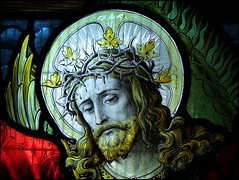
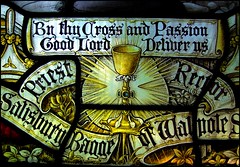
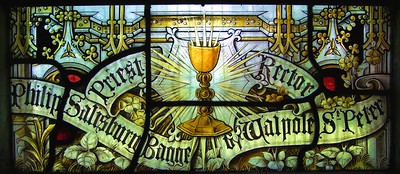
The glass in the tracery above the Adoration scene is also from Augsburg, and so probably is the exquisite panel in the west window depicting the Crucifixion with feathery angels collecting the Precious Blood in chalices. After the splendours at each end of the church the glass of 1891 might feel a little mundane, but it is interesting because, while it is good of its kind, there seems to be no record of the workshop that made it. It remembers Philip Salisbury Bagge, Priest and Rector of Walpole St Peter. Other Bagge memorials line the nave walls, and two of them are by Sir Richard Westmacott. Most memorable is that to Grace Bagge who died in 1834. Two entwined angels look down at her inscription which tells us that she died at the age of 57, deeply regretted by her family. This monument is erected by them as a small tribute of their affection to their lamented and beloved parent. Oddly, Pevsner records this memorial as unsigned, but in fact Westmacott's name is under the right hand pedestal. Seven years earlier Westmacott had produced the memorial to Grace's husband Thomas, which more conventionally depicts the allegorical figure of grief weeping beside a tomb inscribed with a garland.
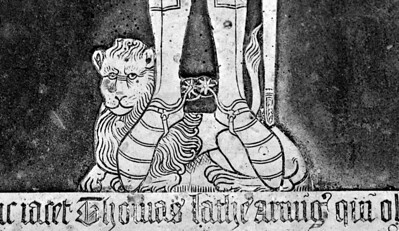
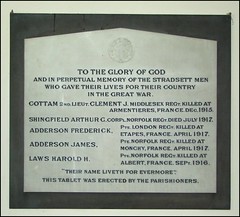
A more typical early 19th Century memorial nearby remembers their son, Henry Case Bagge of the Honourable East India Company's Civil Service. Henry was 26 years old when he died in 1841 at Arrah in the Bengal Presidency. The earliest of all the memorials here is a small military brass to Thomas Lathe of 1418. The inscription, which is undamaged, tells us that he died on St Bartholomew's Eve, and asks our prayers for his soul. On the walls above is a plaque in Perpetual Memory of the Stradsett men who gave their lives for their country in the Great War. There were five of them, and they must all have been estate workers. Unusually, the memorial records the places where they fell. Clement Cottam was the first to die in December 1915 at Armentieres. The following year Harold Laws was killed on the Somme, and then the two Adderson brothers, Frederick and James, who were lost 12 days apart in northern France in April 1917. Finally Arthur Shingfield, who died of his wounds at home here in Stradsett in 1917, is the only one buried in the quiet little churchyard. Simon Knott, June 2021 Follow these journeys as they happen at Last Of England Twitter. |








|
|||||||||||||||||||||||||||||||||||||||||||||||||||||||
|
|||||||||||||||||||||||||||||||||||||||||||||||||||||||
home I index I latest I introductions I e-mail I about
this site I glossary
Norwich I ruined churches I desktop backgrounds I round tower churches
links I small
print I www.simonknott.co.uk I www.suffolkchurches.co.uk