home I index I latest I glossary I introductions I e-mail I about this site
St Botolph, Stow Bedon


Follow these journeys as they happen at Last Of England Twitter.
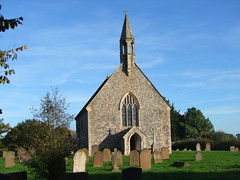
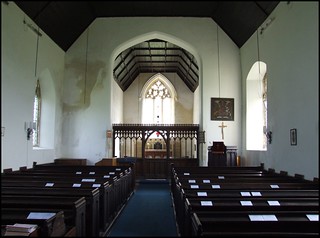
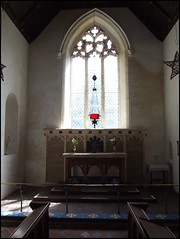
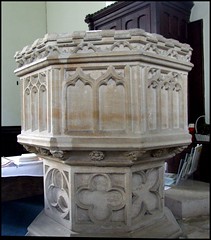
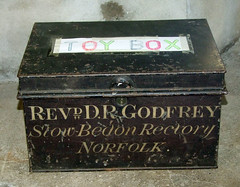
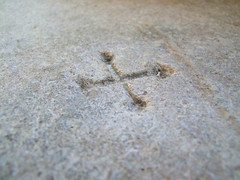
St Botolph, Stow Bedon Stow Bedon is a useful reminder that a village and a parish are not the same thing. All England is divided into the parishes of the established Church of England, and until the 19th century civil parishes and ecclesiastical parishes were virtually identical. Most parishes have a single village in them which takes their name, but a significant minority do not, especially in East Anglia, and especially in central Norfolk, where many parishes contain nothing more than straggles of houses along lanes. Less commonly, a parish has more than one village centre: Stow Bedon has two clusters, about a mile apart, and this church is between them. It feels even lonelier than it looks on a map, partly because of the way the Breckland rolls away in all directions from the wide graveyard. There would, of course, be no point in a remote church like Stow Bedon unless it was kept open, and the parish obviously realise this, transforming what would otherwise have been a dying lock-up into a wayside shrine for pilgrims and strangers. This is especially good because St Botolph is not a remarkable church - or, at least, not for historical or architectural reasons. That it has survived at all is more cause for comment. Cautley, coming this way in the 1940s, reported that this terribly-treated church is rapidly falling into ruins. A German plane returning from the Midlands dropped its remaining bombs near this poor little church, completely wrecking it. Perhaps it is surprising that it was restored to use, but we are right on the edge of the battle training area here, and perhaps the loss of four medieval churches to the British Army galvanised the Diocese into rescuing this one. The building had a chequered life even before this. The west tower fell in the 18th century, and in the 1850s this was one of the last-known churches to be restored by the largely pre-ecclesiological Norwich architect John Brown, much in the style of the 'Carpenter's Gothic' churches he had been building two decades earlier. The bell turret is perky, and below it a curious porch protects the 14th Century west doorway, which for many centuries must have served as the tower arch. The interior feels surprisingly large and barn-like, but even so the massive font comes as a surprise. In the plain nave only the royal arms provide a spot of colour, but this wide space is a perfect foil for the intimacy of the pretty little chancel, which is entirely 19th Century except for the haunting survival of the medieval mensa stone on the wooden altar, a haunting detail. Another thing I like about this church is the way in which the names of people in the past have been preserved in their going about their everyday duties. The 1785 royal arms for George III are signed by Thomas Eldridge and John Watts, the churchwardens of the day. The notice recording a grant of £60 towards the repewing of this church by the Incorporated Society for Promoting the Enlargement, Building and Repairing of Churches and Chapels in 1853 is annotated with the name of the rector of the day, Charles Darby Reade, while another 19th Century rector, the Reverend D R Godfrey, might be very surprised to come back and find that his document box is now in use for the toys in the Children's corner. Lovely little details. Simon Knott, November 2020 Follow these journeys as they happen at Last Of England Twitter. |



|
|||||||||||||||||||||||||||||||||||||||||||||||||||||||
|
|||||||||||||||||||||||||||||||||||||||||||||||||||||||
home I index I latest I introductions I e-mail I about
this site I glossary
Norwich I ruined churches I desktop backgrounds I round tower churches
links I small
print I www.simonknott.co.uk I www.suffolkchurches.co.uk