home I index I latest I glossary I introductions I e-mail I about this site
Holy Trinity, Stow Bardolph
Follow these journeys as they happen at Last Of England Twitter.
| Holy
Trinity, Stow Bardolph It's
now a good twenty years since I first visited Stow
Bardolph church and wrote about it for this site, but
that visit is still vivid in my memory. I had first
come across this place as a child, in an old book in a
dusty, little-used corner of my school library. It was
always a relief to curl up there in one of the crumbling
leather chairs, especially during a wet break or a rare
free period. In my mind, it is always winter in that
library, the high windows steamy and the room warm with
that special fug that comes from old cast iron radiators.
I liked best the shelves of books in their leather
bindings, brought here before the First World War, in the
days when the school was new. I rarely saw anyone else
take these books down. They were mostly bound Victorian
magazines, and in them I would lose myself, the cold,
damp classrooms with their ancient desks would fall away,
gloomy corridors and acrid laboratories would fade, and I
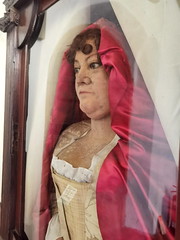
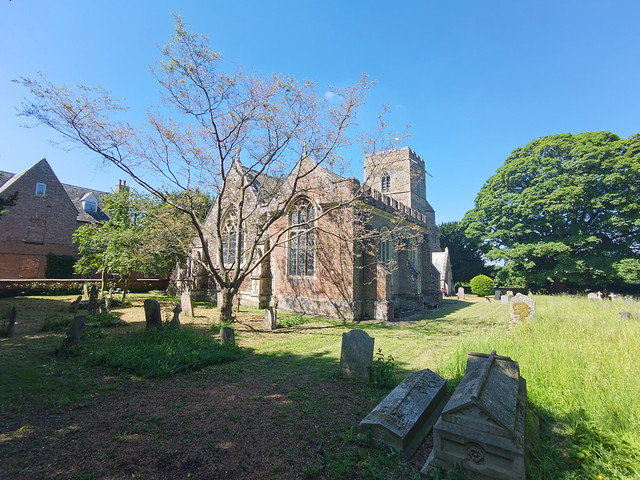
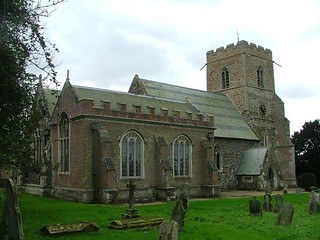
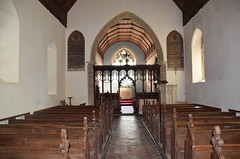
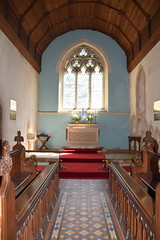
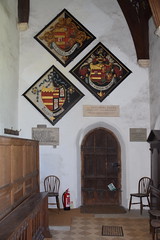
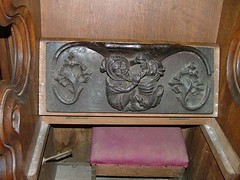
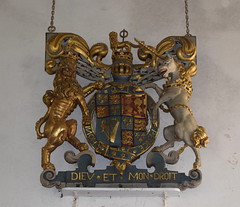
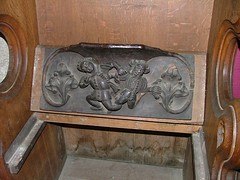
would be somewhere else. Apart from the Hare chapel and the tower, the church was almost completely rebuilt by Raphael Brandon in the 1840s, an unforgiving decade. You step into a church which can feel a little gloomy at first, despite the lack of coloured glass. Mortlock thought the nave fresh and well-cared for, both of which are plainly true, but it is hard to see beyond the early Victorian confidence that Brandon intended. He had an eye to the overarching principle of the place, every carving and every tile playing its part without too much regard for the survival of anything medieval. Of course, we do not know what state this church was in when Brandon came along, and in any case his restoration was overlaid with a series of makeovers later in the century for the increasingly ritualist furnishings and services that the High Church movement was bringing in its wake. The chancel fittings in particular are a sign of the 19th Century enthusiasm for seemly worship here. The Anglo-Catholic tide has now receded, probably long ago in the case of Stow Bardolph, and has left a church which feels at once old-fashioned but a bit of a time capsule. Incidentally, Pevsner and his revising editor got themselves in a bit of a pickle with their entry for Stow Bardolph in the Buildings of England volume for Norfolk North-West and South, which mentions the stalls... with misericords referring to the Hare family: one has a hare gripping the Hare arms and on the other a hind holds the arms of Bishop Hind. How they loved that kind of conceit in the C15! In fact, the Hare family didn't take possession of the Hall until the middle of the 16th Century, and Hind was a Bishop of Norwich in the 19th Century. There is a hare and a hind, but they are on the 19th Century choir stalls. And the misericords? One features two boys fighting, and in the other a cowled monk holds open the mouth of a dragon. They are indeed 15th Century, but they have been reset on 19th Century stalls and so may not even have come from this church at all originally. The other fine surviving woodwork is the carved set of Stuart royal arms, which Mortlock thought the best in Norfolk. But you do not come to Stow Bardolph just to visit what is essentially a 19th Century church and to scoff at Pevsner, for on the north side of the chancel is the doorway into the Hare Mausoleum. It is worth noting that the doorway is also of the 19th Century, and there may not have been any way through between chancel and chapel when the chapel was originally built. The chapel is open on the south side giving a view of the pulpit, but not, you notice, the altar, and Pevsner thought the chancel had been rebuilt along its original lines. You step through into a space which is entirely different in character to the rest of the church. A large, light place, it is lined with two centuries of memorials to the Hare family, perhaps the best collection of their kind in the whole of Norfolk. There are about twenty of them all told, some more imposing and eye-catching than others. It was with something approaching excitement that I entered the chapel on the occasion of my first visit in 2004, and I still feel a similar frisson when I've come back here, most recently in June 2021. I am taken back to my Cambridge childhood, to a steamy school library in a 1970s winter, to an old cracked leather chair beneath shelves of bound Victorian magazines, where I first read about one of these memorials in particular. A plain mahogany cabinet in the north-west corner of the chapel tells its own story on a brass plaque: Here lyeth the body of Sarah Hare, youngest daughter of Sir Thomas Hare Bart and Dame Elizabeth his wife and sister to the present Sir Thomas Hare who departed this life the IX day of April MDCCXLIV and ordered this effigies to be placed here. Open the door, and there she is. A wax effigy, dressed in her own clothes. She was about fifty when she died, and it was apparently her own wish to be immortalised in this way. The story goes that she died of blood-poisoning after pricking her finger while doing needlework. The door to the cabinet is not without reason, for she is terrifying, her face dumpy, warted, defiant. I had obviously seen photographs of her in the years since I first read about her, but nothing can really prepare you for the thrill as the cabinet door swings open. It made me think of fairground peepshows that I can just remember. I thought back to the time I'd first read about her, a lifetime ago, in a book that was already a hundred years old. And all that time she'd sat here, through almost three centuries of wars and treaties, kings and queens, summers and winters, the rise and fall of Empire. And nothing in all her life was as remarkable as this long, silent, immobile vigil. If she could know, would she still want this immortality? Would any of us want it for ourselves?
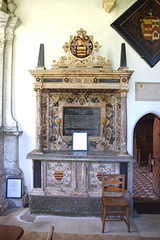
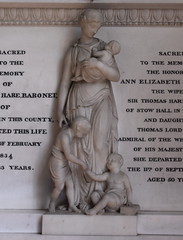
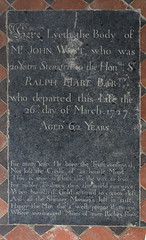
The excitement of Sarah Hare may distract you from the other memorials, but there are tremendous things here. The earliest of the memorials is to Sir Ralph Hare who died in 1623. It's made of painted alabaster, a riot of columns, strapwork and obelisks. It is, as Pevsner notes, a lively design. The most imposing of the memorials is to one of the Sir Thomas Hares, this one dying in 1693. He reclines life-size in slightly absurd Roman armour, and the inscription tells us that the monument was erected by his wife Elizabeth. Sir Thomas died at the age of 35, but his wife outlived him by almost sixty years. Pevsner says that the work is attributed to Grinling Gibbons. More than a century later, the tablet memorial to another Sir Thomas, who died in 1634, is elegant and charming, the figure of Charity separating his inscription from that of his wife who died before him. Opposite, the memorial to Sarah Hare's sister Susannah is by the great William Scheemakers, and Mortlock says it is his only work in Norfolk. When you can eventually drag yourself away and step back into the church to leave, there is one more memorial worthy of notice that you pass on your way. On the south side of the chancel is a memorial plaque to James William Adams VC, Chaplain in Ordinary to the King, Vicar of this parish and Rector of Wimbotsham. Adams' story is really rather remarkable. In 1879 at Killa Kazi, where he was serving as a chaplain during the Second Afghan War, Adams dived into a water-filled ditch under the sight of an Afghan charge to rescue men who had fallen beneath their horses in the muddy water. As a result he became the last of five civilians, and the first ever clergyman, to receive the Victoria Cross, and when he returned to England it was to great acclaim as a popular hero. He was appointed as chaplain to the Prince of Wales, later King Edward VII, who had his country house at Sandringham just up the line from Downham Market, and he spent several years ministering to the people of Stow Bardolph and Wimbotsham next door until he retired to Rutland, where he died in 1903. And after all that excitement, to recover. The Hare family still have something to offer, for just to the north of the church the excellent village pub is the Hare Arms. It does seem a little odd to go into a pub named after all the people you've just been visiting, so to speak. A curious immortality perhaps, although not as strange as being cast in wax like Sarah Hare. I was glad I'd seen her, glad she was still there, glad there was still a thrill. As Mortlock observed, How many nightmares, I wonder, have sprung unbidden from that innocuous mahogany case! Simon Knott, July 2021 Follow these journeys as they happen at Last Of England Twitter. |







Amazon commission helps cover the running costs of this site.
home I index I latest I introductions I e-mail I about
this site I glossary
Norwich I ruined churches I desktop backgrounds I round tower churches
links I small
print I www.simonknott.co.uk I www.suffolkchurches.co.uk