home I index I latest I glossary I introductions I e-mail I about this site
All Saints, Stibbard


Follow these journeys as they happen at Last Of England Twitter.
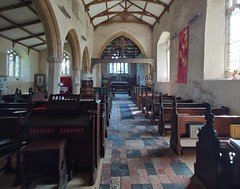
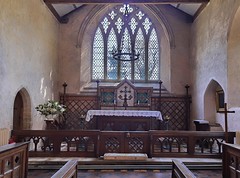
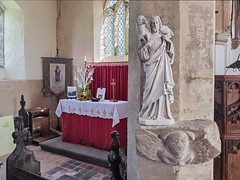
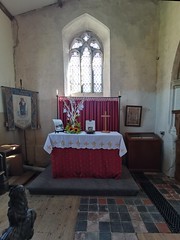
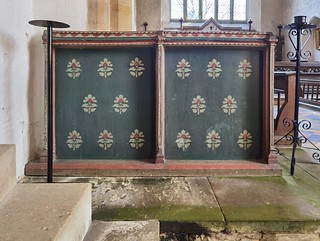
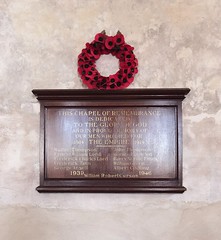
All Saints, Stibbard Stibbard is a scattered parish not so very far from the busy Fakenham to Norwich road, but in the heart of its small, pretty village you wouldn't know the road was there. The houses climb up the hill away from the village street, and behind them sits the church. All Saints has a perky little tower which has evidence of a number of dates but which was probably underway in the 12th Century, the bell stage coming perhaps a century and a half later. The cap is reminiscent of that at Toftrees just the other side of Fakenham. The church against it is essentially early 14th Century. This period brought the intriguing east window, where intersecting tracery builds to a quatrefoil, as if someone was trying something out and was pleased to find that it worked. Thus Early English became Decorated. You step into a pleasingly atmospheric interior, and perhaps it would not be unfair to call it an old-fashioned church. The roof of the north aisle has been raised, and rises up to meet the nave roof, leaving the former clerestory within the church on both sides. This is a symptom of another major event in the history of this building, for in the early 1860s it underwent a restoration by none other than the great William Butterfield. The view to the east is punctuated by the original rood beam, coloured by Butterfield but now fading pleasantly with age. The sanctuary is substantially Butterfield's too, with its ornate reredos and fancy communion rails, but part of the stencilled dado of the 15th Century screen survives in situ, and Butterfield appears to have used some of the rest of it in his pulpit. Other survivals include some old benches with mutilated bench ends, probably more by the sands of time than by iconoclasm. As a wooden plaque on the wall reminds us, the south aisle was designated a Chapel of Remembrance after the First World War, in proud memory of our men who died for the Empire 1914 - 1919. There were ten of them, and another name was added for the Second World War. The altar at the east end of the aisle was dressed in red, which seemed appropriate even though it was Easter Week. On a pillar of the arcade there is a large corbel carved with an angel, now serving as an image bracket and probably older than the arcade against which it is set. It currently supports a large statue of Christ the Good Shepherd, which only added to the quirkiness of this pleasant little place. Simon Knott, May 2022 Follow these journeys as they happen at Last Of England Twitter.
|
|
|||||||||||||||||||||||||||||||||||||||||||||||||||||||
home I index I latest I introductions I e-mail I about
this site I glossary
Norwich I ruined churches I desktop backgrounds I round tower churches
links I small
print I www.simonknott.co.uk I www.suffolkchurches.co.uk