| |
|
St Mary,
Sporle
 |
|
October
2006: We came down through west Norfolk
on a stunning early autumn day. The sky was
crisply blue, the air warmed but full of the
smells of the cold earth exhaling. I love this
time of year. I love the way that the afternoon
light thins out; all is safely gathered in,
Norfolk closes in on itself, and the secretive
countryside prepares itself for another winter. All day,
all the churches had been open. It was a time of
harvest festivals, usually on quite a small
scale, with a scattering of pumpkins on window
ledges, carrots and turnips piled around fonts.
The cool, damp taste of the air in an English
village church was tempered by the sweet aromas
of apples and plums.
|
We were
weaving southwards, left and right of the Swaffham road.
We came through busy, purposeful villages that were off
the beaten track: Great Massingham, Rougham, Wellingham.
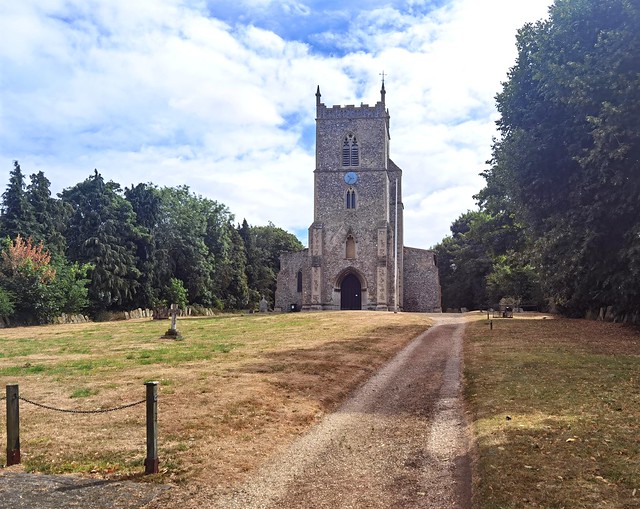
We headed onwards and found Sporle, another large
village, its long pretty street flanked by a stream, a
pleasing bridge carrying across to the church on the
hill.
| On
the face of it, St Mary is architecturally
fascinating, a perfect example of Early English
drifting into Decorated. However, there was a
massive restoration here in the 1890s by the
clumsy Diocesan architect Herbert Green, so what
you see needs to be looked at carefully. Much of
the north side is his, I think, and can that
plate tracery be original? Perhaps the answers
are inside. I want to tell you a story
about Sporle church. Peter Stephens, a regular
churchcrawling companion of mine, had visited
here a year or so previously. It had been a
Sunday morning. This is usually a good time to
visit churches in Norfolk; very few of them
manage a service each and every Sunday.
|
|
 |
Peter
parked on the village street, and crossed the bridge.
There didn't seem to be anyone about, and so he climbed
the hill to the church.
Walking
past the tower, he found the south door, which lets
directly into the church. There isn't a porch, and the
door has a traditional handle as well as a yale lock.
Peter tells me that he turned the handle, and pushed. But
the door was locked, and it wouldn't open. He rattled the
handle a couple of times, but no; it was definitely
locked. He stood for a moment, looking around for a
keyholder notice. There wasn't one. And then, suddenly,
the door opened.
It opened
just a fraction, just enough for a tall man to put his
head out. He took one look at Peter, and said "You
can't come in. There's a service on." And then he
shut the door again.
This
seemed to me an extraordinary thing to have happened.
There was a hint of the absurd about it. The vast
majority of village churches are very welcoming, and
would certainly be pleased if a stranger turned up while
a service was on. I wondered if it had been someone
having a joke, but Peter said no, he could hear the sound
of voices within.
 |
|
I
thought about this story now as we headed up the
path to the church. The great empty niche above
the west door, which looks partly late 13th
century and partly Herbert Green's, looked down
on us blankly. We headed around to the south
door, and found a laminated notice pinned to the
door: NO GOODS OR MATERIALS TO BE REMOVED FROM
THIS CHURCH WITHOUT THE PRIOR WRITTEN CONSENT OF
THE CHURCHWARDENS, it said. Well, what
a strange thing to find. It is self-evident that
no church wants its furnishings stolen, but why
on earth was this notice necessary? Did they
think it would be more effective than a burglar
alarm? The door itself, unsurprisingly, was
locked, and there was still no keyholder notice.
I rattled the handle noisily for a while, but
nobody opened up. This was frustrating, not least
because St Mary has a good cycle of the martyrdom
of St Catherine, and I had been looking forward
to seeing it.
|
A small
priest door to the east was covered in cobwebs, and
clearly had not been opened for years. We wandered around
the church, which is very imposing whichever side you see
it from. The graveyard is gorgeous, and seen from the
east the setting is dramatic. But even the plate tracery
of the east window seemed to throw a blank stare at us.
The north door is actually bricked up, which was
appropriate under the circumstances. The west doors were
also locked, and for want of any other ideas of how to
effect an entry into Fortress Sporle, we scratched our
heads and then went back to the car.
So, what
on earth was going on at Sporle church? Thinking about it
afterwards, I came up with a number of possibilities. If
the church was now redundant, the 'service' that Peter
had encountered might actually have been something
unofficial, and perhaps even something that shouldn't
have been going on at all. If that was the case, then no
wonder that they wouldn't let him in.
But no;
Sporle was surely much too big a village for its church
to be made redundant, and it was the work of a few
moments to discover that it was still a working building.
And so I wondered if perhaps there had been some kind of
feud going on between rival groups within the
congregation. Perhaps there were two factions, holding
separate services and rearranging the furniture
accordingly. Perhaps the dispute over removing 'goods and
materials' was something to do with people claiming
ownership of liturgical furnishings.This would explain
the siege mentality when Peter tried to enter during a
service, and would also give a reason for the very
strangely worded notice. But was such a turn of events
really credible outside the covers of a JL Carr novel?
August
2007: We came back to Sporle about nine months
later, on one of the hottest days of 2007, only to find
that the annual Sporle fete was in progress on the school
field. We walked around to the church, and found that on
the outside of the south doorway there was now a
keyholder notice, listing no fewer than four keyholders.
It still isn't clear to me if this was a result of what I
had written the previous year. Not unreasonably, they
were all out, shying cocunuts and beating the keeper no
doubt. But it was a step in the right direction, and so a
few weeks later, on another beautiful summer day, we
returned again.
Remembering
the notice, I went to one of the keyholders, who turned
out to be a delightful old lady with a cockney accent.
She reiminded me of my wife's great aunts, who all came
from Bethnal Green and Whitechapel. "Have you got
any identification?" she demanded. As far as
possible, I deliberately carry no identification, but I
did offer her my bank card. She laughed, and declined it.
"There you go", she said, handing me the key.
"Enjoy it".
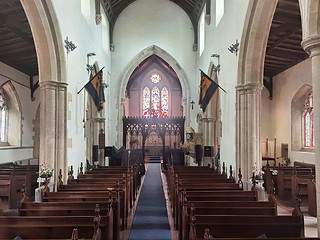
And so,
Peter and I stepped inside Sporle church for the first
time. My first impression was of how dark the inside was,
even with the south door open, thanks to the box around
the doorway, reminiscent of churches in France. The
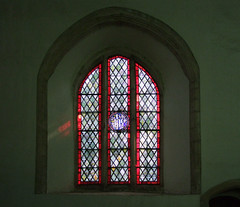
windows, which we had previously been unable to look
through, turned out to be full of high quality printed
quarries from the late 19th century, very expensive at
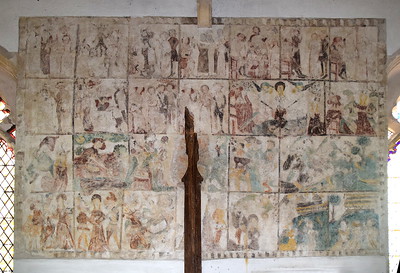
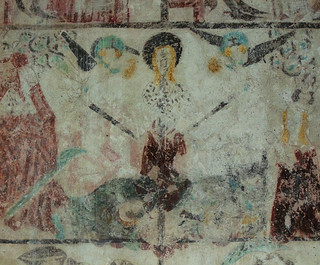
the time, I should think. The famous wall painting of the
life of St Catherine is on the wall of the south aisle,
and as our eyes became accustomed to the gloom, the
images resolved themselves. There are about 24 of them,
and Pevsner points out the self-evident truth: there are
two distinct series, the first of which, consisting of
the initial eleven frames, he dated to about 1400, and
the rest to a few decades later. The candle beam of a
parclose screen still runs between the south aisle and
the middle of the painting, suggesting that it post-dates
it.
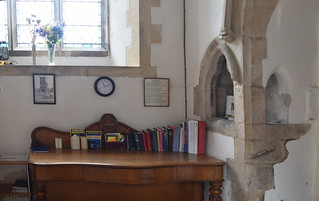
Pevsner is very good on the architectural
history of the building here, which is one of the most
complex I have come across in a Norfolk church. As we
wandered around, it was like encountering a series of
rooms, finding piscina after piscina of different ages,
arcades which alter and contrast, places which appear to
have once been exposed to the elements, and so on. With
the caveat that it is not entirely clear what Herbert
Green did, it looks as if the entire building, pretty
much, was in place before the Black Death. After that,
there was window tracery and the famous wall painting to
come, but that's about all.
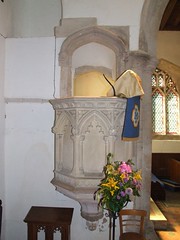
| The
font is a typical purbeck marble octagonal job,
reset on a 19th century collonade. On its great
dias, it is imposing and attractive. In contrast,
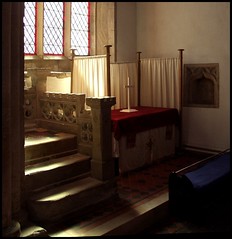
the stone pulpit is mildly absurd, reached by a
stairway that cuts through the former rood loft
stair doorway. it as well that most other
churches don't have one like this, but I was glad
it existed here. As for the church itself, I
thought it was extremely interesting. I couldn't
see any reason for it ever having been kept
locked, and I was pleased that the parish had
seen sense. Sporle is deserving of visitors and
support - it is well worth a visit.
Simon Knott, October 2006,
revised October 2007
|
|
 |
|
|
|