home I index I latest I glossary I introductions I e-mail I about this site
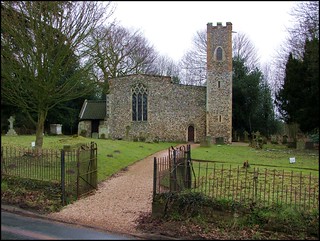
St Peter, Spixworth


Follow these journeys as they happen at Last Of England Twitter.
St Peter, Spixworth If you leave
Norwich by the back door, you can head out along the
former Old Catton High Street which eventually becomes a
perimeter lane to the east of the airport. The only
people about when I first came this way on one bright,
cold Saturday morning in early February were a handful of
plane spotters, their cars pulled tightly up onto the
verge, their binoculars trained. They were escaping the
everyday shopping madness of central Norwich as much as I
was. As I cycled on, a large blue aeroplane came into
land, flying low over the high-hedged field and then
right over my head, so close that I thought I could see
the tread of its tyres. A huge boom of noise filled the
air, and then faded suddenly. I suppose that locals must
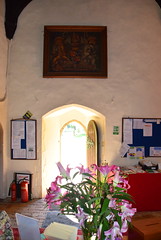
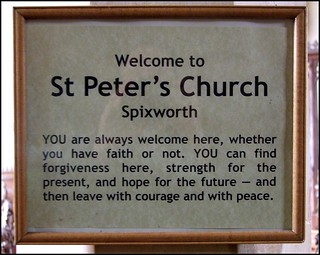
get used to it. A sign inside the
doorway announces that you are always welcome here,
whether you have faith or not. How lovely that is,
and not something you see every day. They certainly
expect visitors, because almost everything has a notice
on it, explaining what it is, how old it is and what it
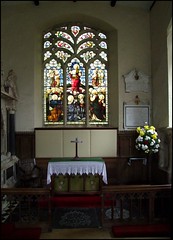
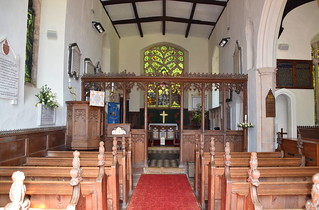
is for. The interior you step into can be a little gloomy
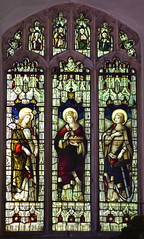
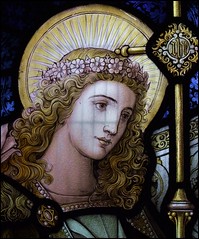
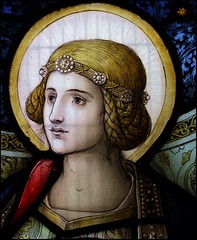
at first, the squarish nave dimmed by the range of
coloured glass, a full scheme by Lavers, Barraud and
Westlake, nstalled over a period of about twenty years as
the 19th Century became the 20th Century.
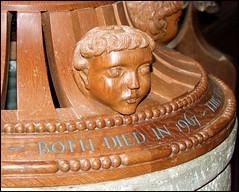
What appears to be a
rugged Norman font (but is it really an old mortar?
There's one very similar at Sudbourne in Suffolk) is
topped by a finely-carved modern cover in the Classical
tradition. It remembers a mother and daughter who both
died in 1967. Nearby are deposited the remains of
William Feltom late of Sprowston. His inscription
notes that the man whose memory this marble
perpetuates performed the relative duties of a Christian
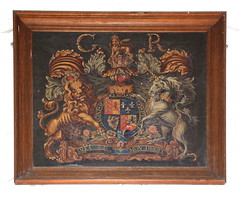
with fidelity. Beside it is the church's large royal
arms, plainly a set for Charles II, but recharged and
relettered for George I. Simon Knott, November 2020 Follow these journeys as they happen at Last Of England Twitter. |



|
|||||||||||||||||||||||||||||||||||||||||||||||||||||||
|
|||||||||||||||||||||||||||||||||||||||||||||||||||||||
home I index I latest I introductions I e-mail I about
this site I glossary
Norwich I ruined churches I desktop backgrounds I round tower churches
links I small
print I www.simonknott.co.uk I www.suffolkchurches.co.uk