home I index I latest I glossary I introductions I e-mail I about this site
St James, Southrepps
Follow these journeys as they happen at Last Of England Twitter.
| St James,
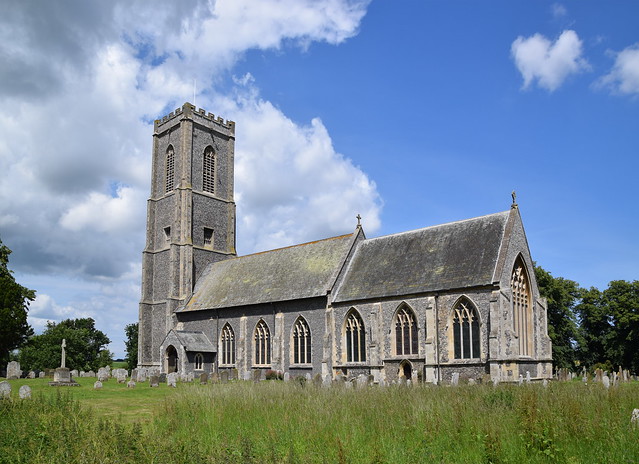
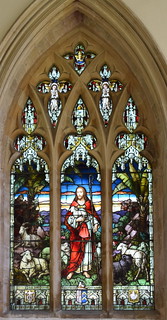
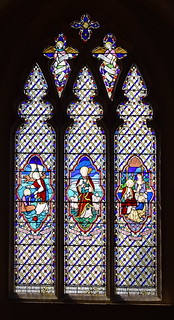
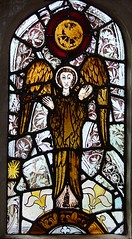
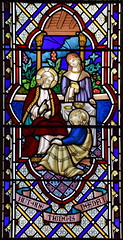
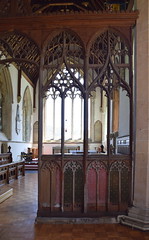
Southrepps This massive church rides the gentle hills to the south of Cromer. Its great tower is visible for miles, one of the tallest in the county. Until the late 18th century, the huge nave had aisles as well. It must have been one of the biggest churches in England. You could never have any doubt about the original medieval dedication of this church, because all around the base course of the tower are scallop shells, the pilgrim symbol of St James. The tower dates from the middle years of the fifteenth century, slightly earlier than its neighbour at Northrepps, and is replete with flushwork and carving. The west door is a grand entrance, the bell windows tall and elegant. It rises almost fifty metres, a beacon over Poppyland. For Frank Allen, writing the definitive account of English church towers in the 1930s, Southrepps served as an exemplar for anyone wanting to understand the church towers of East Anglia. Mortlock thought it one of the best in Norfolk. Stepping inside, the first impression of St James is of quite how well looked after it is, a church which is obviously and vibrantly in regular use. The new screen to the tower arch, and the renewed roof above, create a warmth, the organic feeling of wood on stone. The arcades in the nave walls race eastwards, and you yearn to see daylight through them, but the aisles were demolished in 1791. The chancel was substantially restored in the 19th century, the tracery of the great east window renewed and everything made neat and seemly. I think that the south wall, with its sedilia and piscina and intricately carved figures, is pretty well complete, the work of the early 14th century as Decorated architecture reaches its peak. Incidentally, the way the east and west windows echo each other, the one Decorated and the other Perpendicular, is tremendous. This building must often feel full of light. The late 19th and early 20th century glass is of a high quality. Three New Testament scenes in a William Wailes style are actually by TJ Scott for J & J King of Norwich. The painterly continental style of a Good Shepherd window is clearly the work of Meyer & Co of Munich. However, a curiosity from much earlier in the century is the high quality decorative glass of 1839 in the chancel. The legend along the bottom tells us that it is the work of the Rector's daughter, Lucy Glover, Birkin Haward assumed that, because of the scale, her design had been carried out by a major workshop, but of course this is not necessarily the case. A medieval angel in a south chancel window has been restored dramatically rather than sensitively. There are otherwise few medieval survivals, but there is a sense of every age, a touchstone down the generations. I liked looking up at the west window, and at the roof, and the curiously primitive early 18th century memorial to the Barton family, with an inquisitive skull and the inscription squeezed in. Best of all, I liked being here, because St James is a harmonious whole, an aesthetic delight. |
Simon Knott, July 2019
Follow these journeys as they happen at Last Of England Twitter.






|
|||||||||||||||||||||||||||||||||||||||||||||||||||||||
|
|||||||||||||||||||||||||||||||||||||||||||||||||||||||
home I index I latest I introductions I e-mail I about
this site I glossary
Norwich I ruined churches I desktop backgrounds I round tower churches
links I small
print I www.simonknott.co.uk I www.suffolkchurches.co.uk