home I index I latest I glossary I introductions I e-mail I about this site
St Martin, South Raynham


Follow these journeys as they happen at Last Of England Twitter.
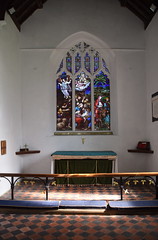
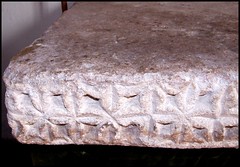
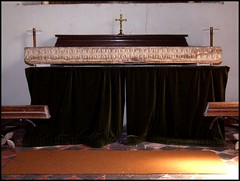
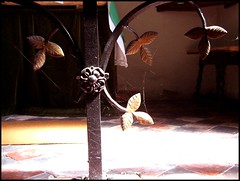
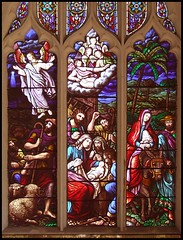
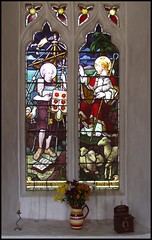
St Martin, South Raynham The setting of this pretty little church is just about perfect, on the edge of the Raynham estate and set away from the nearest road, with only the old Rectory next door and the cows in the fields that bound the churchyard or company. It would be right to call it an obscure church rather than a remote one, for it would be easy to pass close by without realising it was there, although its tower does appear briefly, raising its head among the trees, to traffic on the top road. At the entrance to the churchyard is a wrought iron kissing gate, of a type which must once have been common, put together by some long-dead village blacksmith. As at the other two Raynhams, the churchyard has a fair number of interesting old headstones. The tower dates from the late 13th or early 14th Century. This may also be the date for the rebuilding of the nave and chancel, despite the impressive Perpendicular windows that now line the nave walls, for at some point an arch has been filled in at the east end of the south wall of the nave and a Decorated window set into it. It seems too small for a transept and was perhaps a now-lost chapel, and suggests that this wall was in place long before Perpendicular tracery became a fashion. Similarly, the chancel has a mix of the two styles, so I think it is likely that the new windows were added to an already existing structure. You step into a typical rustic estate church, without the memorials to famous names which you find across the fields at East Raynham. There are no remarkable treasures, but there is much of interest and an atmosphere which speaks of the long generations who have seen it as the heart of their community. The chancel arch is surprisingly large for what is really quite a small church without aisles or clerestories. The mid-19th Century glass in the east window is unusual, designed in what Birkin Haward called a highly pictorial painterly style, although he was unable to identify the workshop. However, the late Geoff Robinson felt it was almost certainly the work of Charles Clutterbuck, and I'm sure that's right. A nave window in a quite different style and of a slightly later date is signed with what appears to be an AM or AW monogram, although again Birkin Haward could not identify its maker. The art nouveau altar rails are lovely, but perhaps the most unusual feature of the church is beyond them. This is the surviving mensa, or altar stone, now in place back on the altar. It has a dog-tooth pattern on the edge that was made perhaps two hundred years before the current church was built. Pevsner thought it might be 12th Century, but it may be older, and is certainly at the end of the Norman period, if not earlier. This makes it the oldest surviving mensa in East Anglia, and one of the oldest in England. For many years, it served as a step into the chancel before Munro Cautley spotted it. It was removed and placed in its current position in the 1980s. Simon Knott, October 2021 Follow these journeys as they happen at Last Of England Twitter. |






|
|||||||||||||||||||||||||||||||||||||||||||||||||||||||
home I index I latest I introductions I e-mail I about
this site I glossary
Norwich I ruined churches I desktop backgrounds I round tower churches
links I small
print I www.simonknott.co.uk I www.suffolkchurches.co.uk