home I index I latest I glossary I introductions I e-mail I about this site
St Andrew, Southburgh
Follow these journeys as they happen at Last Of England Twitter.
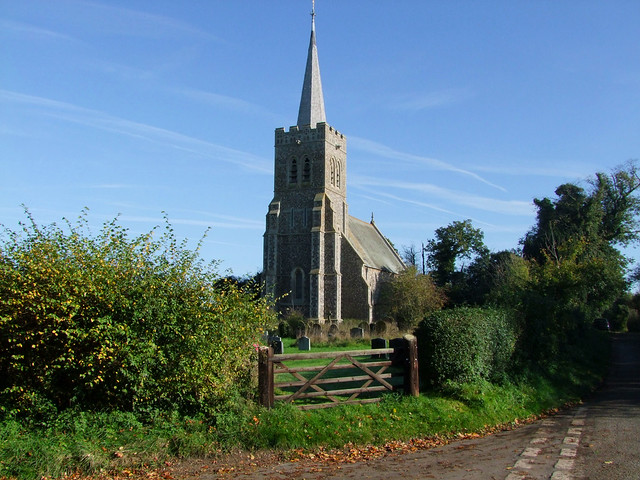
St Andrew, Southburgh Perhaps it was love at
first sight. I first came here in the winter of 2006 and
there was something about the remoteness of St Andrew
that struck a chord in my heart. Maybe it was because
we'd just come from vast, vainglorious Hingham. What a
contrast Southburgh church was! There it rose, that
wholly un-East Anglian tower and spire, far off on the
hill top beyond the meadows and woods. I was out
church-exploring with Peter Stephens who knew these
narrow lanes well, and directed the car through a maze of
them. But even so, the church seemed to come no closer,
keeping its distance in this profoundly rural heartland
of East Anglia. Coming back in October
2013 I remembered it well, but now the year was dying,
Norfolk putting itself back to sleep for the long winter,
and there seemed something elegiac about St Andrew on its
lonely hilltop. Being so remote, this little church would
surely die if it was kept locked. However, St Andrew is
open every day. If England was still a Catholic country I
have no doubt that Southburgh church would eventually
achieve some sort of status as a shrine, and we would
find some obscure local saint to drag up as an excuse.
Pilgrimages would be made here, and the building would be
full of flowers and burning candles. But England took the
reformed path, and St Andrew's austere interior must be
lonely and take its chance.
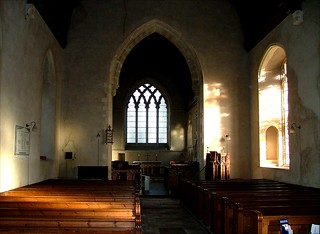
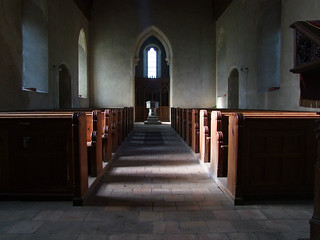
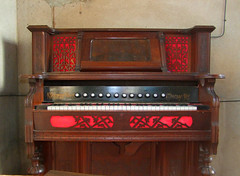
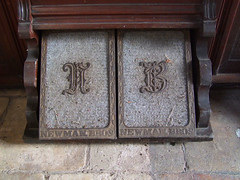
Reeve, or Phipson, or whoever it was, did not undertake a complete rebuilding, for there are a few survivals, including the 15th Century rood screen dado. And curiously, to the east of the window there is a blind roodloft stairway entrance. But since this wall is entirely 19th Century it must be a conceit, which is to say a Victorian attempt to recreate a medieval church by including a survival that a proper medieval church would have. And yet, despite the obsession of those High Victorian decades with ecclesiological correctness and a lush gothic, the nave roof here is a rustic barn-like affair with big kingposts looking as if it has stepped straight out of the 18th Century. The little harmonium built by Newman Brothers of Chicago must have been installed when the church was rebuilt and is equally charming. Up in the chancel is a memorial to William Tawell who lived beloved and died regretted in 1797. It must have been reset during the rebuilding, as must the little 17th Century brass inscription to Elizabeth Townsend under the tower. She died in 1661, and her crude inscription is a reminder of how, at a time when the European artistic and cultural Renaissance was at its height, we had allowed puritanism to take us back to the Dark Ages. It reads:
And what changes her short life saw! Born in the early years of the reign of James I, she saw a regicide, a civil war, the triumph of puritanism and the world turned upside down, the Commonwealth, the Restoration of the monarchy and of the Church of England, and, at last, the first new years of peace under Charles II. What a lot to live through. And I wonder if news of the restoration of the monarchy and of the Church of England had even made it through to lonely Southburgh before Elizabeth Townshend died. Outside in the churchyard two charming modern headstones caught my eye, their inscriptions noting 'He enjoyed it while he was here' and 'She meant well', bless her, two humble sentiments that I'm sure most of us would be happy to have applied to us. More somberly, William Green's inscription of 1875 reminds us that In that great day when men are met and angels stand around, when books are opened, thrones are set, where shall my place be found? And what shall be the best man's lot if thou great saviour pitiest not? Something to ponder as we headed on to Cranworth. Simon Knott, November 2020 Follow these journeys as they happen at Last Of England Twitter. |




|
|||||||||||||||||||||||||||||||||||||||||||||||||||||||
|
|||||||||||||||||||||||||||||||||||||||||||||||||||||||
home I index I latest I introductions I e-mail I about
this site I glossary
Norwich I ruined churches I desktop backgrounds I round tower churches
links I small
print I www.simonknott.co.uk I www.suffolkchurches.co.uk