home I index I introductions I e-mail I about this site
St Peter, Smallburgh


Follow these journeys as they happen at Last Of England Twitter.
| St Peter,
Smallburgh Here we are on the edge of the Broads to the
south of North Walsham, and St Peter is perhaps one of
the area's lesser-known churches, though full of interest
nonetheless. Like many East Anglian towers, the one here
was in a state of disrepair by the late 17th Century.
Flint is a fairly high maintenance material, and
lavishing money upon the buildings had been frowned upon
for many years. And so, it collapsed, taking the western
half of the nave with it, to be patched up with the
mean-looking tower that Bloomfield saw in the early 19th
century.
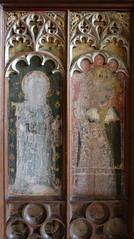
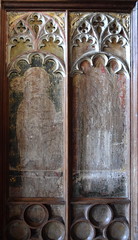
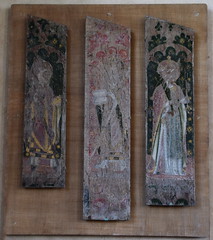
Intriguingly, there are three more panels reset on the east wall. The panels themselves are of different sizes, but they may have come from either the rood loft or from the doors in the screen. One of the figures holds a key and might be thought to be St Peter, but the figure is dressed in royal robes and wears a crown and so I think is likely to be St Genevieve. The other two are Bishops, and it has been conjectured that these two, along with the two faded figures on the screen, might make up the four Latin Doctors: Augustine, Jerome, Ambrose and Gregory, a popular foursome on late medieval Norfolk screens. However, it must be said that one of the figures appears to have the word 'Martinus' lettered at the bottom and so is most likely St Martin.
A number
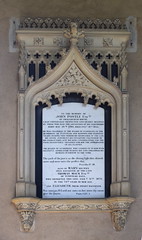
of memorials tell the story of significant families and
changing fashions over the years from the middle of the
18th Century to the middle of the 19th. The That to
Richard Oram, dying in 1762, is still Baroque in style,
under a wreath with crossed trumps, flanked by scrolls
and fronds and supported by a cherub. The inscription
tells us that he was content to have been obscurely
good, which contrasts somewhat with his memorial.
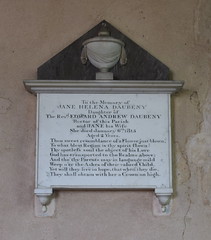
The most elegant memorial is to the two year old Jane
Daubeny, a rector's daughter dying in 1815, and wholly
classical in style under a simple draped urn. Thy
sweet resemblance of a flower just blown, to what blest
region is thy spirit flown! it wonders.
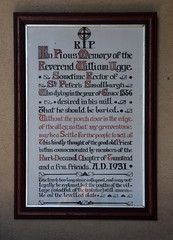
A
delightful little memorial of 1931 is hand-lettered on
vellum and framed in the south side of the nave. It
remembers William Ugge, rector of the church during the
turmoil of the 1540s and 1550s. His will desired that he
should be buried without the porch door in the edge of
the alley so that my gravestone may be a settle for the
people to sett on. As the inscription drily notes at
the bottom, the tomb has long since collapsed and may
not legally be replaced, but the youths of the village
(mindful of the testator) still assemble on the levelled
slab. Simon Knott, December 2019 Follow these journeys as they happen at Last Of England Twitter. |



|
|||||||||||||||||||||||||||||||||||||||||||||||||||||||
|
|||||||||||||||||||||||||||||||||||||||||||||||||||||||
home I index I latest I introductions I e-mail I about
this site I glossary
Norwich I ruined churches I desktop backgrounds I round tower churches
links I small
print I www.simonknott.co.uk I www.suffolkchurches.co.uk