| |
St
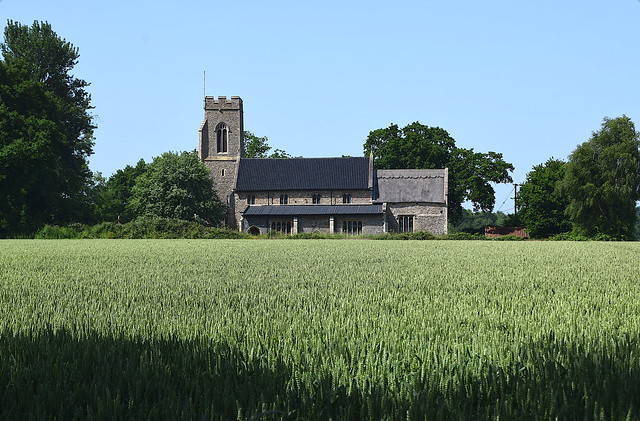
Bartholomew, Sloley In this wild area of remote
villages with churches in wild graveyards, where narrow
lanes wind through fields and woodlands, St Bartholomew
is a clean-lined church in a neat, trim, bowling green of
a graveyard. I couldn't help wondering if this was
because it sits so close to the railway, and perhaps the
bourgeois spirit of Norwich has made its way down the
line from that fine city. That said, the south side of
the churchyard has been left as a nature conservation
area, so here we have the best of both worlds.
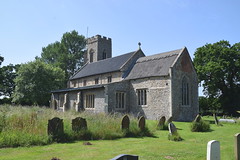
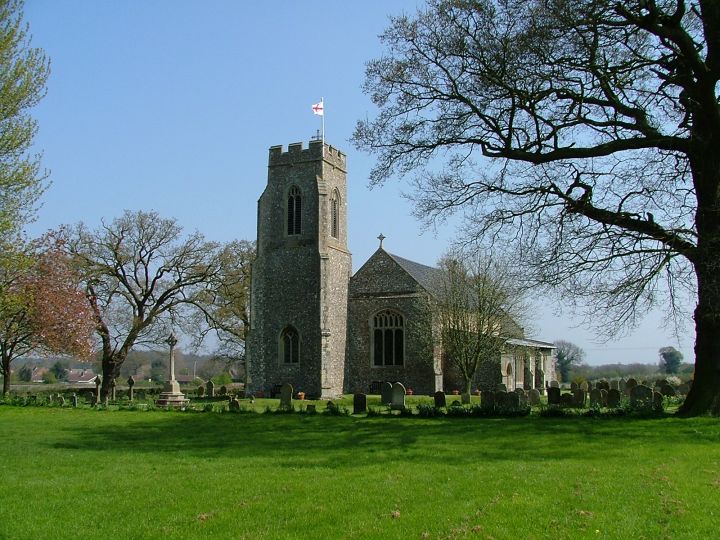
The anatomy of this church is a complex one, and the
building is best seen first from the east, as you do from
the train. Here, we see that the tower is at the west end
of a long, low north aisle. The high, broad nave stands
to the south-east of the tower, and beyond it there is a
short south aisle. The development is slightly clouded,
because the 19th century restoration here was so
rigorous, but the dripcourse of a higher structure
survives on the east face of the tower, and the part of
the building that shows its age the most is the south
aisle, and so it is possible to make a judgement about
what has happened here.
The north aisle is on the site of the original Norman
church. The tower was built at its west end in the early
part of the 14th century, and then the Black Death
intervened. A century later, a vast clerestoried new
church was built to the south of the old one, which was
then demolished, and replaced with a new north aisle
beyond an arcade. Finally, on the eve of the Reformation,
a south aisle was added.
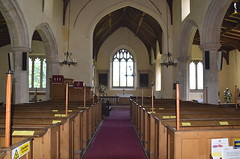
In the early part of the 19th century, St Bartholomew was
refurnished, probably before the major restoration. The
furnishings were considered good enough by the Victorians
to remain, and so we are left with a good example of a
pre-Tractarian plain and simple evangelical interior. It
is a good reminder that the 19th century revival in the
Church of England did not begin with the Oxford Movement
in the 1830s, but a good thirty years or so earlier with
the so-called Clapham sect - indeed, John Henry Newman,
one of the architects of the Anglo-catholic movement, had
grown up and learned his faith in an evangelical
revivalist family.
Such a homely, neat setting then, for one of the great
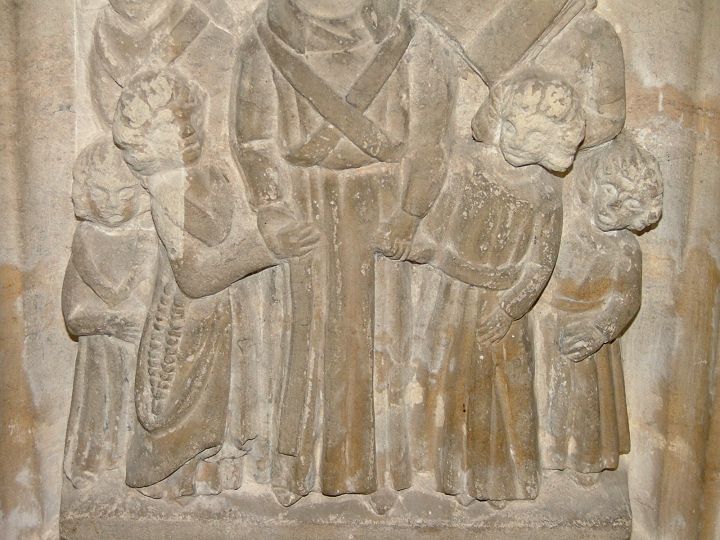
treasures of medieval Norfolk. This is Sloley's seven
sacrament font, an example of the first rank. Although it
bears a resemblance to those at Burgh-next-Aylsham and
Brooke, it is finer than either of these. The font at
Seething was probably recut by the Victorians using this
one as a model. This font has also been recut, but enough
old survives to thrill. The stem has been entirely recut,
and is probably based on that at Burgh-next-Aylsham, with
the column set on the symbols of the four evangelists.
 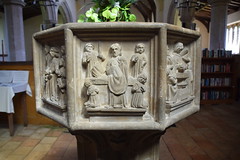 
  
 
 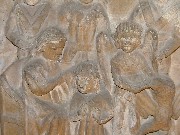 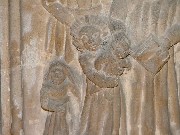
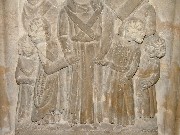 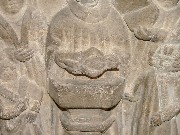
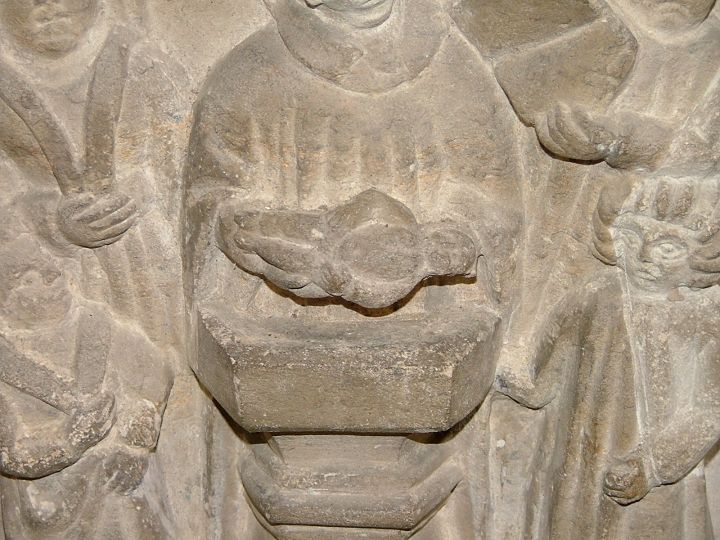
One of the remarkable things about Sloley
font is its condition. It has been carefully repaired,
but not much recut. No font I know has such characterful
figures, such apparent movement. Simply, the people on
the Sloley font look alive.The extra panel, facing east,
is the Baptism of Christ. Look at the expression on the
bearded Christ's face as the water is poured over him!
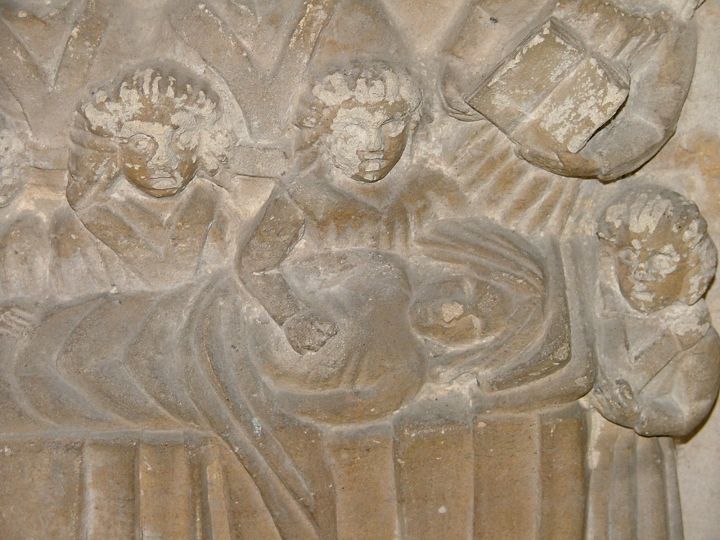
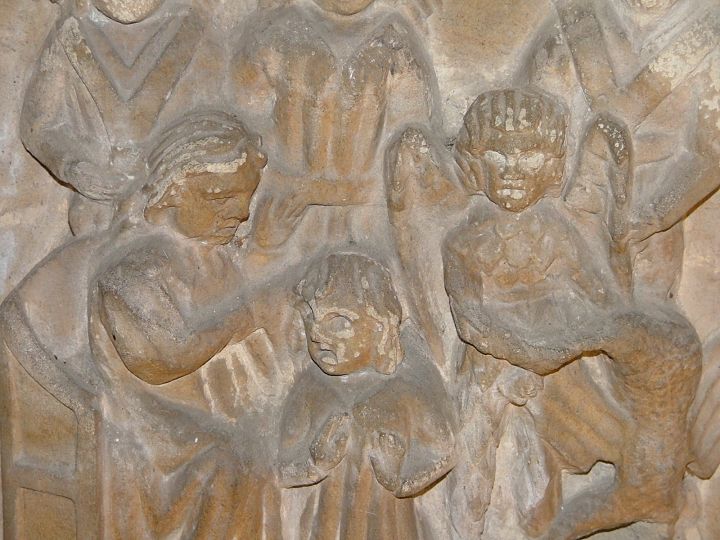
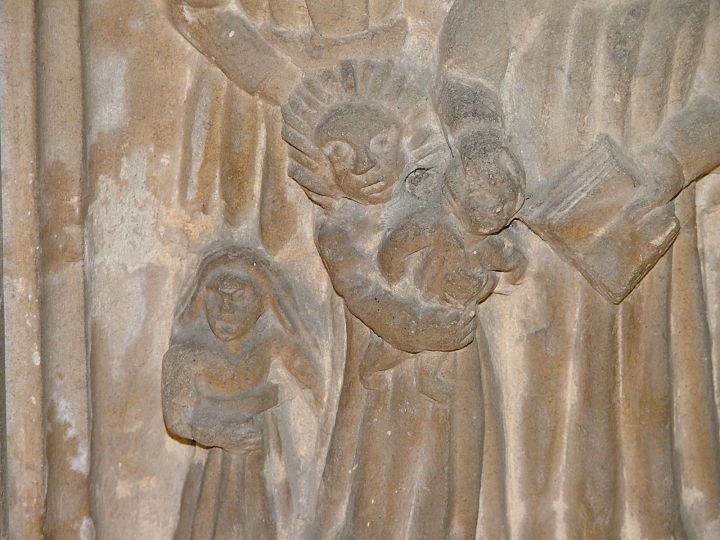
Heading clockwise from the east, the panels represent
ordination, matrimony (a deacon performing the ceremony),
baptism (the font recut, the infant about to be totally
immersed), Mass (an odd one - the most repaired. Did the
Priest originally face towards the altar?), confirmation
(of a group of children, including infants), confession
(in a shriving pew) and last rites, with quite a crowd
around the bed!
The font is the star of the show, but there is some good
early 20th century glass by Powell & Sons in the west
window depicting Justice, Charity and Fortitude, the
figure of Charity apparently made from Henry Holiday's
earlier cartoon for the workshop. A roughly contemporary
heraldic shield has been squeezed uncomfortably into the
east window, and there is an inlay for what would have
been a priest's chalice brass in the south aisle. The
second hand bookstall is one of the best in the area,
and, after a browse, outside is a pleasant place to sit
for a while in the sunshine, the birds singing, the
occasional train passing not far off.
Simon Knott, August 2019
Follow these journeys as they happen at Last Of England
Twitter.


|
|