| |
|
All
Saints, Skeyton Skeyton is
one of those quiet, lonely little churches that I can
never pass without stopping and going inside. I vividly
remember the very first time I came this way. It was late
March 2005. I had been cycling around the Bure valley
between Hoveton and Aylsham, but it was only early
afternoon on this first proper spring day of the year,
and I saw hills to the north that were the most beautiful
thing I had seen all day. Tiny lanes threaded into them,
and so I followed one.
The land folded gently, a long corrugated ridge curving
between Swaffham, North Walsham and the sea. Although I
had my OS map, I had to keep my wits about me, for tracks
split off in all directions, and cycling in the folds I
could see no landmarks ahead. When All Saints first
appeared where I knew it to be, it was as a pillbox on
top of the next ridge.
This resolved itself into the top few metres of the
uncrenellated tower, and then I was climbing the ridge,
the church rising lonely on the plateau beyond. For the
first time, a chilly east wind caught me, and even in the
sunshine I could tell that this would be a bleak spot in
winter. PH Ditchfield, in his Edwardian celebration The
Parish Clerk, recalls a Mr Stracey Clitherow, who,
when he went to his first curacy at Skeyton in 1845,
found the clerk sweeping the whole chancel clear of snow
which had fallen through the roof.
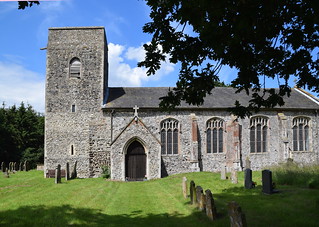
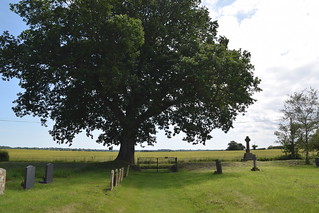
A farmhouse keeps the church
company, but otherwise there is nothing for miles. You
can see at a glance that this is an ancient building on
an ancient site. The west end of the 12th century nave is
helpfully delineated in brown carstone, and the lower
part of the tower is probably the same age. The
buttressing and big windows of the nave make it look
bigger than it is. Curiously, the tower is actually set
at the south end of the nave west wall, and I am guessing
that a north aisle was absorbed at some point. There was
never a separate chancel, so the Victorian tracery in the
centralised east window might suggest that this was when
it happened, although this assumes that the aisle
extended right to the east end. Puzzling.
In those days, of course, I did not know that Skeyton
church is open every day. The double doors in the porch
looked rather forbidding, and I was sure the church would
be locked, but they opened, and inside the porch I found
that the grill was also unlocked across the inner door. I
pulled it back, and tried the handle doubtfully, but it
turned, and I stepped down into the cool interior.
Coming back in June 2019 for what must have been the
fourth or fifth time, I remembered that first moment as I
let myself into the church. Elsewhere on this site I have
mentioned 'bread and butter' churches, the ordinary
parish buildings that serve their purpose and have done
so for hundreds of years, but are otherwise unremarkable.
All Saints is certainly that. When Stracey Clitherow came
to Skeyton in the 1840s, not only did he find the chancel
in ruins, but the font was of wood, painted orange
and red... the singers sat within the altar rails with a
desk for their books within the rails. But change
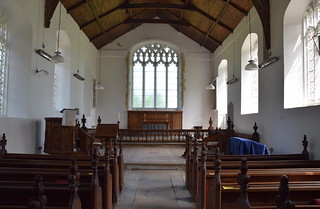
was coming. All Saints is now, pretty much, a Victorian
church inside. A radical restoration, with plain, simple
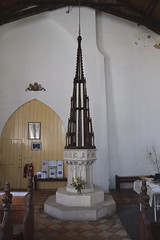
furnishings. The benches, the font cover, the sanctuary,
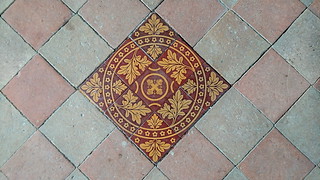
the tiled floor, all are 19th century. The cast iron
royal arms are typical of those mass-produced and
hand-painted in those years, and all in all it feels a
fairly plain, sparse kind of place.
And yet, and yet... on the west wall there is a
photograph of All Saints in its 1920s Anglo-catholic
heyday. It is only a black and white shot, but still... I
gazed at the silverware and flowers around the high
altar, the grand reredos and altar frontal, the candles,
the incense... all gone now, all gone. Turning around and
looking towards the chancel it was possible to recognise
that this was the same church, but only just. What an
extraordinary lonely little shrine in the hills this must
have been then! And now, bare and plain, just another
church.
Back in 2005 I had left the inner and outer doors open,
closing the grill to keep out birds. It had seemed a sin
to shut out the sunshine, the birdsong, the warm air, the
world coming back to life. Feeling a little serious, I
headed off in the direction of Tuttington, deeper into
the hills.
Simon Knott, August 2019
Follow these journeys as they happen at Last Of England
Twitter.
|
|
|