home I index I latest I glossary I introductions I e-mail I about this site
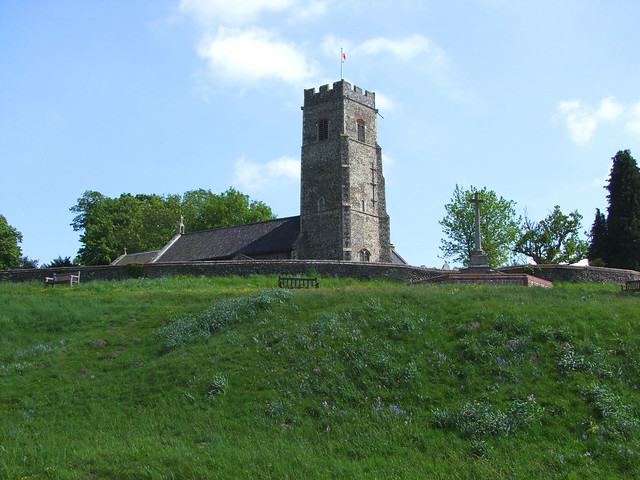
All Saints, Shotesham

Follow these journeys as they happen at Last Of England Twitter.
All Saints, Shotesham When I first wrote about this church back in
2006 I observed that England is
actually a very small country. This had always struck me
particularly when returning from France, where I had
usually spent a few weeks cycling in remote hills,
visiting tiny village churches beyond the back of beyond.
But even the autoroutes seem empty in France, so when you
come back to England and the first thing you have to deal
with is the madness of the M20 it reminds you that
England has roughly the same population as France, but
with less than a quarter of the land area. In the
south-east of England we are packed in so closely
together that it is sometimes hard to be alone.
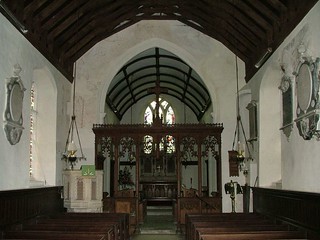
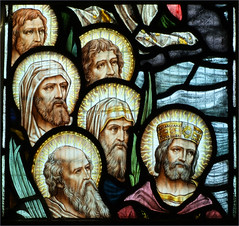
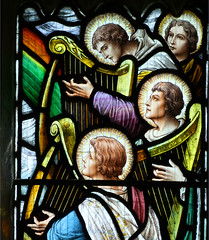
The major restoration here was late, right on the turn of the 20th Century, including an almost complete rebuilding of the chancel, which meant it was ecclesiologically correct and historically sympathetic, but perhaps it lacks something of the excitement of what was happening in rural parishes twenty or so years before. But not only the wall paintings survived. The 15th Century font is a good, bulky example of the typical East Anglian style, and is the same design as several others in this part of Norfolk including Morningthorpe, Fritton and Saxlingham Nethergate. Angels holding shields alternate with lions around the bowl, and standing lions around the stem alternate with buttresses cut by the Victorians to replace the vandalised woodwoses that once stood there. All Saints is a narrow church, which makes the glass more imposing than it might be, but it is of a high quality. Heaton, Butler & Bayne were generally past their best by the 1890s, a victim of their own success after Robert Bayne's brilliant designs of a quarter of a century earlier had made them popular and pushed them into mass production. But the Apocalypse window here, with Christ seated in majesty surrounded by martyrs, saints and angels is finely drawn and coloured. Several of the windows are glazed in a colourful abstract pattern that appears to be Art Nouveau becoming Jazz Modern - Birkin Haward thought it was probably early 20th Century. William IV royal arms are not common, simply because the poor old man was not on the throne long enough for many churches to get around to replacing the old arms of the Georges. It was easy enough to adapt the arms of Hanover from George I to George II, and then to George III and George IV, but replacing a G with a W was a different matter altogether. While they were still thinking about it he died, and Victoria came along with a completely new set of arms and an excuse to stop adapting the old Hanoverian ones. There are William IV royal arms both here and across the valley at Shotesham St Mary, but the ones here, hanging above the south door, are probably the best of their period in East Anglia, a fine gilded moulding set on a black background in a gilded frame and dated 1833. Simon Knott, November 2020 Follow these journeys as they happen at Last Of England Twitter. |






|
|||||||||||||||||||||||||||||||||||||||||||||||||||||||
|
|||||||||||||||||||||||||||||||||||||||||||||||||||||||
home I index I latest I introductions I e-mail I about
this site I glossary
Norwich I ruined churches I desktop backgrounds I round tower churches
links I small
print I www.simonknott.co.uk I www.suffolkchurches.co.uk