| |
|
All
Saints, Shelfanger The area south of Norwich has the
largest concentration of medieval buildings anywhere in
northern Europe, because there are so many medieval
parish churches and they are so close together. But all
of them are different, as if the local masons of the 14th
and 15th century added quirky little details to make
their church unique. The centuries after added their own
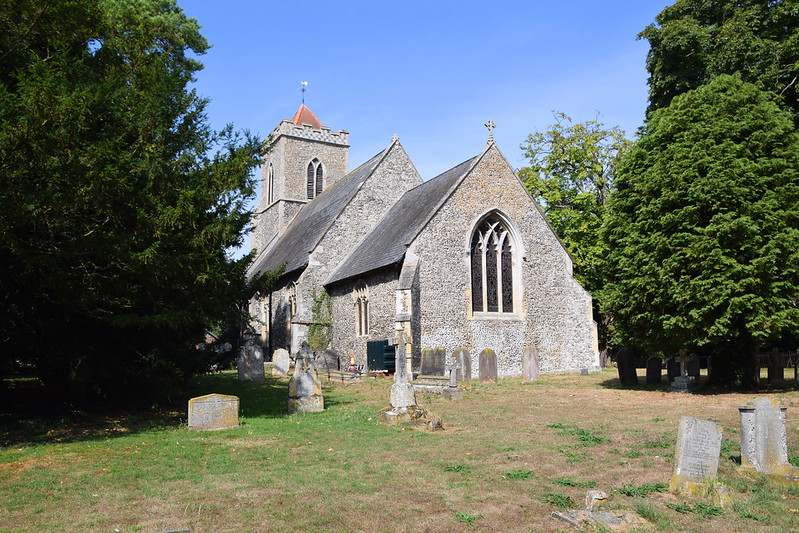
idiosyncracies, and Shelfanger's tower is at once odd and
pleasing, with its flushwork battlements and pyramid cap.
The buttressing adds to the individualism, with two tall
angled buttresses on the west side, and two shorter
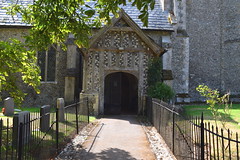
buttresses partway along each side. The 15th century
half-timbered porch on the north side is a delight, as
big as a cottage and making a real focus for the building
from the street.
One thing not immediately obvious from the north side is
that the tower is set off centre. Your first thought is
that the nave has been extended southwards, but there is
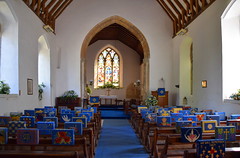
no trace of an arcade. The beautiful modern scissor-brace
roof is no clue, although there is a quatrefoil window at
the south-west corner of the nave. The chancel is aligned
centrally rather than on the tower, and this makes the
situation even more curious, because we know that the
chancel and the tower are almost exactly contemporary.
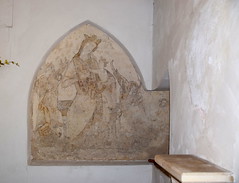
How do we know this? Sam Mortlock records that in 1966 a
workman restoring the chancel discovered that the wall at
the east end was partly hollow. The inner plaster was
broken to reveal wonderful wall paintings, of the highest
artistic quality. Now set in a pointed arched alcove on
the south side and a low arched alcove on the north, they
are probably part of a sequence of the life of Christ. In
the extreme south-east corner, the angel appears to the
shepherds on the hillside. Next, on the north, the most
dramatic and imposing scene, the Adoration of the Magi.
They offer their gifts to the infant Christ, who is
seated on the lap of the Blessed Virgin. The paintings
have been dated to the late 13th century, almost
certainly original to the building of the church. There
is something similar at Little Wenham in Suffolk.
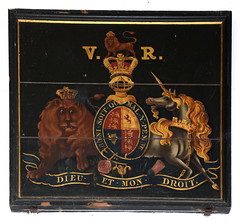
Otherwise, this is a substantially Victorianised
building, with a bizarre set of Victoria's royal arms,
obviously the work of a local sign painter. The lion
looks most alarmed as he watches the unicorn apparently
going mad. Victorian propriety made the painter place the
animals emerging from beneath the charged shield, thus
obviating the need to include signs of their masculinity.
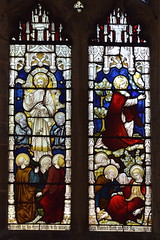
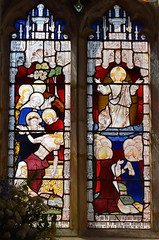
The Clayton & Bell glass reminds us that, as with
their mass-market rivals Ward & Hughes, they were
really quite good in their early days. Part of the
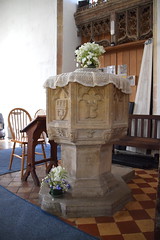
medieval roodscreen is reset on the front of the ringing
gallery, and the late 14th Century font is grand and
substantial, with the crowned letters A and B - not
Andrew and Bartholomew as you might expect, but the
initials of the donor Adam Bosville, who was recorded
making several bequests as Dec became Perp in those years
of theological and artistic ferment.
Simon Knott, August 2018
|
|
|