home I index I latest I glossary I introductions I e-mail I about this site
All Saints, Sharrington

Follow these journeys as they happen at Last Of England Twitter.
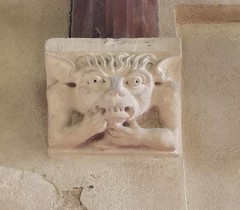
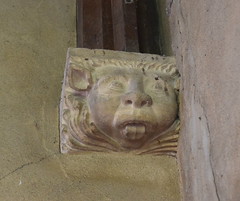
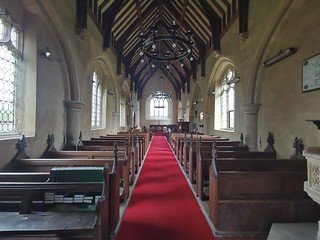
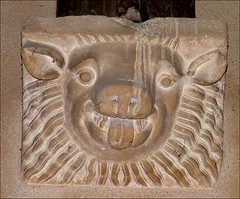
All Saints, Sharrington Sharrington is a scattered village tucked in the rolling landscape between Holt and Fakenham. There's no real village centre, and the church stands to the south on the back road between Bale and Thornage. The first impression is of a disproportionately tall tower, and there is a good reason for this which we will come to in a moment. The nave and chancel were built first in the early 14th Century, the tower probably coming as things settled down after the mid-century years of pestilence. Unusually for East Anglia you enter the church from the west under the tower, and this is because at some point, probably at the very start of the 19th Century, much of the church was demolished. The aisles and the transepts on both sides of the church went, and this is what leaves the tower looking too large for such a small church. The arcades were filled in, and so south and north entrances were lost. The priest door on the south side has been partly filled with an 18th Century grave marker. The bottom of the tower stairway is buttressed by the remains of a traceried arch, which is odd, to say the least. All in all, it makes for a singular building. There was a big restoration in the 1880s which was probably very necessary by then, and the building you step into feels pretty much all of that date, with the caveat that this is an interior of great character, with much of interest. The most striking, and certainly the most memorable of these is the series of twenty large corbels that line the length of the church on both sides They depict green men, hooded faces, and animals including a bull, a pig, a bat and what is probably Norfolk's friendliest sheep.
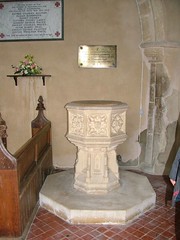
Perhaps all is not what it seems. It is tempting to think that these are medieval survivals of the old roof. Cautley and Mortlock certainly both thought so, but Pevsner raises the point that during the 1880 restoration the chancel roof was raised to bring it in line with that of the old nave. Were these carvings added to the old medieval corbels? Perhaps. Are some of them actually medieval? It is not impossible. But I think they're more likely to all be late 19th Century in execution. It makes for an intimate space, the old font sitting comfortably down in the south-west corner, the building full of light from the clear windows. Reset on the south wall is a set of brasses to the Daubney and Botolph families over a century and a half from either side of the great Reformation divide. They include a mid-15th Century knight, a priest of later in the century, and Christopher Daubney and his wife shortly before the following century came to an end. And this pretty church has two further amusements to offer. The Hanoverian royal arms is a pretty set, with an earnest looking lion and a rather coy unicorn, and a stall depicts a beehive above a barrel, or tun, dated 1879. A rebus for the Beeston family. Simon Knott, May 2022 Follow these journeys as they happen at Last Of England Twitter.
|
|
|||||||||||||||||||||||||||||||||||||||||||||||||||||||
home I index I latest I introductions I e-mail I about
this site I glossary
Norwich I ruined churches I desktop backgrounds I round tower churches
links I small
print I www.simonknott.co.uk I www.suffolkchurches.co.uk