home I index I latest I glossary I introductions I e-mail I about this site
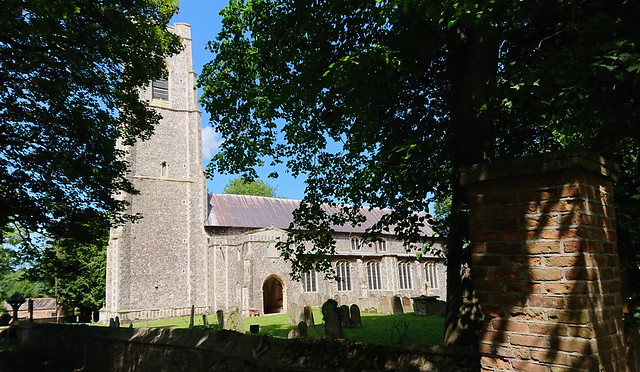
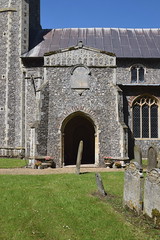
All Saints, Scottow


Follow these journeys as they happen at Last Of England Twitter.
| All
Saints, Scottow Scottow is a
village on the busy Norwich to Cromer road, but its
parish church is far off, and there is no straight line
between the two. All Saints is a remarkably interesting
and apparently little-known church, and not at all
typical of what you might expect for Norfolk. But this is
not at all apparent from the outside, for All Saints is
very much a large example of the grand perpendicular
rebuildings you get in East Anglia at the end of the
medieval period. The church sits in a pleasing old estate
village of largely 19th century housing, shoehorned into
the edge of the former RAF Coltishall airbase. To get
from the village to the church, you need to go around the
old perimeter. A farm track heads off into woods, and
then you are on the estate, with its gorgeous old hall,
its stable block surmounted by a clock turret, and
cottages scattered about farm spaces. The church is
tightly hemmed in by its graveyard, and difficult to
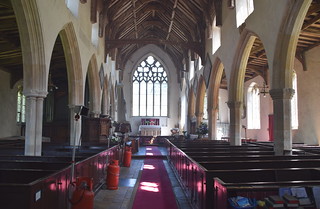
photograph. Coming here on a sunny Saturday afternoon in late June 2019 I was surprised to discover the church full of incense, the sunlight shafting down through it from the south clerestory. I had never known the church filled with so much light before, as if the haze of smoke absorbed and illuminated the brightness from the day outside. It was a perfect moment. There are no less than ten
hatchments lining the walls high above the east end,
frowning down on the sea of dark woodwork below. Part of
a St Christopher still bestrides the north arcade, the
fish circling the Saints feet rather glumly, and no
wonder, for a sea monster is gobbling them up on the
right hand side. A post-reformation 'goodly text' can be
seen further west along the same wall. In the south aisle
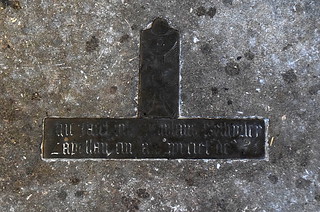
there is a chalice brass for a priest during this
church's Catholic days. And most precious of all, a
perfect medieval altar mensa preserved in a case in the
chancel as a memorial. Simon Knott, August 2019 Follow these journeys as they happen at Last Of England Twitter.
|
|
|||||||||||||||||||||||||||||||||||||||||||||||||||||||
|
|||||||||||||||||||||||||||||||||||||||||||||||||||||||
home I index I latest I introductions I e-mail I about
this site I glossary
Norwich I ruined churches I desktop backgrounds I round tower churches
links I small
print I www.simonknott.co.uk I www.suffolkchurches.co.uk