home I index I latest I glossary I introductions I e-mail I about this site
St Mary, Saxlingham Nethergate


Follow these journeys as they happen at Last Of England Twitter.
| St Mary,
Saxlingham Nethergate Saxlingham
Nethergate is not a small village, but it is far enough
from the busy Norwich to Ipswich road to be retain the
sleepy peace you might hope for in such a place, with
none of the awful traffic of neighbouring Newton Flotman.
In common with several parishes in this area, Saxlingham
Nethergate's name is a combination of Anglo-Saxon and
Viking elements, the homestead of Seaxa's people and a
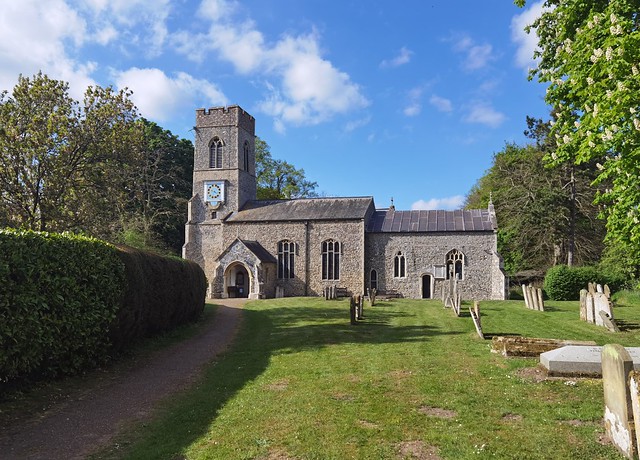
outer road. Not only is it a lovely village, it has
perhaps the most interesting church in the area,
especially if glass is your thing. Set back from the
village street with some fairly substantial houses for
company, the church rests neatly in its graveyard,
surrounded by the memories of 18th and 19th Century
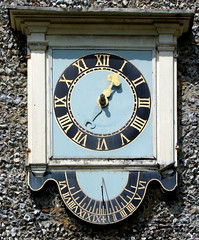
parishioners. The tower's unusual combined clock and
sundial is a splash of colour, a smiling face as you walk
up the path to the south porch.
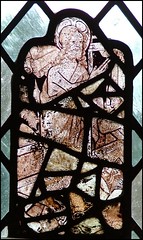
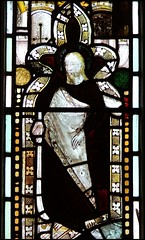
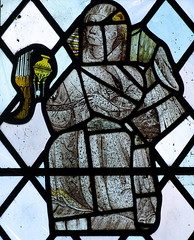
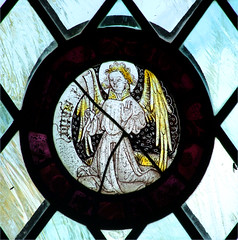
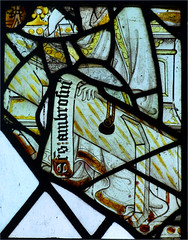
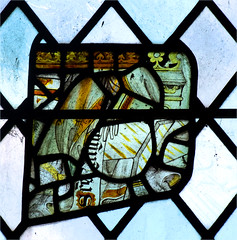
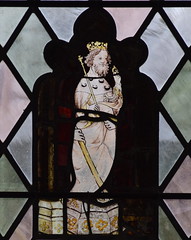
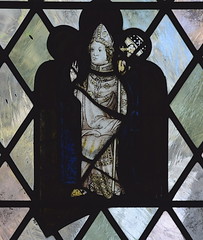
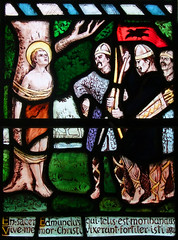
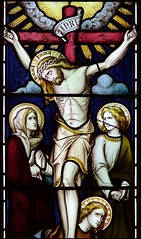
They date from about 1250, and so predate the famous early glass at Elsing. Two of them show scenes from the legend of St Edmund, East Anglia's patron saint. In one, he is martyred, while in another he offers the arrows, the instruments of his martyrdom, as a gift to heaven. A third shows what is probably the martyrdom of St Paul, and the fourth shows two of the Apostles, St Thomas and St James. Some of the other early glass here is clearly from the Norwich School of glassmakers, while other panels are continental. Two fourteenth century Bishops, and two fifteenth century Angels and a Resurrection, are probably local, while continental roundels include an exquisite 17th Century scene of the Holy Kinship. St Anne sits with an open book beside the Blessed Virgin with the infant Christ, who peers across as if to read the prophecies that foretell his coming. More fragmentary are the 15th Century English images of the four Latin Doctors of the Church. The most complete is St Jerome, his scarlet Cardinal's hat picked out vividly, a rare survival. St Ambrose is identifiable by his scroll.
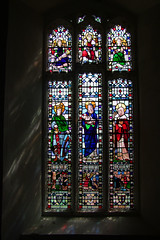
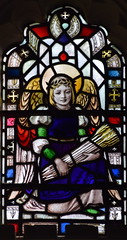
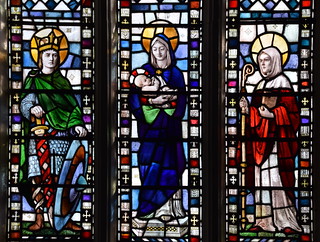
The most striking glass, and amongst the best examples of pre-WWI 20th Century glass in East Anglia, is by Hugh Arnold, and depicts two East Anglian Saints flanking the Blessed Virgin. St Edmund stands above a scene of his martyrdom, and St Withburga above a scene of her establishing a church. Underneath Mary is an Annunciation, while above three gorgeous angels hold the symbols of the three Saints. It dates from 1910, and so it is roughly contemporary with Anning Bell's exquisite Adoration of the Shepherds not far off at Hethersett. Arnold was a pupil of Christopher Whall who did most of his work for the studio of Powell & Sons. He was killed in 1915 while serving as an officer in the Northumberland Fusiliers at Gallipoli.
Not much medieval survived the Victorian and edwardian restorations. There is a bulky 15th Century font in the familiar East Anglian style, similar to that of several churches around here, and another medieval survival is a consecration cross at the west end of the south nave wall. The screen is modern, but what appears to be part of a medieval screen is built into the east wall of the sanctuary. A more recent survival is the handwritten Roll of Honour from the First World War. This was filled in to show who had gone off to France and beyond, and it indicates those who did not return. A touching and fitting tribute then, a touchstone now. I must mention my most recent visit here in the spring of 2022. I arrived with fellow Norfolk enthusiast Cameron Self late one afternoon towards the end of a long bike ride only to find the church already locked. As we stood there disappointed, a woman hurried up from the church car park and asked if we wanted to see inside. It turned out that the church usually closed at 4pm, and she had just locked up but had seen us arrive as she started to drive away. Of course, we were very grateful, and promised we wouldn't take too long. "Oh, take your time, I'm in no hurry!" she responded cheerfully. What a lovely warm welcome, and such a contrast with my experience at North Creake in Norfolk the previous week where a churchwarden had refused to let me in, even though he was locking up two hours before the advertised time. Sometimes you just know when a church is in safe and loving hands. Simon Knott, October 2022 Follow these journeys as they happen at Last Of England Twitter. |






|
|||||||||||||||||||||||||||||||||||||||||||||||||||||||
|
|||||||||||||||||||||||||||||||||||||||||||||||||||||||
home I index I latest I introductions I e-mail I about
this site I glossary
Norwich I ruined churches I desktop backgrounds I round tower churches
links I small
print I www.simonknott.co.uk I www.suffolkchurches.co.uk