home I index I latest I glossary I introductions I e-mail I about this site
St George, Saham Toney

Follow these journeys as they happen at Last Of England Twitter.
| St
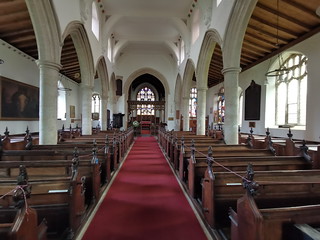
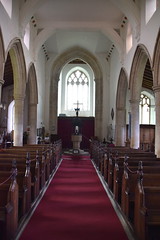
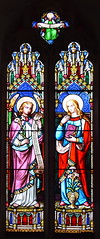
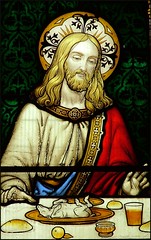
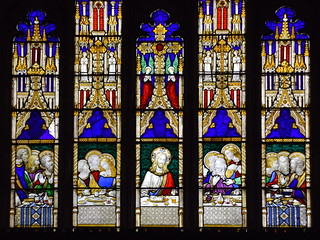
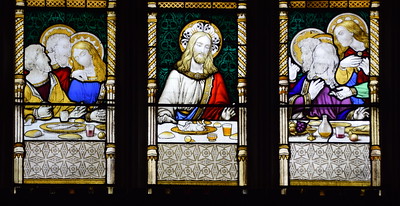
George, Saham Toney One of the delights of cycling around East Anglia is that you only have to go another couple of miles to come across yet another medieval church, and, unless you have been there before, you never know quite what you are going to find. Some are small and homely, some extravagant and breath-taking, some austere, some beautiful, some quirky. The late Peter Stephens once described St George at Saham Toney as a stately church, and it was one that he much admired despite his usual prediliction for what he used to call 'the rough and ready', something that could not be said at Saham Toney. On an earlier version of this page I described the church as nothing special, hastening to add that it was a large, attractive building, its exterior redolent of the excitements of the late medieval years, its interior a testimony to the full confidence of the late 19th Century. It is set imposingly at a bend in the road, and it is open to passing travellers every day. It has some fascinating survivals, and some memorable features from the centuries in between. But if the medieval churches of England are the greatest act of witness that the Church has in this country, then St George is typical of that at its best, and typical of much of Norfolk, and so, in that sense, is nothing special. Long may it remain that way. The story of the building is roughly laid out from the east westwards. The chancel came as Norman tipped into Early English. Then as the 13th Century became the 14th Century, the arcades and clerestories appeared, the aisles as we see them now seeming slightly later. The grand Perpendicular tower came at the end of the 15th Century with splendid flushwork worthy of those across the Suffolk border a few miles to the south of here. The two-storey porch probably came last of all. The church underwent a considerable restoration under JC Buckler in the 1860s, late enough to be full-on grand ecclesiologically-correct Gothic, too early to be particularly sympathetic to what was there before. And much the same might be said of the church you step into, dark and rich, typical of thousands of Anglican churches all over the world which were built or refurbished in the 1860s. Buckler's restoration retained some earlier survivals, including medieval bench ends applied to the new range, their little lions looking up defiantly. A beautiful wine-glass pulpit with a 19th Century stair rail which Pevsner pronounced memorable... for the rector to snake up and down, stands to the north of a screen which, while without any surviving figures on its dado, has lovely tracery. At the other end of the church the font is presumably that provided by a bequest of 1522, with plain, decorative tracery and shields. The grand domed and collonaded Laudian font cover that surmounts it rather puts it in the shade. The interior is perhaps let down by the coloured glass, which is neither one thing nor another. It cries out for a grand scheme by one of the late 19th Century workshops or, even better, clear glass throughout to flood the nave and chancel with light. William Wailes's 1845 Last Supper in the east window in particular ill-serves this splendid, indeed stately building. Simon Knott, June 2021 Follow these journeys as they happen at Last Of England Twitter. |





|
|||||||||||||||||||||||||||||||||||||||||||||||||||||||
|
|||||||||||||||||||||||||||||||||||||||||||||||||||||||
home I index I latest I introductions I e-mail I about
this site I glossary
Norwich I ruined churches I desktop backgrounds I round tower churches
links I small
print I www.simonknott.co.uk I www.suffolkchurches.co.uk