home I index I latest I glossary I introductions I e-mail I about this site
St Mary, Rushall

Follow these journeys as they happen at Last Of England Twitter.
| St Mary,
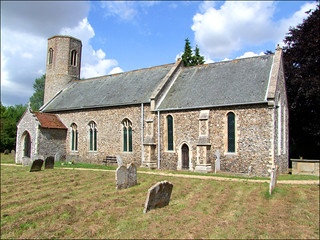
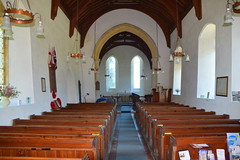
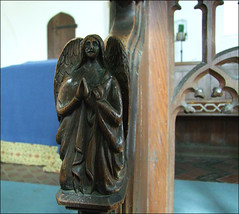
Rushall Here we are in the Waveney Valley, an area of small, homely churches on both sides of the border. Simon Jenkins described the parish churches of England as the greatest folk museum in the world, and Rushall church is one of the best examples why. Perhaps the word 'museum' suggests a place which is no longer of spiritual significance, but that is not the case at all. Rather,buildings like this are spiritual touchstones down the centuries to the long generations of local people, and the hearts of their historic communities. By being open, they become living churches, offering locals and strangers a place for peace and quiet as well as being full of interest. Rushall's round tower is an early one. Pevsner thought the traces of a former circular opening on the west side might indicate it was of Saxon origin. Towards the end of the medieval period the octagonal bell stage was added to the top. By the start of the 18th Century the church was recorded as being ruinous, as so many small country churches must have been, and so the 1870s restoration was a considerable one. Unsurprisingly, the exteriors of nave and chancel are crisp and neat. Unusually, the east windows are in the form of a double lancet, a design not commonly used by 19th Century restorers so it may well replicate was there before. On the north side of the chancel is a blocked doorway which once led to a chapel dedicated to the Trinity. Until the restoration a piscina was recorded in what had become the outside wall. The church had been substantially rebuilt in the 15th Century, and Mortlock thought the door was a survival from this time, decorated with flowers and monograms. You step through it into a simple country church, pretty much all of its 19th Century restoration. There is no coloured glass, and the font is a late 19th Century simplified version of one of those window tracery fonts which were common in the 14th Century. The prayerdesk in the chancel is unusual and memorable, and the angels striking. The First World War memorial contains the names of nine boys, which must have been a devastating loss in such a small and sparsely populated parish. A brass plaque recalls that the bell was put in the tower in 1912 for Mary Eliza Gape, by her sorrowing daughter. When new, it would have tolled for those nine young men. Simon Knott, April 2021 Follow these journeys as they happen at Last Of England Twitter. |




|
|||||||||||||||||||||||||||||||||||||||||||||||||||||||
|
|||||||||||||||||||||||||||||||||||||||||||||||||||||||
home I index I latest I introductions I e-mail I about
this site I glossary
Norwich I ruined churches I desktop backgrounds I round tower churches
links I small
print I www.simonknott.co.uk I www.suffolkchurches.co.uk