| |
|
St
Remigius, Roydon
 |
|
I'd
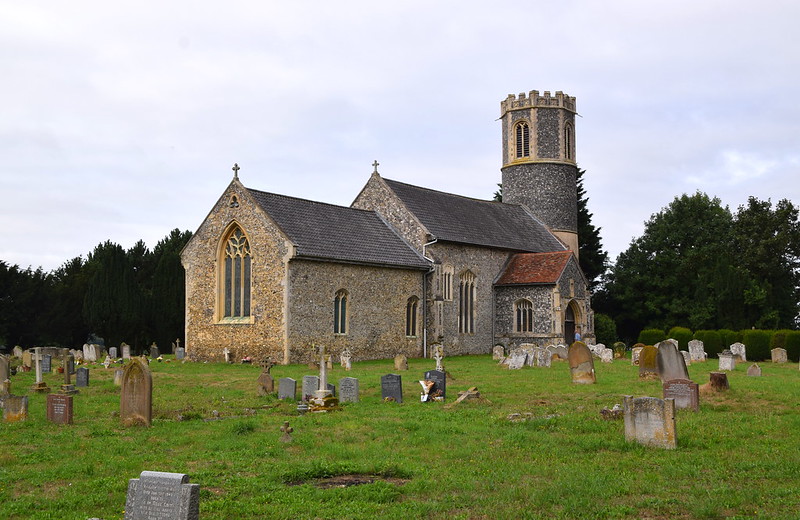
seen this church for years. Its stately round
tower is a beacon for miles across the upper
Waveney Valley, and when I had been visiting the
churches of Suffolk I often noticed it beckoning
enticingly across the border. And then, to
Norfolk; coming up from Ipswich, I would often
get off the train at Diss and head off on the
Thetford road through Roydon, a pretty place
which we will be too polite to call a suburb. As with
many of the churches around here, I knew St
Remigius to be an open, welcoming place; and yet,
I had never stopped. It was always a place I was
saving, and in the winter of 2006 my time came at
last. Peter and I were finishing off the churches
between Diss and Thetford, and decided we would
do the friendly ones first.
|
This meant
those near to Diss - I am at a loss to understand why
most of the churches in the Thetford area lock out us
strangers and pilgrims in such a hard-hearted way, but
that is a story which we must save for later. So, with
smiles on our faces we approached St Remigius, a bold
sign in the north porch reminding us that ROYDON CHURCH
WELCOMES VISITORS.
| The
porch itself is worth a look, with its fine
flushwork and five niches tiered above the
entrance. It is in the Perpendicular style, and
is echoed by the crown of the tower, and the
south aisle, and the east end of the chancel, and
so you might think that we have a church here
that is largely the work of the 15th century,
apart from the tower itself. In fact, this is not
the case. The top of the tower is Victorian, and
so is the aisle, and so is the tracery of the
east window, but they are done exceptionally
well, and now seem wholly organic. The body of
the church itself is much older than the 15th
century. The vestry on the south side of the
chancel is actually the medieval south porch,
contemporary with the north porch and moved to
this position by the Victorians. Where it once
stood is now an excellent modern suite of parish
hall and meeting rooms of the new century, one of
the best of its kind that I have seen, at once
discreet and elegant.
|
|
 |
I was
pleased to learn from Sarah Briscoe of the Roydon PCC
that the ceiling in the Parish Room is made from an old
cedar tree which grew in the churchyard. She tells me
that this cedar was diseased and had to be felled, so the
timber was kept and made into boards to be used in the
new Parish Room. The cross in the room and the frames for
the noticeboards in the room and the church are also made
from the tree.
This
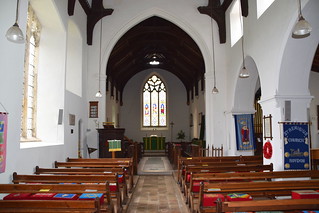
elegance is repeated inside the body of the church. Just
as with the outside, the interior is essentially a
Victorian rebuilding, but this is done so well that there
is a feeling of continuity, despite there being few
medieval survivals. The most interesting are probably the
corbel heads in the arcade, which reveal that a Norman
church was substantially rebuilt in the 13th century.
Here in
the aisle, and elsewhere in the church, are memorials to
the Frere family, with spare and heartbreaking
inscriptions that are well-known enough to make them a
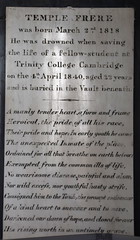
goal of visitors here. Temple Frere, we are told, was drowned
when saving the life of a fellow-student; he died in
1840, at the age of 22. A little further along the same
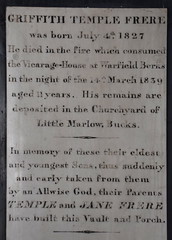
wall is Griffith Temple Frere, who died in the fire
which consumed the Vicarage-House at Warfield, Berks, in
the night of 14th March 1839. He was just two years
old.

There's
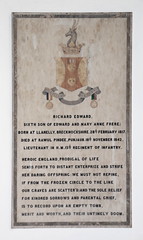
another striking memorial up in the chancel. Richard
Edward Frere died in 1842 in India, at Rawalpindi - or,
as the memorial puts it, Rawul Pindee. He is not buried
here. The inscription reads:
 |
|
Heroic
England, prodigal of life,
Sends forth to distant enterprise and strife
Her daring offspring: We must not repine
If from the frozen circle to the line
Our graves are scatter'd; And the sole relief
For kindred sorrows and parental grief,
Is to record upon an empty tomb
Merit and worth, and their untimely doom. |
The Royal
Arms are interesting. My correspondent Bryan Kitson
points out that someone has
added G R at the top, but the heraldry is certainly of
that short second half of Queen Annes reign
following the union with Scotland (1707-14). But the
motto is Dieu et mon Droit, not Annes invariable Semper
Eadem, so these Arms may well have been amended more
than once. The usually indefatigable Cautley merely
states they are for George I! Simple, elegant
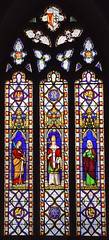
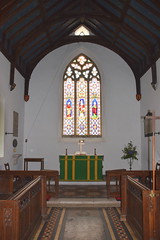
coloured glass in the chancel completes the harmony of
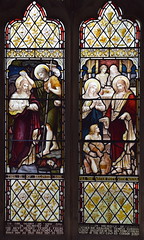
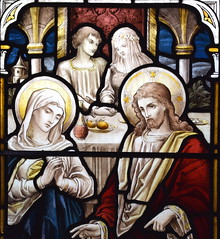
this pleasing interior. In the east window are St
Susannah, St Remigius and St Elizabeth; best of all is
the decorative glass in the north chancel window, an Arts
and Craftsy pattern of roses and lilies. A church, then,
to lift the spirits.
Simon Knott, January 2007
|
|
|