home I index I latest I glossary I introductions I e-mail I about this site
St Mary, Rougham


Follow these journeys as they happen at Last Of England Twitter.
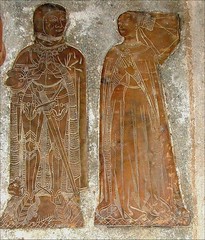
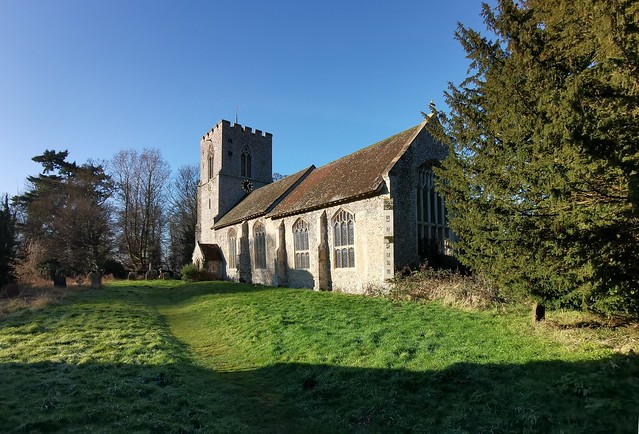
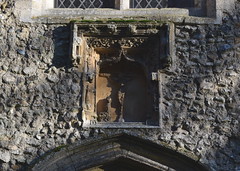
St Mary, Rougham Here we are in Norfolk off the beaten track, in the intensely rural heartland between Swaffham and Fakenham. You travel along narrow, winding lanes to the surprise of a proper village, the church in a sweetly overgrown churchyard at its heart, some ordinary cottages, a small green with a village sign, and the Big House beyond the churchyard. Seen from the south, St Mary appears to be a typically small village church of the second half of the 14th Century and the first half of the 15th Century, which is to say a predominantly Dec tower beside a Perp nave and chancel. Standing at the west doorway you can look up at an exquisitely ornate niche containing a rood group, a rare survival, although the figures are badly damaged and St John has been completely lost. An adornment for a little village church then. But coming around to the north side you see with some surprise perhaps that here there is a clerestory and a long, low north aisle stretching the length of the building. On the south side the walls had seemed so low that it is hard to see how they fitted a clerestory in on the other side of the church. It is as if they are halves of two different churches. As we will see inside, it was the start of the 16th Century which brought the north aisle, but by the 17th Century it was in ruins (was it ever completed?). Sir Charles Nicholson came along in the year before the First World War and led a major restoration costing £13,000, about half a million in today's money. he rebuilt the north aisle and, I think, replaced a fair amount of the window tracery. His also are the roofs and the furnishings, so unsurprisingly you step into a building which feels all of the early years of the 20th Century. But there is rather more to it than that, as the surviving 16th Century arcade with its floriated capitals and angel image brackets hints. Nicholson put a large vestry and meeting room into the most westerly bays of the north aisle, not quite reaching the north side of the arcade, and so the church appears narrow as you enter, but it then opens up outwards as you head eastwards, in contrast with most medieval churches which narrow to the east. Nicholson's screen runs across the nave and then turns eastwards, separating off the north chancel aisle and creating a long, narrow space, almost a corridor, while it makes of the chancel a square. Only one bay of the arcade is open between the vestry and the screen, and so it is as if you are in a building with separate rooms. St Mary has some memorable brasses to the Yelverton family. The best of these are the 1470s brass of Sir William Yelverton and his wife, she in a fine butterfly headdress, and another to a Sir William from a century later with both his wives (although not at the same time, of course) with an enormous number of children attendant on them. A curiosity is a little plate depicting two dead babies in their chrysom cloths, and the simple inscription telling us that John Yelverton died in 1505, Roger Yelverton in 1510.
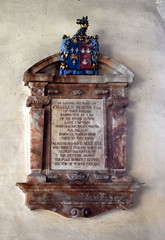
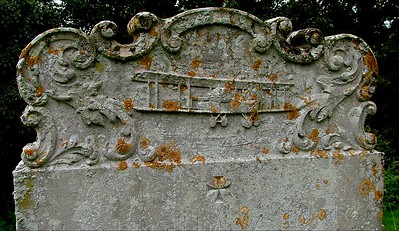
The chancel furnishings are entirely Nicholson's, including the curiosity of substantial return stalls as if for a college of priests. He reset a 14th Century carved frieze of figures, presumably saints under arches, in the panelling on the south side. It looks as if it might once have been part of a tombchest, or perhaps even an altarpiece, but whichever it was enthusiastically incorporated by Nicholson into his reimagined chancel. From a century later come the figures of St Catherine and St James in 15th Century glass in the south side of the nave. There are a number of memorials to the intermarried Keppel and North families. The Keppels we have already met nearby at Lexham Hall, the Norths had their country seat at Kirtling Hall in Cambridgeshire. Roger North was a prominent English barrister in the heady years of the Restoration and the Revolution, and his memorial records that he retired to his Country Seat in this Parish, where he lived many years approving himself a sincere son of the Church of England. By his constant attendance upon Divine Service and Sacraments according to the Rites of it, by doing good continually, and freeliy communicating to all without Fee or Reward his great Knowledge in the Laws whereby he had formerly acquired that moderate fortune he died possessed off. There, an 18th century novel in a nutshell. Two quirky survivals to finish with. Rougham retains one of those hand-coloured, printed commandment boards featuring Moses, Aaron and Joshua. These used to be common, but Cautley saw them gradually disappearing in the early years of the 20th Century. There's another one at Bruisyard in Suffolk. And outside to the south of the tower is the gravestone of Thomas Keppel North, who died in the flu pandemic of 1919. It features a biplane, because North designed the aeroplane to make the first Atlantic crossing, but he died before he could see Alcock and Brown make history in it. Simon Knott, January 2022 Follow these journeys as they happen at Last Of England Twitter. |




|
|||||||||||||||||||||||||||||||||||||||||||||||||||||||
home I index I latest I introductions I e-mail I about
this site I glossary
Norwich I ruined churches I desktop backgrounds I round tower churches
links I small
print I www.simonknott.co.uk I www.suffolkchurches.co.uk