| |
|
St
Andrew, Ringstead At last, it can be revealed - Norfolk's part
in the Da Vinci Code. I knew that something
mysterious was going on here as soon as we arrived; from
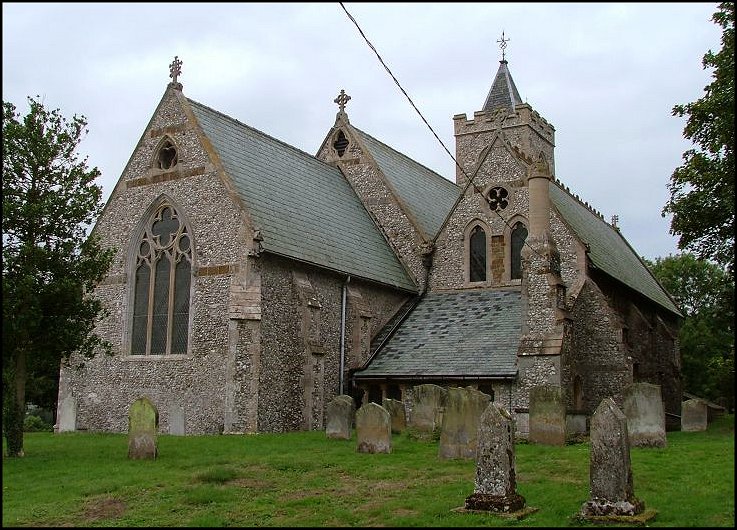
the south, St Andrew appears to be a normal, if
over-restored, 14th century church, but the north side
has been comprehensively redeveloped to give it the
appearance of some kind of nightmarish institution. Huge,
angry grotesques guard the guttering, and the tower
beyond is like that of a Scottish baronial castle. A
massive chimney in the north-east corner completes the
effect, giving the whole piece the look of a lunatic
asylum.
| And
here's something even stranger. St Andrew was
locked. Now, this is near impossible; here on the
outskirts of Hunstanton, we are at the heart of
the greatest concentration of open medieval
churches in northern Europe. Every other single
medieval church for miles and miles, hundreds and
hundreds of them, is kept open for business,
welcoming to strangers and pilgrims alike. It
seemed impossible that, deep within this area,
there should be a renegade, and so I assumed that
it was a mistake. Not so, apparently. Peter,
who was with me, assured me that he had never
found this church open, and several other church
explorers have also mentioned to me that they
have yet to see inside the walls of Ringstead
church. Now, some people might suggest that the
PCC responsible for running such a church must be
inhospitable, or unfriendly, or unhelpful, or
disinterested, or suspicious, or unenthusiastic,
or ungenerous, or thoughtless, or mean-spirited,
or lacking in energy, or rude, or incompetent, or
even downright lazy.
|
|
 |
But not
me. I would like to be charitable, and offer an
alternative solution. Above the locked gates of the
rather ugly south porch is a massive 19th century niche
with a statue in it depicting Christ as the Good
Shepherd. It isn't done well - Christ looks bored, or fed
up, and the lamb looks as if it is struggling to escape -
but I had been looking at it for a few moments when I
noticed the inscription. In large letters beneath
Christ's feet it reads I AM THE DOOR.
Of course!
Now, I have not actually read the Da Vinci Code - I
reached about page 12 before I realised that it was the
biggest pile of nonsense I had picked up in months, and
my time would be better spent in doing something useful
like cutting my toe-nails - but I had read enough to know
that we should all be looking for secret signs. And
perhaps this was one of them!
Now, it
may be that the 19th century restorers of St Andrew had
put up this inscription to remind passers-by that
Ringstead church is the House of God, and that His home
was always to be open to those seeking Him. However, I do
not think this can be the case, for why now would the
Parish of Ringstead go out its way to lock God's people
out of His house? I was sure that Peter and I had
stumbled on something mysterious, something that would
knock Dan Brown's poppycock into the shadows.
We looked
up at it, wondering. Presumably, you climbed to the niche
and did something to the statue to open the door. What
could it be? A twist of the lamb's ears, perhaps?
What we
needed, of course, was a ladder. We wandered round behind
the tower - which, incidentally, is most curious, the
entire western side of it rebuilt in brick at some point
- and there it was, a tall ladder leaning against one of
the buttresses. It wasn't locked to anything, it was just
leaning there. This was too unlikely to be a coincidence,
that the only church for miles around which is kept
locked should also carelessly leave a ladder behind the
tower. Nobody obsessed with security could be that
stupid. No, I imagined north-west Norfolk's Freemasons
meeting up here after dark, hauling the ladder around to
the porch, and using the secret entrance through the
niche.
Peter was
all for taking the ladder and giving it a go, but I did
not want to get into trouble. The thing was, if we were
caught, was there not a danger that someone might think
that I, too, was a Freemason? As a Catholic, I am banned
on the point of excommunication from becoming a
Freemason.
Because of
this, I am unable to imagine what shadowy activities such
people might get up to once entry was gained. If it was
me, of course, I would be wandering around like the saddo
I am, photographing the font and the pulpit, and enjoying
Frederick Preedy's east window, which I am told by
Mortlock depicts St Andrew and St Peter holding the
former churches of Great and Little Ringstead. I might
even say a prayer or two. No doubt the Freemasons eschew
these excitements for drinking toasts to Dan Brown and
sacrificing goats on the altar. It's a funny old world.
Simon Knott, September 2006
Postscript:
the parish webmaster for Ringstead has asked me to
indicate that this article about Ringstead St Andrew is
not in any way endorsed by the parish.
|
|
|