home I index I latest I glossary I introductions I e-mail I about this site
St Peter, Ringland


Follow these journeys as they happen at Last Of England Twitter.
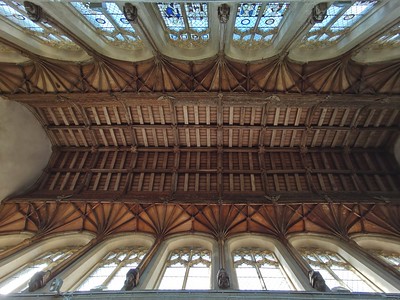
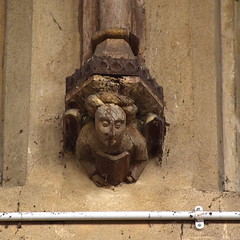
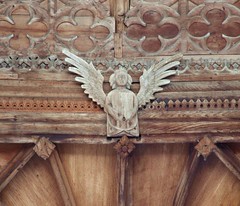
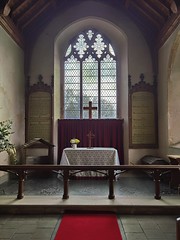
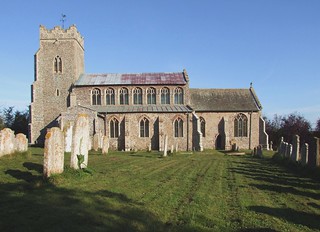
St Peter, Ringland Ringland has just about everything you could ask from a Norfolk country church. We're not so very far from the edge of Norwich, but this lovely little village sits by the River Wensum which sprawls out into water meadows here, the gentle wooded hills to which it gives its name rising to the west. It is as idyllic a spot as you can imagine in East Anglia, and so perhaps you won't be terribly surprised to learn that Norfolk County Council wants to force a dual carriageway right across the parish, through the water meadows and the wooded hills, joining up the ugly Northern Distributor Road with the A47 that connects Norwich and Great Yarmouth with the Midlands. Most gratifyingly there has been an enormous opposition to this act of destruction, including from some district authorities that might expect to benefit from a new road. Will it be enough? Only time will tell. Be that as it may, the setting is beautiful for now, the church raised above its village, a diadem adorning a sprawling walled mound of a churchyard. Of the current church, the tower came first in the 13th Century. The chancel was rebuilt in the following century before the Black Death intervened, and then the nave, aisles and chancel were a magnificent rebuilding lavishly bankrolled in the second half of the 15th Century. And yet, this is not a large church, but everything is in proportion to make it seem so. The approach to the church from the direction of Taverham may provoke a shock of recognition even if you haven't been here before. One sunny Sunday morning in 1948, a young artist named Albert Ribbans stood in this road and captured the parishioners on their way to the morning service. This lovely coloured engraving forms the cover of Henry Munro Cautley's magnificent Norfolk Churches and their Treasures, the follow-up to his similar volume on Suffolk. Cautley's work on East Anglian churches was so influential that, at this distance, it is difficult to see how innovative it was at the time. Like Augustus Welby Pugin in architecture, or The Smiths in popular music, so many people were inspired to do similar work that he has become indistinguishable from the great wave of his admirers. But up until Cautley, ecclesiological writing had been a somewhat dry and dusty affair, and topographical essays were a gushing and sentimental form of journalism. Cautley's writing about the churches of Norfolk and Suffolk exhibits at once a great enthusiasm and an academic precision, albeit one occasionally prone to error. It is the writing of a man who knows his subject in reasonable depth, likes it a lot and is eager to share it. And so, following in Henry Munro Cautley's footsteps, we enter the south porch and step into Ringland church. The nave is more intimate than you might expect from the outside, and perhaps at first sight its 19th Century restoration confers on it an anonymity. There is no coloured glass in the aisles or chancel, and so clear, dusty light falls across simple Victorian benches and tiled floors, a long imposing red carpet offering to take you all the way up to the altar. And then you look up at Ringland's remarkable 15th Century nave roof. Above the clerestories, wooden vaulting lifts the roof as if it were floating in space, as if it were a vast rood loft. This is in fact an illusion, for this is a hammerbeam roof, and what appears to be vaulting is actually coving, which hides the hammerbeams. Flights of angels punctuate the vaulting, and their more learned colleagues read books at the bottom of tall columns that appear impossibly thin to hold up the roof, for in fact they merely support the coving. I try to avoid superlatives, but it really is breathtaking. There are similar roofs at St Peter Mancroft in Norwich and at Framlingham in Suffolk, both much larger churches with nothing like the impact of the roof here.
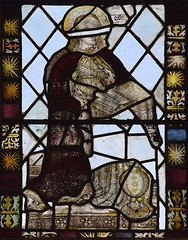
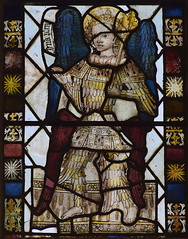
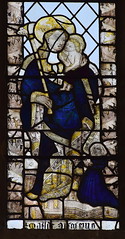
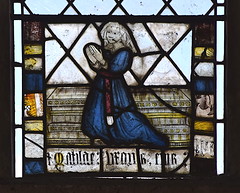
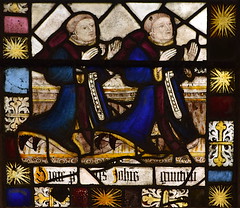
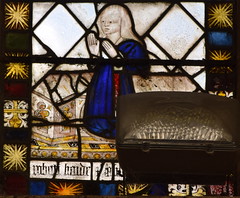
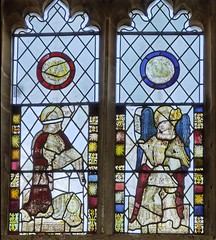
Beneath the coving are the tall windows of the clerestory, almost a wall of glass. As Pevsner observed, it is exactly how a Perp clerestory should be. As if all this were not enough, set into the clerestory is one of Norfolk's best collections of late medieval stained glass. Pevsner points out enthusiastically that it dates from the same time as the window tracery, which is true but we should be wary. For a start, why is it in the clerestory at all? It was set here in 1857 by J&J King of Norwich, and while it may well have come from Ringland church originally, it certainly did not come from this clerestory. Given its subjects it may well once have filled the east windows of the aisles. There are five main figures. Two of them, the Blessed Virgin and St Gabriel, form an Annunciation scene. Another Blessed Virgin holds the Christchild. The last two scenes are what must have been a magnificent Holy Trinity scene, with God the Father seated, the crucified Christ on his lap and the dove of the Holy Spirit descending, and St John the Baptist. In another window are the figures of donors at prayer. These must originally have been at the bottom of the windows which contained the larger figures.
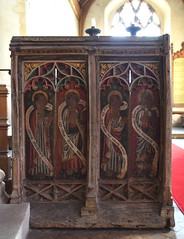
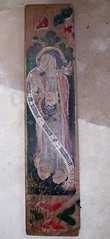
As I say, the glass may not have come originally from Ringland church. It was not uncommon for the 19th Century restorers to enhance a church with medieval pieces from elsewhere. The 15th Century glass at nearby North Tuddenham, for example, was acquired by the rector from JC Hampp, an antiquities dealer in Norwich. And the rood screen dado here at Ringland, with its painted saints, most likely came from elsewhere. It simply doesn't fit the chancel arch. The panels are eight figures from what is known as a Apostle's Creed sequence, which is to say, the twelve apostles holding scrolls with clauses from the creed. Not only are there not enough of them, but the ones that do survive are out of order. Obviously, at some time, the panels have been removed from the dado and replaced. There used to be a ninth panel hanging in the north aisle when I first visited, depicting St Philip. It is not impossible that St Philip and the three other missing Saints formed the gates of the screen, but it is more likely that the screen was once longer, and came from elsewhere, possibly even from Morton over the hills. The survivals here are St Jude, St John, St Andrew and St Peter on the north side, and St Matthew, St James, St Thomas and St James the Less on the south side. All of them have been heavily defaced by iconoclasts, with virtually no trace of face and hands surviving on any of them.
On the occasion of a previous visit I had met a lady who was tidying up at the back of the church. She'd lived in the parish all her life. Indicating the roodscreen panels, she told me that they used to be very dirty, and you could hardly make anything out. "What happened?", I wondered. "Did the Courtauld Institute restore them?" She shook her head and smiled grimly. "No, I had a go at them with some hot soapy water", she said, which may, I suppose, explain why the faces and hands were scoured quite so cleanly. The roof, glass and
screen are spectacular but Ringland church also has
quieter treasures, including a typical East Anglian 15th
Century font, and a roundel in the south aisle depicting
a centaur playing a viol, his tail sprouting a vine and a
little dog running beneath him. As Sam Mortlock says, he
might have sprung out of the pages of a 14th Century
manuscript. The door to the tower is ironbound with,
as Munro Cautley noted, a curious slide in it.
When Cautley was at Ringland the rood screen was still at
the back of the church, where it had been put by the
Victorians. Apart from that, the church is pretty much
just as he saw it in the first decades of the 20th
Century, as are almost all Norfolk churches. Cautley was
an architect, and had written his Suffolk volume in his
official capacity as diocesan surveyor for St Edmundsbury
and Ipswich, but it was the personal journeys which he
had made in his younger days which informed the bulk of
the follow-up work on Norfolk. As he says in his
introduction, For forty years I have been visiting
churches in Norfolk and compiling notes and taking
photographs... and so many people have urged me to
publish them that rather unwillingly I have consented. My
reluctance arose because my notes have to be so condensed
to bring them within the compass of a book owing to the
current restriction on paper... it must be understood
that I am in my 74th year and that owing to petrol
restriction it is impossible to go round and take the
photographs again. Cautley was not a Norfolk man. He was born at Bridge in Kent, where his father was rector, but when he was a small child the family had moved to Ipswich for his father to take up the incumbency of the newly-built church of All Saints, before becoming rector of Westerfield on the outskirts of the town. Cautley lived in Ipswich for the rest of his life, and he is buried with his wife in a corner of Westerfield churchyard. Being almost native to the southern county, and having explored it first, his writing about Norfolk is perhaps tinged with a hint of the exotic, as if he was exploring a foreign country with which he was quite familiar, but where his status as an outsider might occasionally be betrayed by his accent and manners. He had that fascination with remoteness, in both time and place, which was typical of the early 20th Century urbanite. He was more at home in his beloved Ipswich, in the little office above the shops on the edge of the Cornhill that he shared with his partner in their architectural practice, Leslie Barefoot. This was where Cautley designed three churches and a chapel for Ipswich, as well as banks, a library and a mock-Tudor shopping centre, and in his spare time wrote these books. And what did Henry Munro Cautley have to say about Ringland church? For the Norfolk volume, he adopted a curious star system, offering favoured churches up to five stars. Most Norfolk churches received none at all. Ringland gets two, which may seem like damning it with faint praise, but he tells us that it is beautifully situated... with the lovely road approaching it from Taverham. Cautley continues by noting that the church has one of the finest roofs in Norfolk. He spends most of a lengthy paragraph on the roof, but takes time to tell us about the glass in the clerestory, albeit mistaking the Holy Trinity for the Crucifixion (easily done at first glance) and St John the Baptist for St John (a misreading of his notes?). Such minor errors are part of the charm of Cautley, and occur more frequently in Norfolk than in Suffolk. In the southern county he could demand, in his official capacity, that scaffolding be put up for him to examine features and take photographs (as he did for the Stanningfield Doom). In Norfolk, he was one of us, doing his best under difficult circumstances. We follow in the footsteps of Cautley all across Norfolk and Suffolk, and those of his wife Mabel, who receives the charming dedication of the Norfolk volume: To my dear wife, who in a long and happy married life, has, for forty-five years, unselfishly accompanied me all over England and Wales inspecting churches, and must, in the number of churches she has seen, hold a record for her sex. Simon Knott, June 2022 Follow these journeys as they happen at Last Of England Twitter.
|
|
|||||||||||||||||||||||||||||||||||||||||||||||||||||||
home I index I latest I introductions I e-mail I about
this site I glossary
Norwich I ruined churches I desktop backgrounds I round tower churches
links I small
print I www.simonknott.co.uk I www.suffolkchurches.co.uk