home I index I latest I glossary I introductions I e-mail I about this site
St John the Baptist, Reedham


Follow these journeys as they happen at Last Of England Twitter.
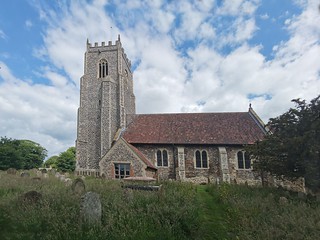
St John the Baptist, Reedham The Rivers Bure, Yare and Waveney carve up the south-eastern corner of Norfolk as they head towards the sea, bringing with them the wild flat marshes what were once a great estuary. This means that Reedham was a coastal village at the time this church was built, its tall tower a landmark. The Romans had built a lighthouse here, and there are fragments of Roman brick and stone in the structure of St John the Baptist. The church is a long one, pointing like a ship towards the sea. As often in this part of Norfolk there was an early 14th Century rebuilding, and in the middle years of the 15th Century came a series of bequests for a new tower, and in 1517 there was a further bequest for a bell, suggesting that the tower was complete by then. The east end is curious, with, apparently, two separate chancel windows side by side, one a triple lancet, the other with four light interlocking tracery. The 19th Century
restoration here need not concern us too much, because
one day in the summer of 1981 a cigarette stub thrown by
a workman from the roof of the tower set light to the
thatched roof that was continuous over nave and chancel.
The building was completely gutted and was repaired over
the next two decades. The church is open every day, and
you step into a light interior that has been entirely
renewed since the fire. The view to the east is
unfamiliar, because, as with the view from the outside,
there appear to be two separate chancels side by side. In
fact, that to the north is the true chancel, and the one
on the south is a chancel aisle chapel, sometimes
referred to as St Anne's Chapel, but more often as the
Berney Chapel. I have seen suggestions that there may
well once have been an arcade dividing the south aisle
from the nave, but if so no trace of it survives. Looking
at the roofline it is hard to see how there ever might
have been one. Perhaps the nave was simply widened
southwards, and a chapel built on to the new east wall of
the widened nave.
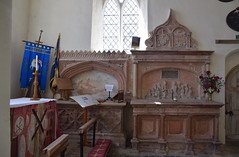
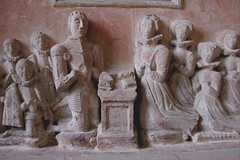
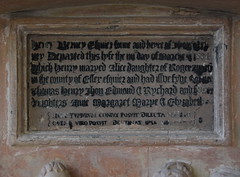
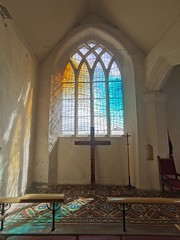
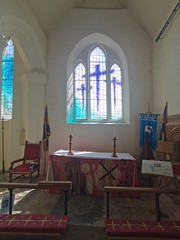
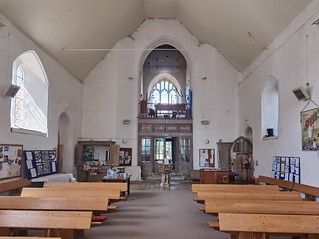
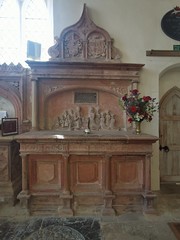
One result of the fire is that all the trappings of the 19th Century restoration here are gone, and the replacement furnishings are striking. The wide bleached wood benches that took their place have an imposing confidence, but the choir stalls create a kind of tunnel effect discordant with the brick chancel floor. The capitals of the chancel arch are curious, carved with tracery patterns and with sockets above that would once have supported the rood beam. At the other end of the nave, the 14th Century font survived the fire. More survivals are in the Berney Chapel. The Berneys were one of the significant East Anglian families who cross the divide from the late Middle Ages and the early Modern period. Their name is remembered at Berney Arms Station a few miles to the east in the marshes, which in all England is the railway station furthest from a public road. Several Berneys are remembered in this chapel, none more magnificently than Henry and Alice Berney and their family. Henry died in 1584, and his tomb is an early example of that puritan piety which would become the norm over the next century. He and his wife kneel at a prayer desk, their children arrayed in ranks behind them.
This is a lovely part of Norfolk to walk or cycle, the lonely lanes rising and falling with a surprising drama, and the occasional distant views memorable. When I first explored this area some twenty years ago I remember finding most of the churches locked, but today they are pretty much all open daily with only a couple of exceptions. The Halvergate Marshes sprawl to the east, and the only crossing of the Yare between Norwich and Great Yarmouth is here at Reedham, and it isn't a bridge. The Reedham Ferry is beloved of generations of Broads holidaymakers, wanting to avoid the hectic A47 and the misery of the Norwich rush hour on their way to and from their holiday boat, but it is well-used by locals too. The chain ferry, and the pub beside it, are best seen on a summer evening, as the light begins to fall, and you might have stepped into an Arthur Ransome children's book. Simon Knott, August 2022 Follow these journeys as they happen at Last Of England Twitter.
|
|
|||||||||||||||||||||||||||||||||||||||||||||||||||||||
home I index I latest I introductions I e-mail I about
this site I glossary
Norwich I ruined churches I desktop backgrounds I round tower churches
links I small
print I www.simonknott.co.uk I www.suffolkchurches.co.uk